
Die Hard, Draw Harder.
Read More
Sketchbook Confessional November 2019
Welcome to November 2019’s Sketchbook Confessional, where I get all of the art out of my system.
The Sketchbook Confessional is a place where I post and describe all of the art that I did in one month’s time, an effort to reel in the chaos of art and objectively know what I did and did not do.
Art:
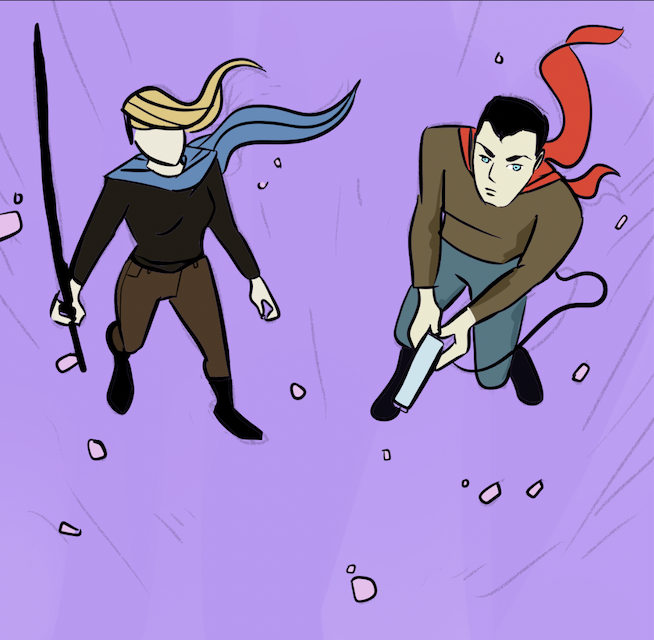
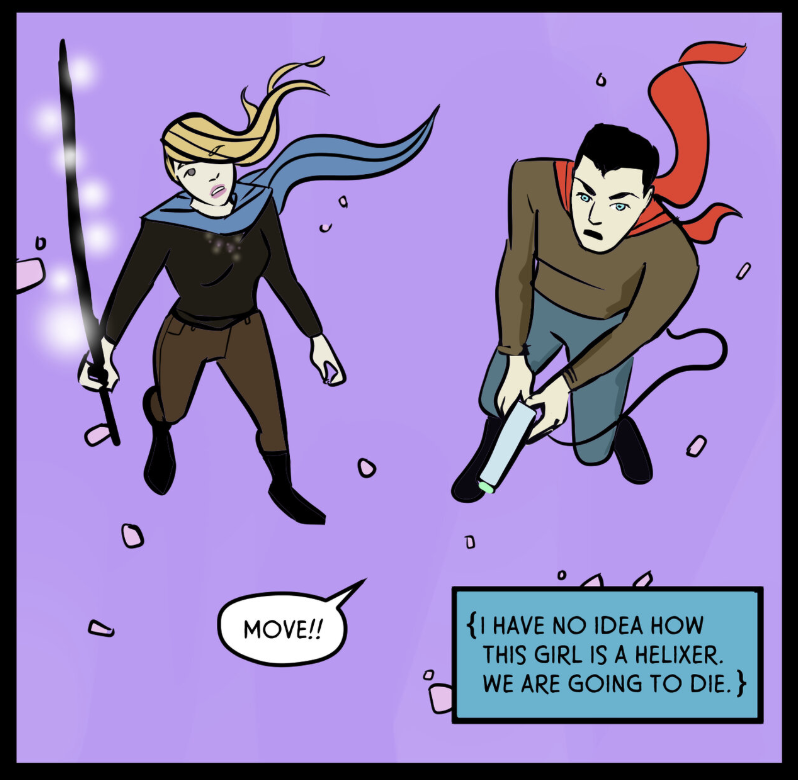
Tilted Sun: I cranked quite a bit on Tilted Sun, it’s almost moving as fast as I want it to. How the comic works at this point is that I have characters, places, ideas about technology and life, and Things to Say, and weaving them together is what takes most of the time. I’ll make basically a ‘key page’ and retroactively work back from the key page I am trying to get to. I’m doubling down on working on environments, since I am pretty weak at thinking about places, furniture, interiors from a visual development standpoint.

I like faces, not places
But there’s so much to be had in little details! Like if you truly care about a character you’ve made, surely they need a pouch to carry their items in, or they need a coat because it’s cold. Or they prefer sneakers because they run, as opposed to boots because they plod.
The energy that goes into thinking about outfit details or accessories or interior design doesn’t really come up if you’re not working on original characters, so that’s where a lot of the effort goes.
It sounds really relaxing to draw Batman right now because I know what Batman looks like and I know a bunch of his accessories - I don’t have to reinvent the wheel. This is why doing fan art as an artist or working with existing characters is such a mental break. Seriously drawing a hero after working on your own OC and original characters feels like prismacoloring a relaxing-AF coloring book about butterflies at this point. It’s like, hey man, you don’t have to re-envision Wolverine. You could, but you don’t have to.
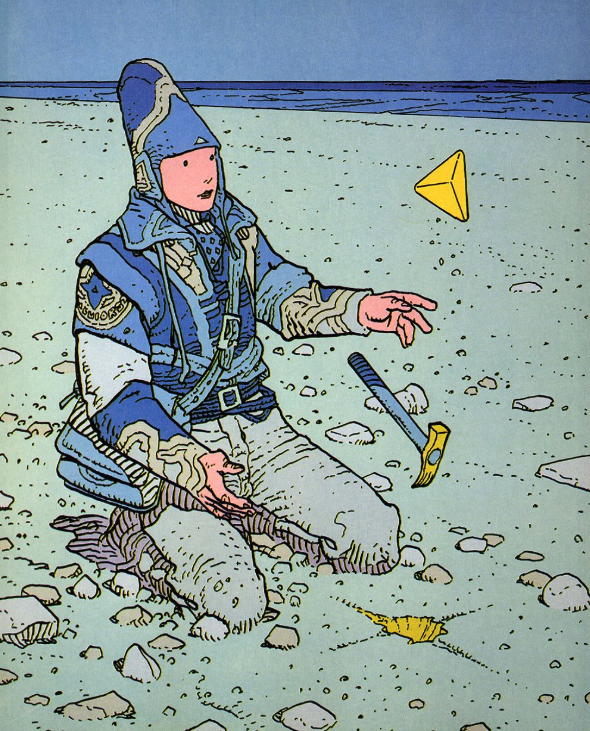
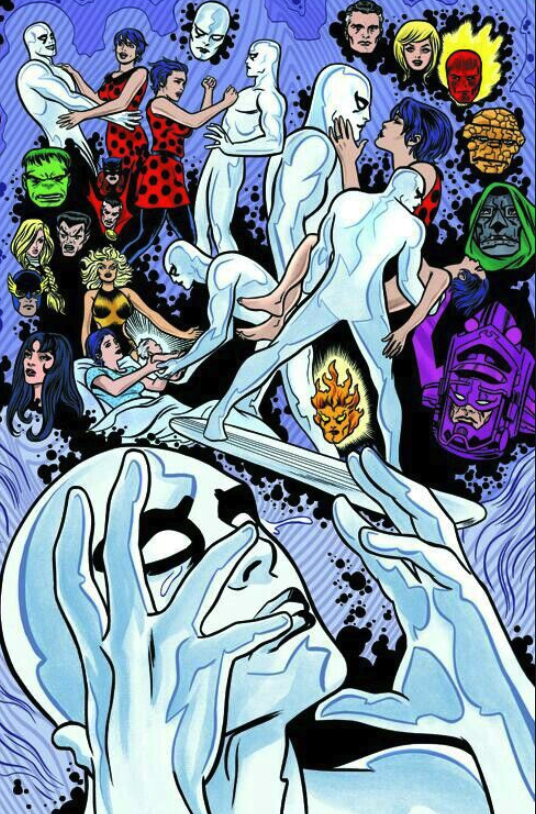
I’ve found that using a lighter line weight helps me move more quickly as an artist. I was once pretty attached to these thick black lines, but the problem with those is that if you make the slightest squiggle, it looks pretty bad. A lighter weight or a thinner line is much better and helps me draw more quickly. I suppose it’s the difference between drawing like Moebius or drawing like Mike Allred - both amazing artists, one just has a thinner line and the other has a much thicker line.
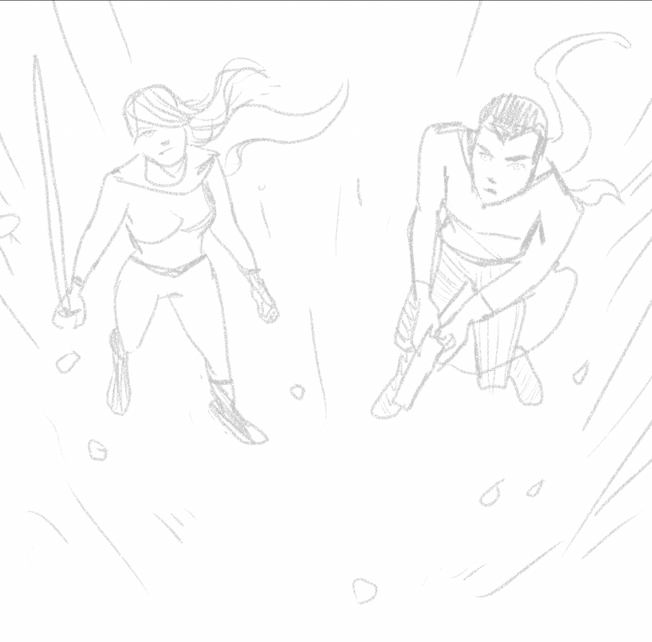
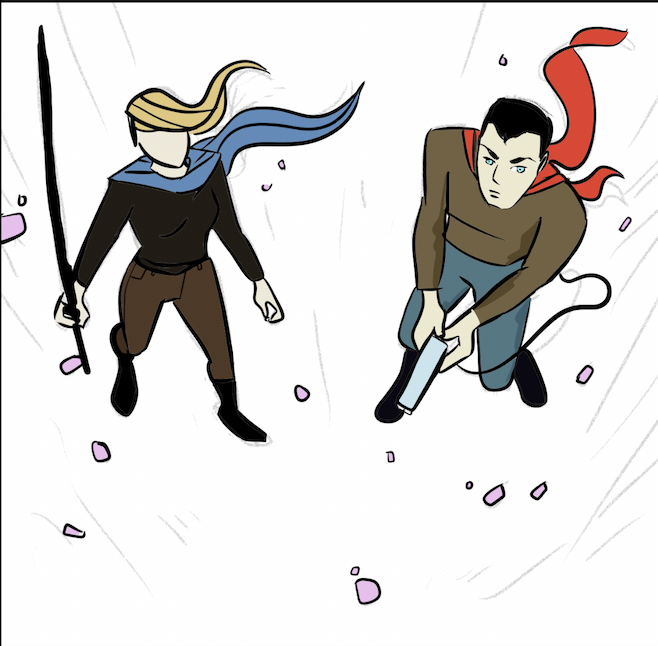
There were some moments in making Tilted Sun where I captured the full process of each panel, like below. I really am attached to the initial pencils and the whole time while making these, I find myself working to bring life to the inks and colors in a way that honors the pencils. Maybe I should just do a whole book in pencil someday.


Reading:
I read Can’t Hurt Me by David Goggins and also Super Attractor by Gabrielle Bernstein, but I only made it through the first half of Super Attractor. So, wow! Yes, if you want to go on the self-help rollercoaster ride of your life, read these two books immediately back-to-back and call me.

I like the thoughts and efforts behind Super Attractor but as soon as the author started talking about summoning archangels to help you with your problems, I just couldn’t get there. I couldn’t get on the Archangel boat with Gabby. Maybe it works for some people, but I feel the David Goggins thing more closely, running hundreds of miles seems more accessible than archangels. This is the great thing about our world, you can kind of just choose what works best for you.
Can’t Hurt Me is a good read for any artist since Goggins is a person of extremity. I guess it’s so easy to give up on art, or to give up on anything - your business, yourself - when the circumstances are bad, or chances are slim. For Goggins, giving up is as hard as going further. I’m a fan of this book and following David Goggins on Instagram because he does the exact opposite of most coddling self-help books. Some of his posts say “Hey, sometimes you’re just not good enough.” Harsh but true, and, he’s not mean about it. For the entire book, he transforms by relentlessly confronting himself and he doesn’t bash other people. He stays in his lane of self-focus without being selfish or pompous. It’s liberating. I’m absolutely magnetized by it.
Playing:
I played almost no video games in November but I did get a bit more into DnD with a couple campaigns rolling right along. In one campaign, sadly my carefully-thought-out elf instantly died by getting one-shotted by some ochre jelly. I’m not good at surviving DnD but I get lost in the art and ideas in the books. Playing DnD when you are a fantasy artist is like going to see a band and the lead guitarist plays the exact same guitar that you do. I like the world-building aspect of DnD as well, where in Magic the Gathering the card art is phenomenal but you don’t get a sense of the environment or exactly ‘where’ all the combat is happening, on top of ‘why’. (Plains, swamp? For some reason?) Why are there 300 mushrooms taking on an enchantress deck? Anyhow the narrative aspects of DnD draw me in, plus, you’re not piling a beatdown on everyone, it’s more an operation of working together. It’s like improv, with elves.
Working Out:
I’m adding a new part to Sketchbook Confessionals: what I’m doing physically!
Art and exercise have always been integrated for me, and to write about art without writing about what I’m up to in the gym seems unfair somehow. Most artists I know are not just sitting at a desk all day - they’re out running, playing sports, or at dance class - and if they’re not, they sort of want to be.
This month I joined up at my local gym and am doing Zumba and also Personal Training once per week. What captured me on both is that I found that after each workout, I’d be excited to go home and work on art, and I’d work for longer amounts of time instead of just falling asleep.
Usually I’m into running for miles on end into some kind of blue delerium, but I think the dance classes and strength training will add to the mix in a positive way.
I did do a 2009-to-2019 post too, here it is.

I was making massive art in 2009 and had relative success with paintings, success at that time meaning I sold a few paintings here and there for $300 - $1500. It sounds great but if you only sell three paintings per year, well … Also in 2009, I would overwhelm people with 30 ft paintings, which were impossible to get installed at local galleries until finally they found a spot at Norlin Library at CU Boulder.

Here I am in 2010 with one of the paintings I made in 2009 - Norlin Library at the University of Colorado, Boulder
Going big with art was great, I’d do it again in a heartbeat and am not sure why I stopped. It is a bit hard when the show is over and you have to roll up your painting and put it in a basement, but, the painting above got a good three years of time at Norlin Library and, I don’t know, probably tens of thousands of people saw it.
Crushing it on Big Art is kind of like the David Goggins thing where you think you’re doing as much as you can, but in reality you’re only doing 40% of what you are truly capable of.
Most of what I make these days is enclosed in an iPad, which does save time and space and produces previously unimaginable colors. Even if it all seems stuck in a computer, there’s always the internet. At least, no matter what happens with our world as far as tech, art is real.

Until next time, Space Cowboys! Let’s do our best.
Related Blogs:
Sketchbook Confessional September 2019
Sketchbook Confessional August 2019
Sketchbook Confessional July 2019
Who wrote this?

I’m a painter, I make comics, and sometimes I do computer stuff!
- Becky Jewell

Sketchbook Confessional October 2019
Welcome to another Sketchbook Confessional, where I get all of the art out of my system.
The Sketchbook Confessional is a place where I post and describe all of the art that I did in one month’s time, an effort to reel in the chaos of art and objectively know what I did and did not do.
Art:
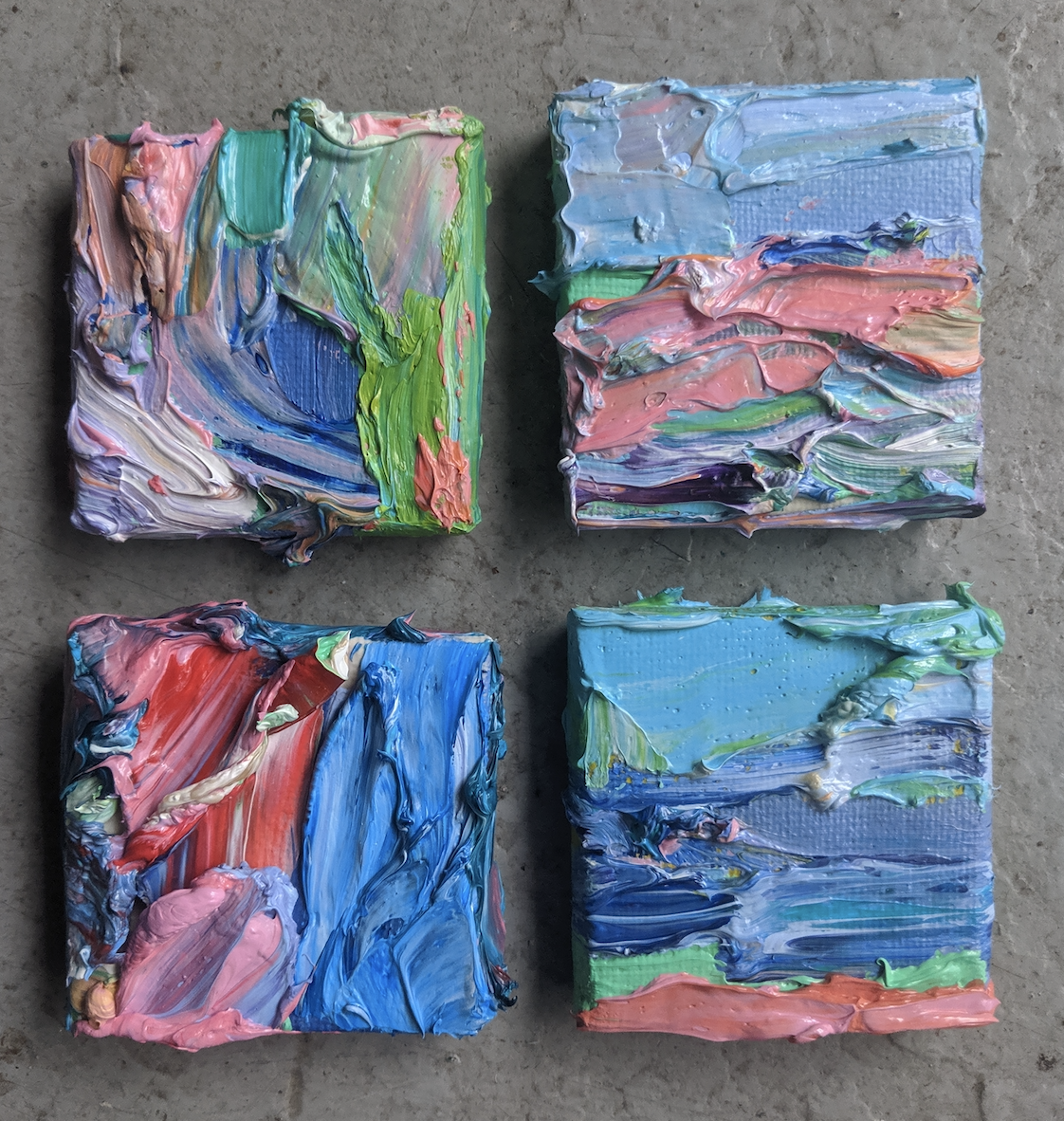
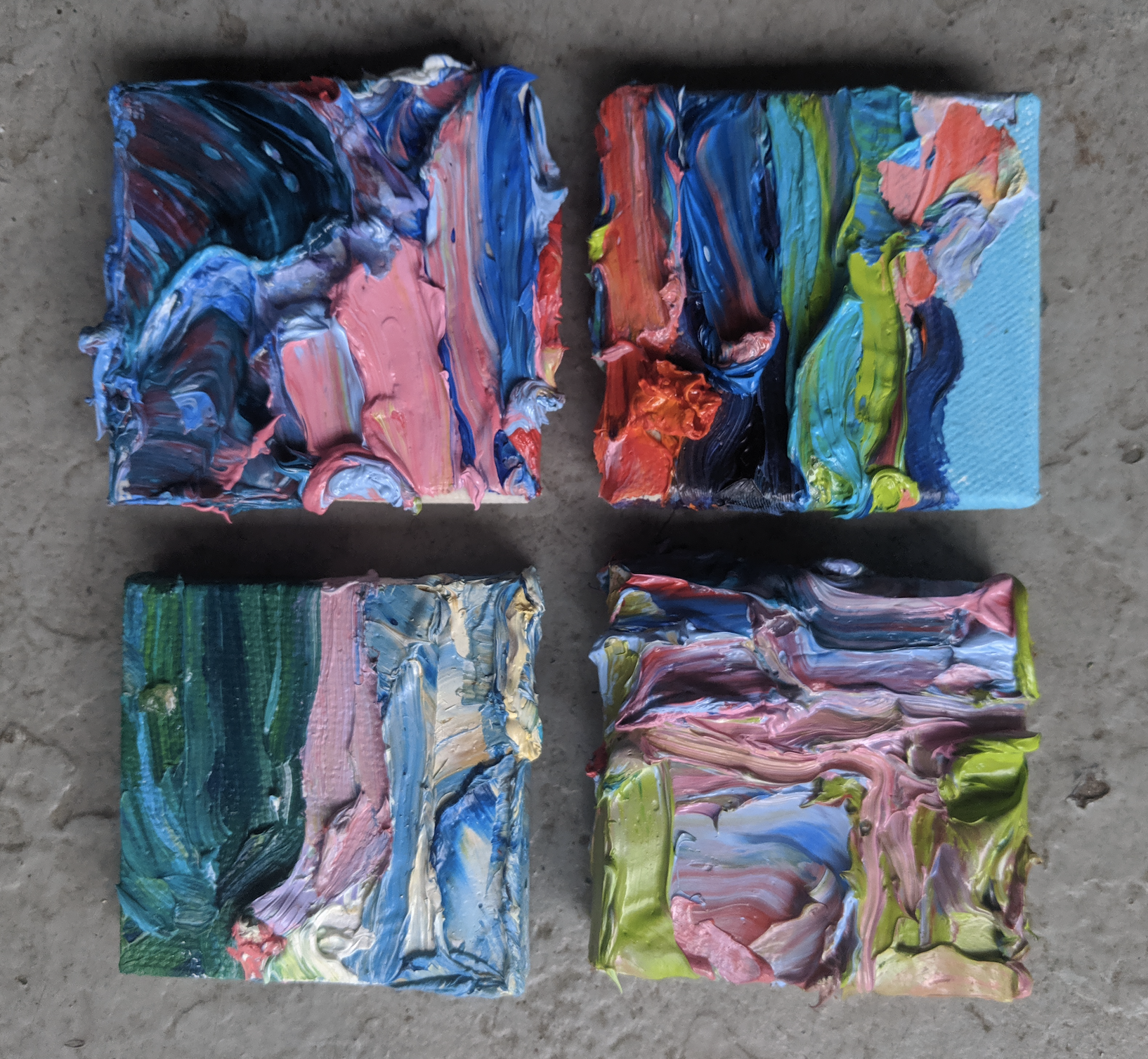

I made mini oil paintings to just ‘get something down’ .

I also drew a lot of cats in October for a fun upcoming project!


In other cat creations, I collaborated with my friend Kate to make the above piece of a Sphinxian Riddle Moment. I liked the original sketch Kate made and just had to color it. The piece at the top of this blog has similar vibes - there’s something magnificent in the onlooker who gazes upon a terrible beast.
Reading/Watching/Playing

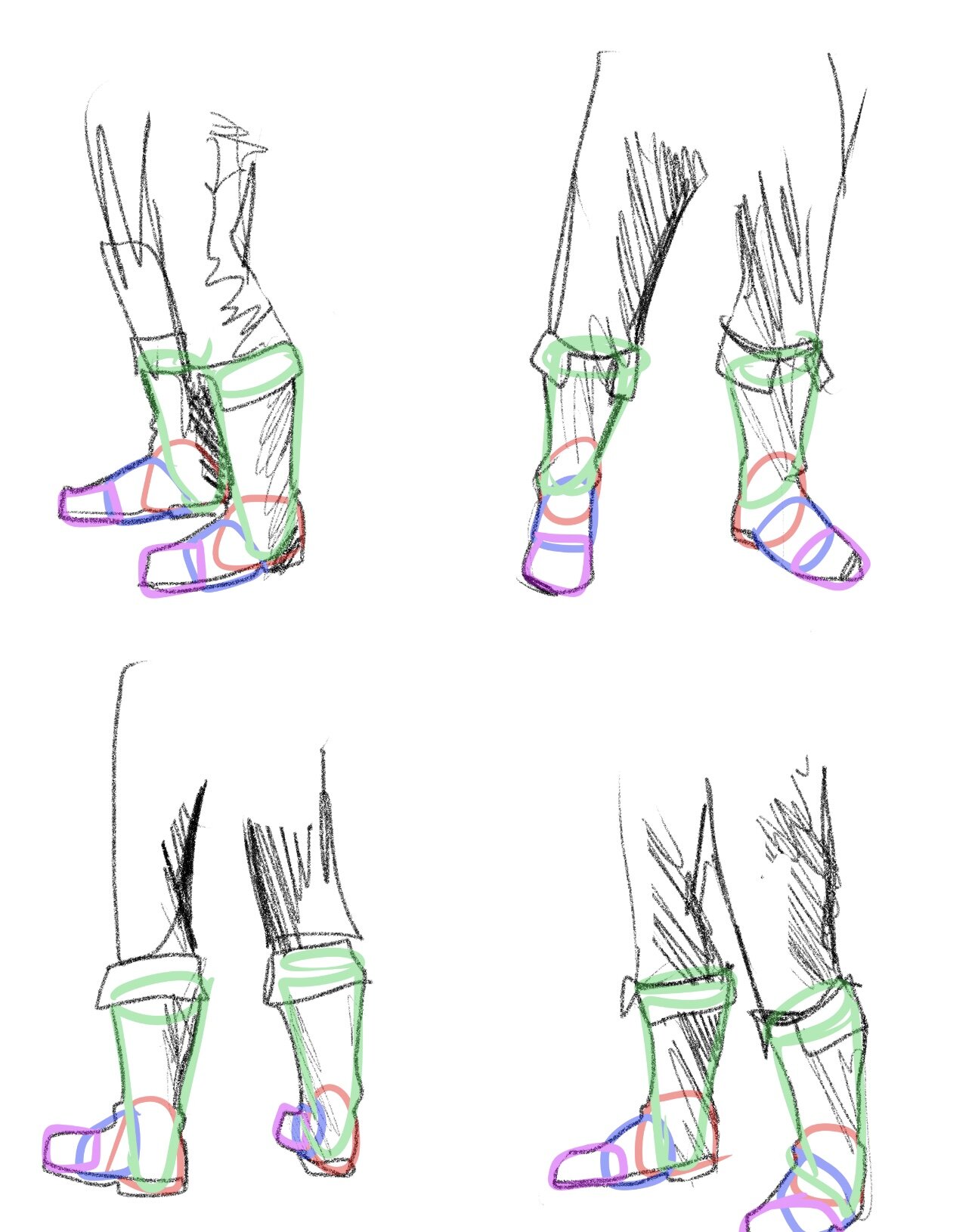
I’m still playing Octopath Traveler and Breath of the Wild, and am making many drawings from BoTW for reference, like these drawings of Link’s boots!
Travel:
I went to Milwaukee for my cousin’s wedding and picked out some of my favorite paintings from the Milwaukee Art Museum. The MAM was great and I’d recommend that you absolutely go if you ever find yourself in Milwaukee.

This month I wanted so badly to do Inktober, but I just didn’t. I had too many other projects on the table which took precedence. It’s too bad, usually with art, the more you make, the more you make, but not this October.
Until next time, Space Cowboys! Let’s do our best.
Related Blogs:
Sketchbook Confessional September 2019
Sketchbook Confessional August 2019
Sketchbook Confessional July 2019
Who wrote this?

I’m a painter, I make comics, and sometimes I do computer stuff!
- Becky Jewell
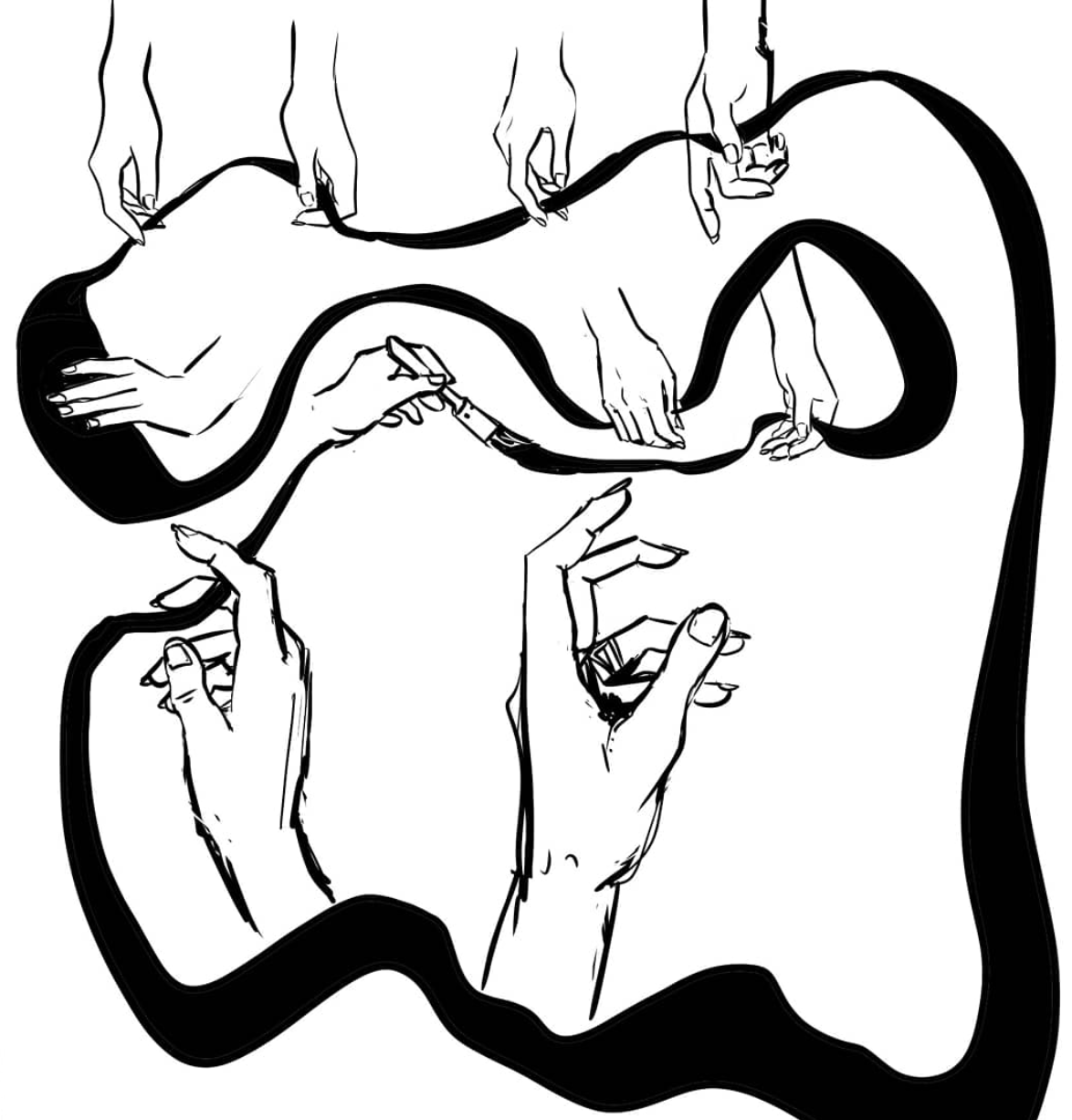
Drawing Hands and Feet
It’s a sign of intelligence to use your hands gesturally in public speaking.
Hands and gestures are a huge component of speaking in a compelling way. Think about the last public speaker you saw who kept their hands in their pockets, and you’ll probably be thinking about an awkward, weird speech.
We laugh when we hear stories about hand models, yet, people really do care, a lot, about hands!
Drawing believable hands is as important as drawing a believable face, as important as a voice - without believable hands, the whole thing isn’t believable.
Here are some ideas and toolsets that I hope you will find useful for drawings hands that are expressive, and drawing feet that are believable.

And what about, gulp, feet?
Sometimes I have nightmares where I am sent to a gulag and am forced to draw feet all day.
Every time I look at a foot - my foot, your foot, the foot of the most beautiful person on earth, the foot of the ugliest person on earth - I think to myself “How did this thing ever evolve?”
Feet are full of tiny little complex bones and really they make no sense at all. To learn to draw them I have to power forward at them, overcome my fear of feet, and draw them in isolation:
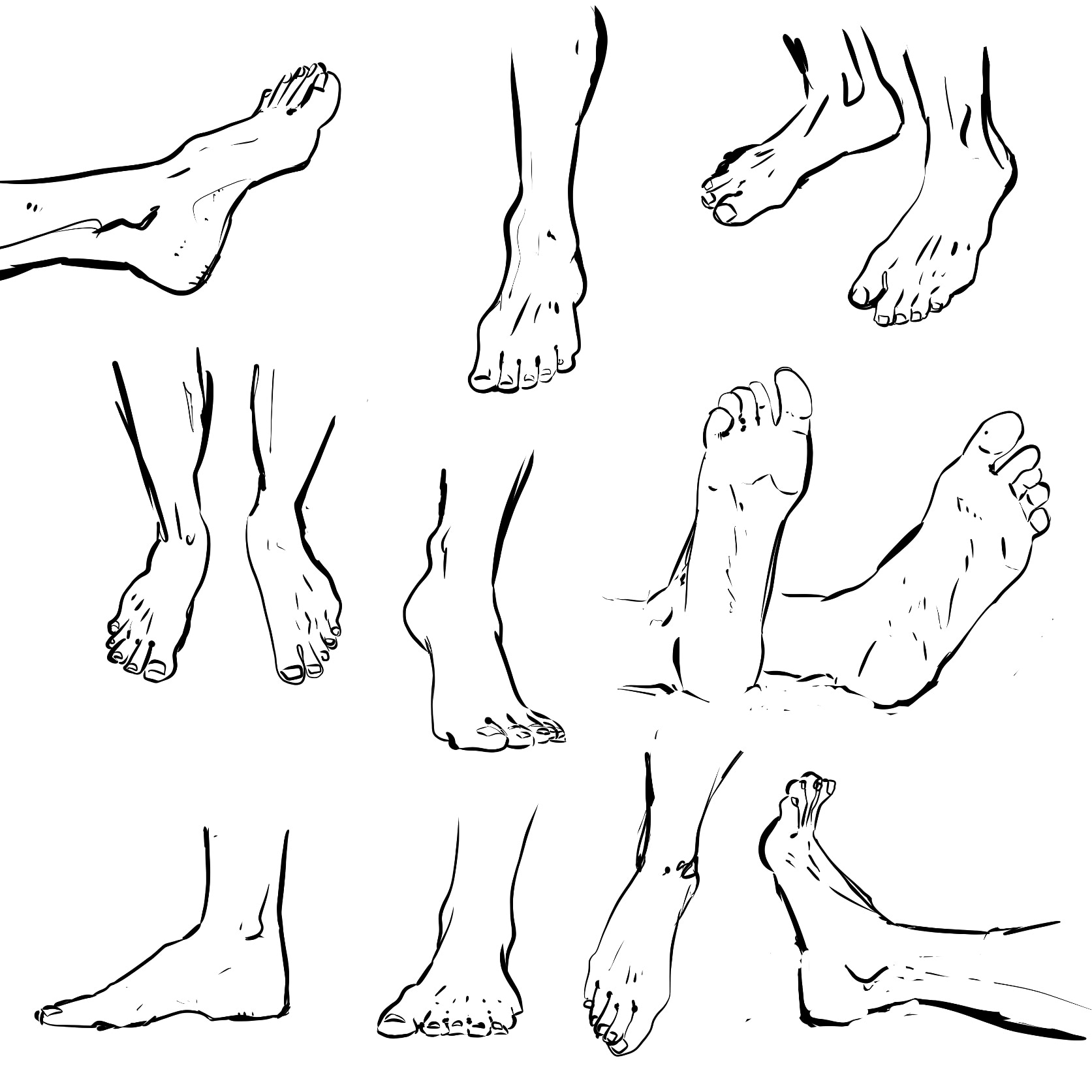
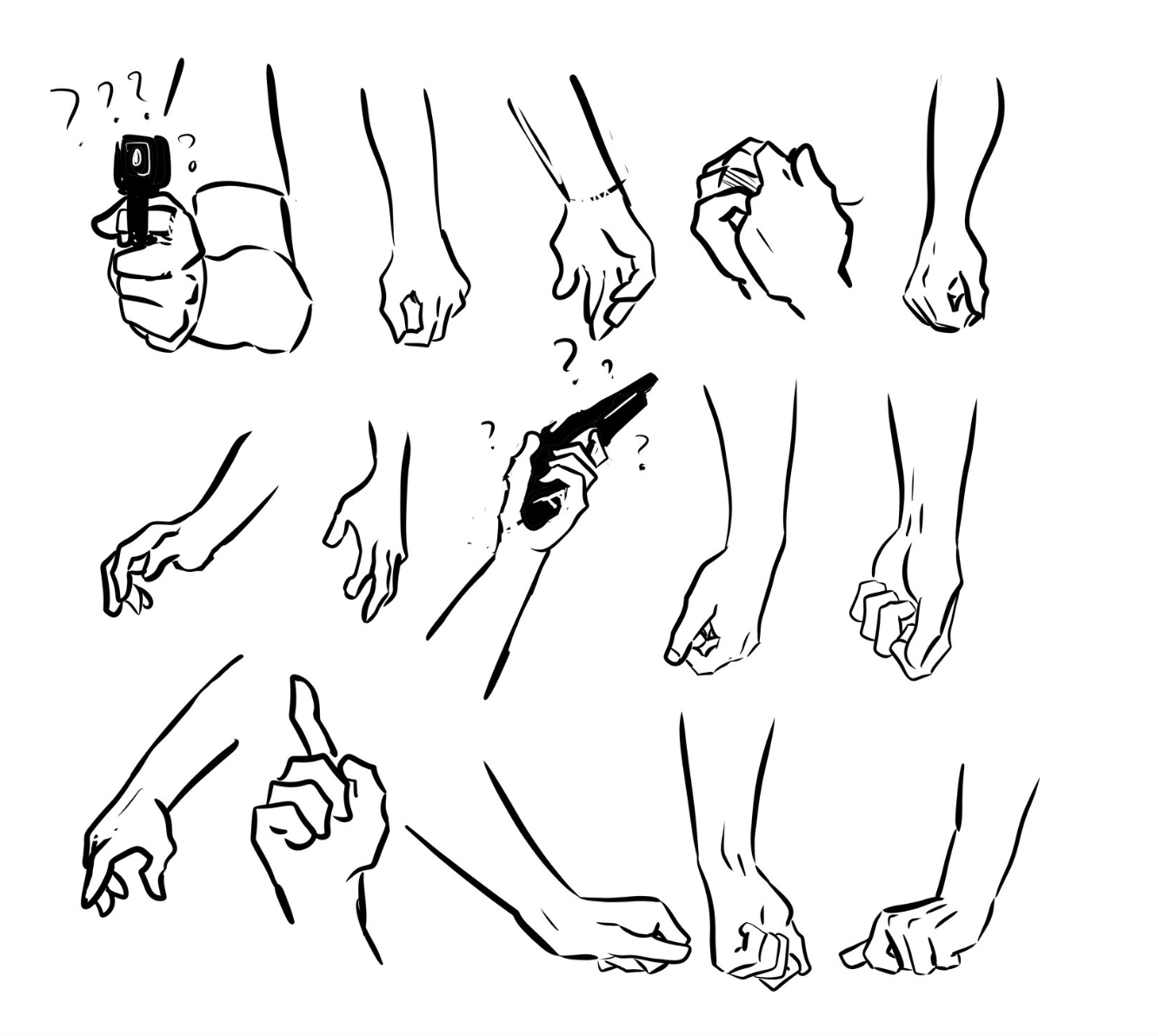
So where do you find hands and feet to draw? How do you get good at drawing them? I think it’s a matter of repetition for me, and, finding good sources for models. If you asked me to draw a hand right now I could draw one, but I’d prefer to actually look at a hand and draw one instead of just mentally fabricating one.

1. Model hands and feet yourself.
Aside from always having your non-dominant hand as something that can be drawn, or even your drawing hand. I draw my hands all the time and take photos of my hands to draw from. This works most of the time, except when I need to draw VERY MANLY hands, or small hands, or Hulk fists or basically any hand that doesn’t look like my hands.
The same goes for feet - though it is weird to take pictures of your feet all day, stranger things have been done in the name of art.
2. Ask a friend to model.
The problem with having your hands and your feet are… you only ever have one type. You have masculine hands, feminine hands, in-the-middle hands, hobbit hands, or just plain hands. Eventually you will need a friend if you ever want to draw a different kind of hand. Oddly, modeling art from ourselves or from one model too often can result in art that is pinned too closely into one style (See: Same-Face Syndrome.) You probably don’t want all of your characters to have the same hands, unless you’re drawing a comic about clones, or something.
3. Read comic books, watch movies, play games
There are 8 billion of us out there and about 16 billion hands, and there are even more on the internet and in pop culture like comics, games, and movies.

Movies are good for capturing and practicing drawing hand poses. Just hit the play button a movie you’ve seen dozens of times and pause it throughout, and draw the hands you see. This works well for body poses, feet, guns, anything that challenges you. It’s good to not do it too much though with the same movie, or your audience will slowly and surely start to recognize that most of your art looks a lot like poses from Die Hard.
Games are a treasure trove for finding poses, because most games are about moving a person through a world. Take Breath of the Wild for instance - Link’s feet are angled here in a way that is useful for modeling a scene, because, well, he is in a scene. He is at a sparkly fairy fountain, and I find myself fully believing in the reality of the fountain due to how firmly his feet are planted on the fountain shore. I believe in Link’s feet, I believe in the trees, the cliffside - I believe in the fountain.
I used the character screen of Breath of The Wild to make some drawings of Link’s boots, and from there, added some basic shapes in colors so that I could get a good idea of the structure of the boots. When it comes to drawing feet well, I’m a pauper, like the homeless guy on the side of the road with a cardboard sign that says Anything Helps. In this case, the colorful shapes help.


4. The Handy app

It’s a funny name for an app but it has a hand model that you can use to pose. This app is great if you don’t have someone nearby to help you model, or if your significant other is tired of being your hand model, or if you’re playing a game to gather up hand poses, but Link never makes the hand pose you are looking for.
At first I thought there was no foot aspect to Handy, it being named Handy and all — it turns out that I mentally repressed the fact that there were hundreds of foot poses available. I haven’t personally tried drawing or tracing from these but they look promising.
Not recommended:
Pinterest: Be extremely careful with Pinterest tutorials. Some are good, some are extremely bad. Use your best judgement and go forth, but, with several, several pinches of salt!

Google Images: Though it is something that can be done on a rainy day, I’d recommend against Googling for hands, such as ‘Hand holding apple’ or ‘hand holding onto ledge’ because there will be so many disappointing stock photos that, if you’re anything like me, you’ll get mentally fatigued. Or, you’ll start laughing at the stock photos and start posting them on Twitter or texting them to your few remaining friends, or facepalming because you’ve plunged into some kind of previously unknown misery, where none of our ancestors were ever genetically prepared to have their retinas bombarded by scroll after scroll of emotionally dead hand poses.
So there you have it! Everything that I know about drawing hands and feet. I hope this blog helps you out with some tools and ideas on how to draw hands that look like hands!
Related Blogs:
DC Metro Drawings in Clip Studio Paint
Featured on the Clip Studio Paint Website!
Who Wrote This:


Milwaukee Art Museum
Recently I found myself in Wisconsin for my cousin’s wedding.
Landing at the Milwaukee airport late Friday night, my husband Marc and I hustled off the plane, prepared to race to the pickup area. Marc and I clock in at 6’3 and 5’11 respectively, and are insufferable long-legged fast walkers - we like to get to where we are going as quickly as we can.
Only, there was no reason to rush, no crowds to transcend or beat to the baggage claim. MKE was absolutely empty, bereft of other travelers. I looked over my shoulder a couple times and thought “Where is everyone?” and other strange parallel-world thoughts materialized in my head: “Am I on a show? Is everyone about to jump out from behind a trash can and surprise us?”
I guess that’s what happens when you go straight from east coast urban life to the midwest.
While we waited for our Lyft driver to pick us up, I almost lifted my phone to take a photo of the absolutely unpeopled pickup area. It would have been Hopperian, only there was not a single soul, not a single lone person who would have been the Nighthawks couple of Hopper’s splendor. Just nobody.
Before the wedding (congrats cousin!!) we made our way to the Milwaukee Musuem of Art, definitely a cool place and with parking so cheap (6 dollars!), so empty, and so available, that my constricted heart valves relaxed and blood flowed more smoothly through my stressed little soul.

The museum is home to a couple outstanding pop artist pieces. It’s not the worst or best Warhol or Lichtenstein, but they’re among the more dramatic, more romantic pieces from each.


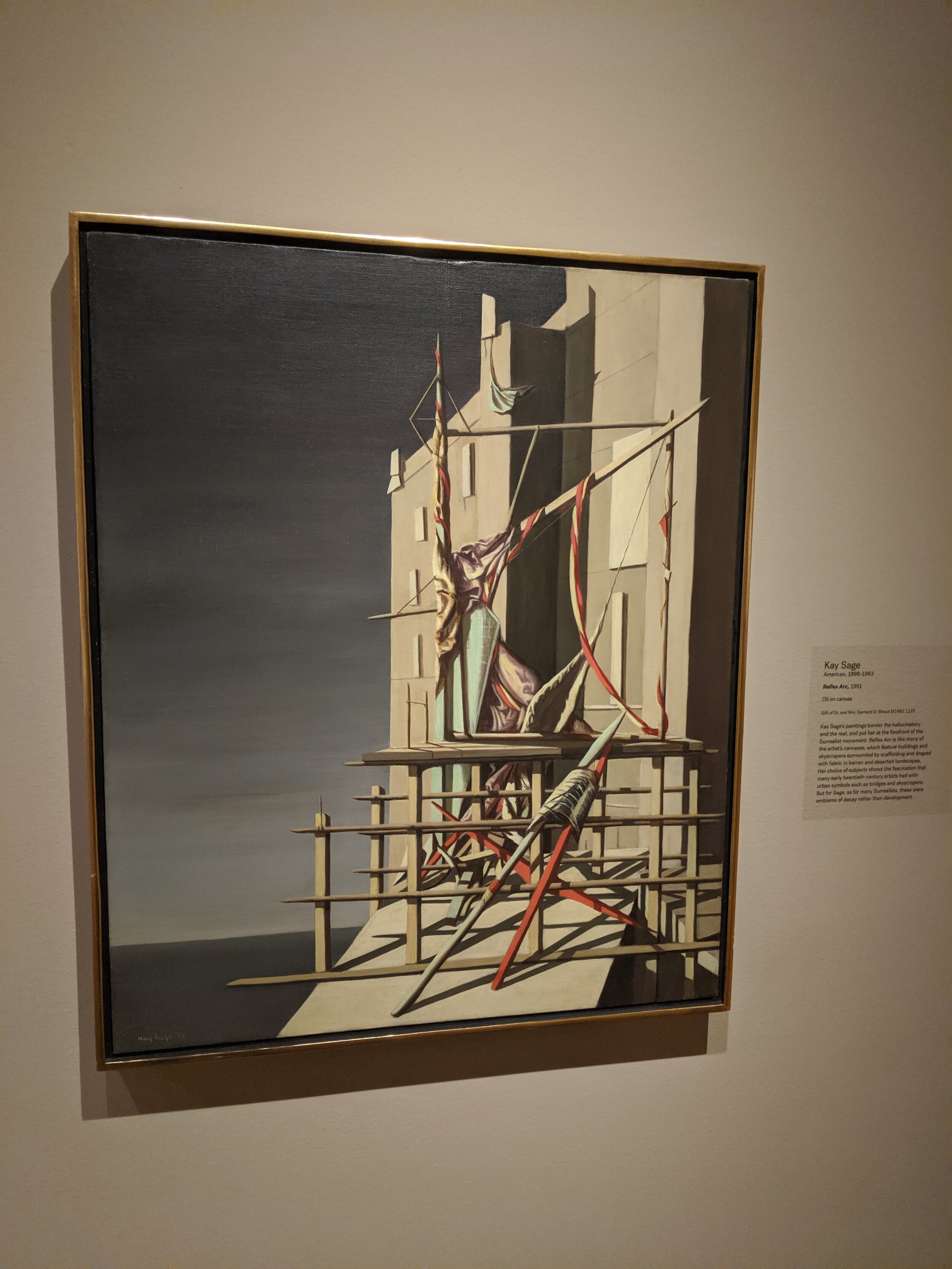
Hiding in a more dimly-lit corner of the third floor, a room of Andrew Wyeth, Norman Rockwell, and of all things Kay Sage in one room. Kay Sage is pretty rare for me to see in the wild, where her partner Yves Tanguy shows up much more commonly.
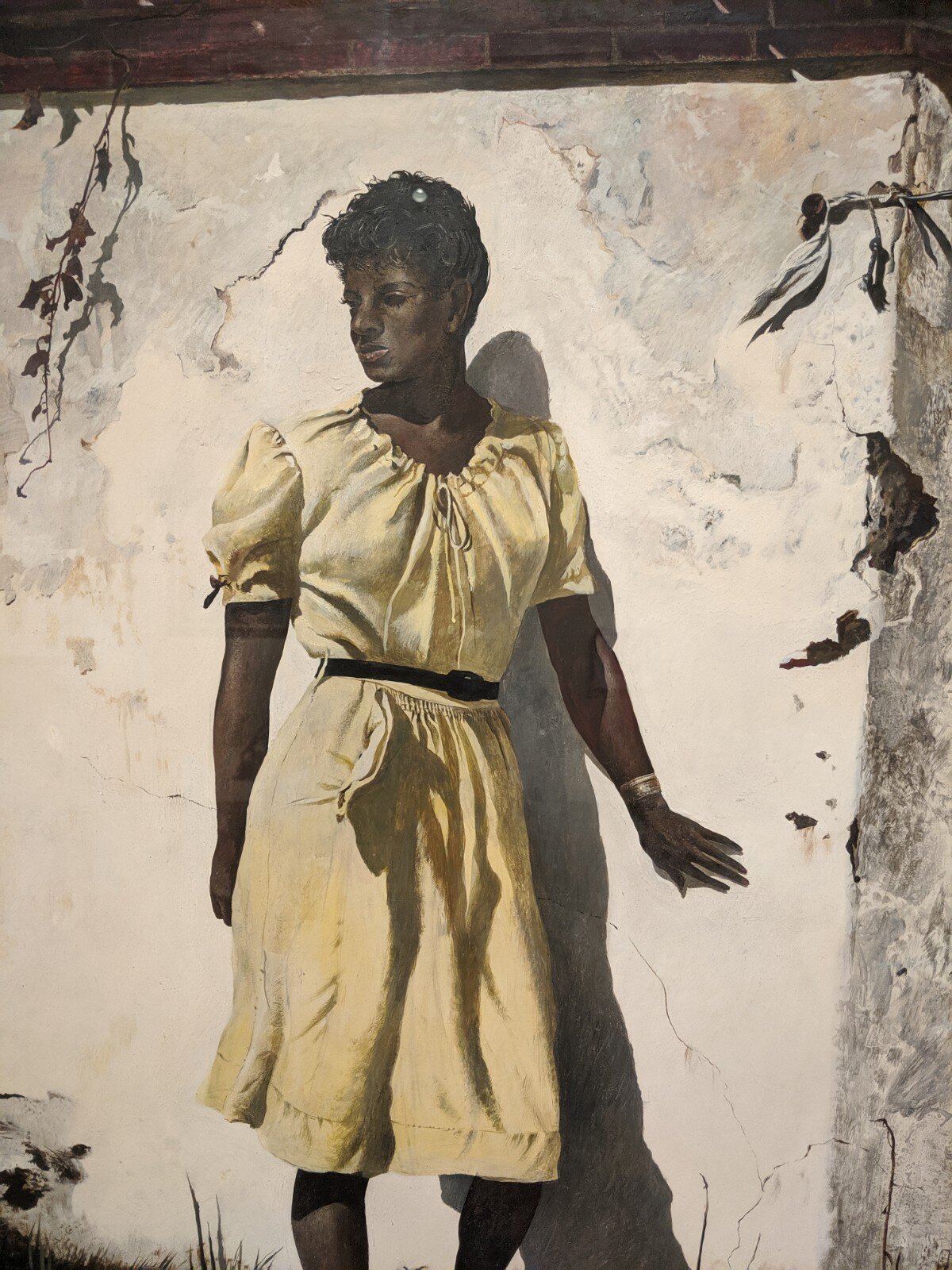
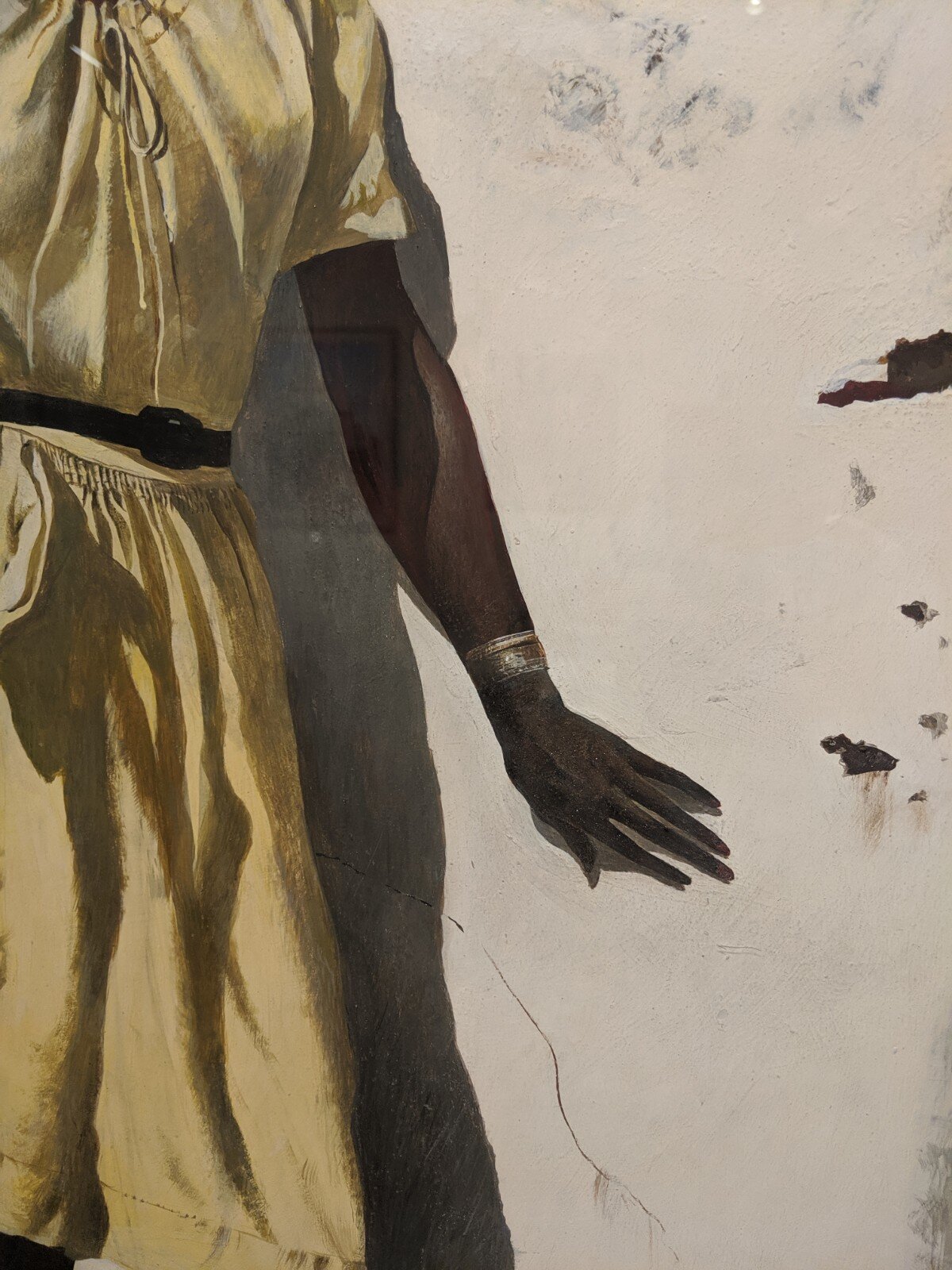
The Norman Rockwell was good but this painting from Andrew Wyeth stole the show:

I died over this painting. The woman’s expression, her simple yet striking dress, and her incredibly delicate hand against the wall speaks more truth than anything else on the entire floor. There was so much power in this painting - like a painting that glows on the wall. It’s one of the most beautiful paintings I have ever seen.
The Milwaukee Art Museum has more art and more contemporary art than you’d think. It gives art more space than most museums in the west, and it puts new and old on the same floor. An O’Keefe sits just a couple steps away from an Olafur Eliasson. It’s worth a visit if you’re in Milwaukee for any reason, and even if you’re not in Milwaukee.


Sketchbook Confessional September 2019
Welcome to another Sketchbook Confessional, where I get all of the art out of my system.
The Sketchbook Confessional is a place where I post and describe all of the art that I did in one month’s time, an effort to reel in the chaos of art and objectively know what I did and did not do.
Art:
I drew on my iPad on the Washington D.C. Metro as the train carried me away back and forth across the Potomac each weekday. For some reason this month, I had a lot of seatmates who were fans of art and who asked me questions about art.
This doesn’t always happen! Usually people are a bit more shy and watch me draw with a couple flicks of the eye and they go back to playing Bejeweled as the car goes screaming past the Pentagon. Either way, it was nice to meet some people on the train. One fellow rider told me I should be a tattoo artist, and I thought yeah! I could design tattoos, just not jab them into people.
The stabilizer tool in Clip Studio Paint does a good job of letting me draw even, smooth lines even as the metro car jolts and jives.
So, I stuck to simplicity when drawing and drew pretty repetitive things, like these crystals:

As I was having pretty much the busiest professional month of the year, I realized that I’d kept kicking the re-release date of Tilted Sun into the future, and that there would never be a perfectly good time to relaunch it. Like every point on a sphere being equidistant from the center, every time would be a bad time, so I might as well relaunch at will.

If every day is total chaos, why not do it today?
And so on September 10, Tilted Sun went live again! 75 pages of Tilted Sun are now out in the world.
If you haven’t read, start at page 1: https://www.tiltedsun.com/comic-1/2018/5/5/page-1
New pages update every Tuesday and Thursday and you can check the newest page on TiltedSun.com any day. <3


Alex and Lambda the cat from Tilted Sun
In September I also worked on more drawings with themes of love and romance.

And, I kept up some practice on hands and other challenging things to draw, like glasses. Ever try to draw glasses? Holy smokes.


I’d never seen so many tourists in such a small place. Online guides all mentioned that it would be crowded and that parking offsite was the best thing to do, and I didn’t quite believe it until I was riding into the city on a bus packed with 40 other people from various countries, India, China, Europe, all to see Harper’s Ferry.

The floor at SPX
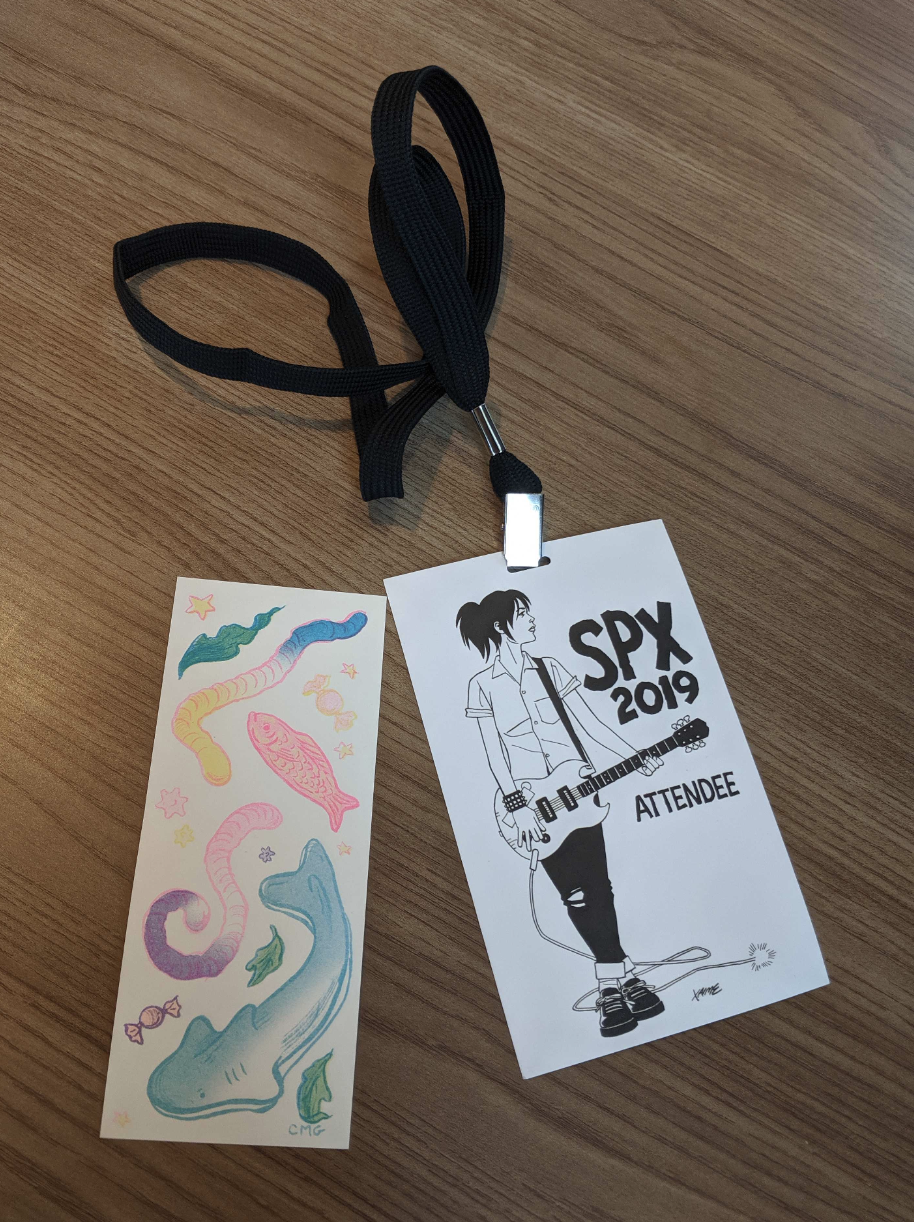
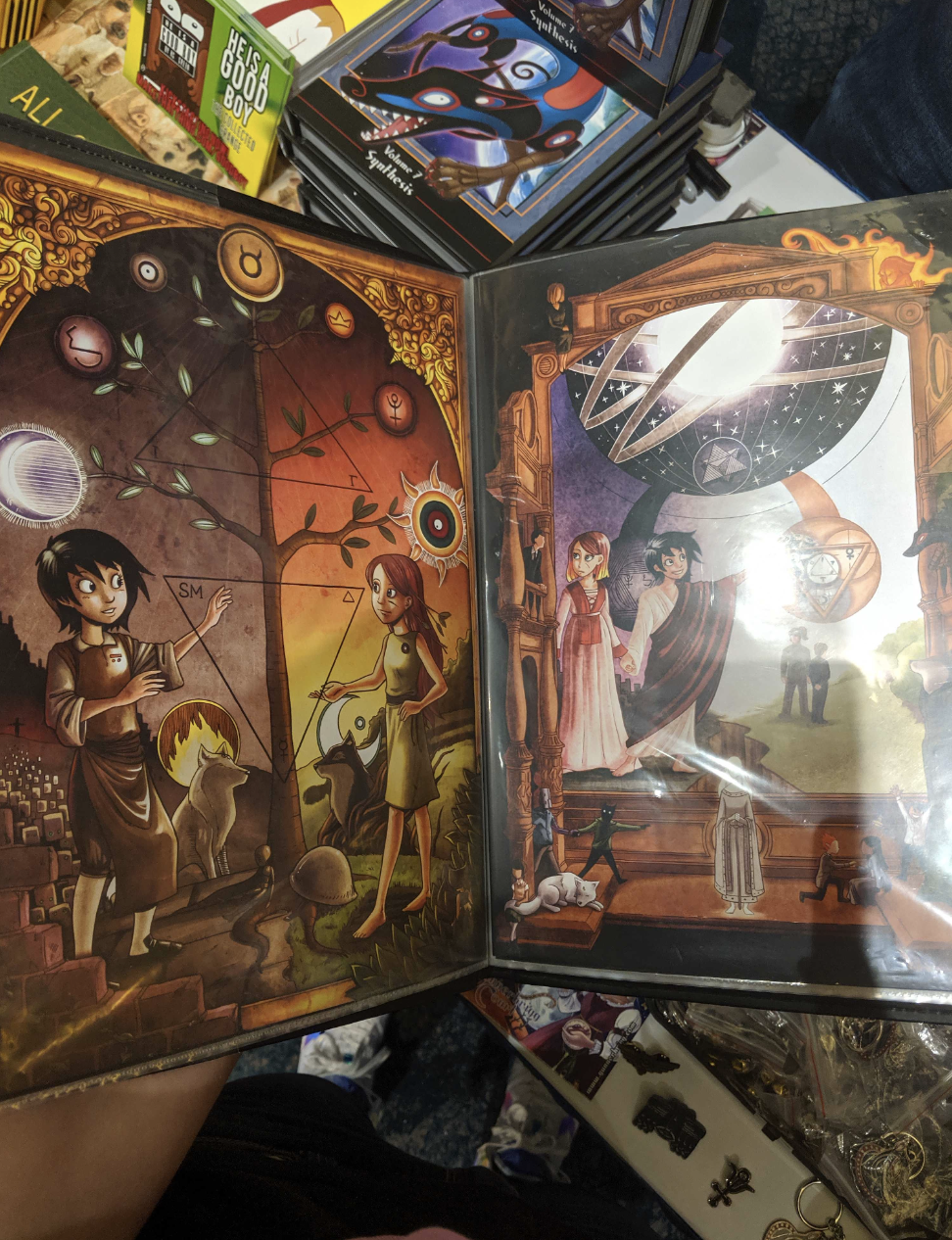
I also went to Small Press Expo, or SPX! I spent wayyy too much money, or, the way I see it, the exact right amount of money on amazing creations from indie artists and authors.
It was so great to meet new and old internet friends and also a few comic artists I’d been following for years. Super to meet Henry Barajas, Tom Siddell (Gunnerkrigg Court, bottom right) and Chloe Giroux (bookmark to the right is from her!).
The panel at SPX with Jessica Abel about working efficiently and organizing your time was amazing. The full title was “Butt in the Chair: How to ensure your comics projects get the love they deserve.”
Of all the comic book topics you could talk about at a convention, a seminar about being diligently organized probably doesn’t seem like the most exciting thing on the planet, but it was the most energizing panel I’ve ever attended. It was even better than learning how to draw Ninja Turtles.
Abel's approach to documenting time and responsibilities was the most realistic take I'd ever seen on art life - way more realistic than hoping for a savior project, or cranking out grueling, unattainable hours under a #neversleep mentality. One of her slides is below: "You act your way into thinking differently. You can't think your way into acting differently.”


The headliner event for Saturday evening was a panel between Chris Ware and Eddie Campbell. It was a pretty funny conversation, I remember a moment where Eddie Campbell said he was in the process of coloring From Hell and had to keep himself from fixing 'mistakes' or what he perceived to be mistakes. Chris Ware was great. He described some idiosyncracies of artist life where at one point his wife found him on the couch as he was sewing mockup dolls for Jimmy Corrigan and was busy stitching together doll clothes. I think most artists relate with these kinds of moments, where what you are doing makes perfect, logical sense in your art world, but to the rest of the world, it just looks like you are agonizing over tiny brown pants.
Related Blogs:
Plein Air Painting at Harper’s Ferry
Sketchbook Confessional August 2019
Sketchbook Confessional July 2019
Who wrote this?

I’m a painter, I make comics, and sometimes I do computer stuff!
- Becky Jewell
Plein Air Painting at Harper's Ferry


This Jullian easel has been with me for almost 15 years as it was a high school graduation present from my dad to me. It’s heavy, but it carries everything. Whenever anyone asks me how I became so fit, sometimes I want to answer “Painting” but I know they wouldn’t take me seriously, so I usually tell them I am just genetically blessed. There’s a part in van Gogh’s letters to Theo where Vincent is basically beaming at the fact that his doctor mistakes him for an iron worker. It’s something no one would believe after years of being pummeled by ‘art is weak, math is strong’ pop culture. Painters have to be incredibly strong.

Painting itself is an effort to understand the world, space and time, and to interpret it in a way that is interesting to others, or interesting to you. Sometimes, the only goal is to just try, and to accept that nothing is perfect, no art happens in a vacuum, flies will get in the painting, people will say it’s an ugly painting, but it’s still important to try.
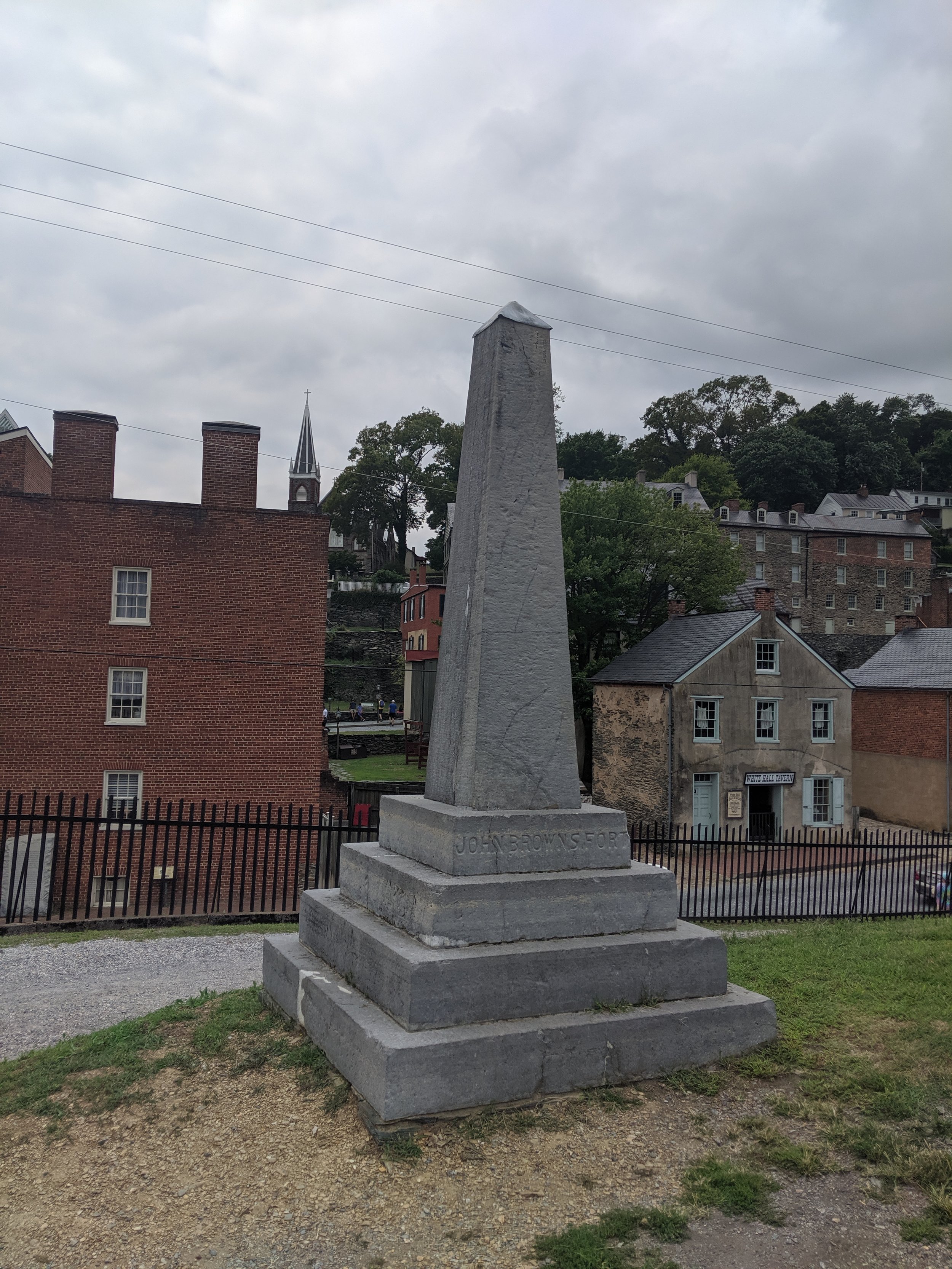
At the top of a small hill in Harper’s Ferry there is a monument to John Brown, but the whole town is a monument to him, with a structure at the bottom of the hill being dedicated as John Brown’s Fort. Almost every building has a placard and a historical marker. After a while you realize how well-preserved the town is despite seeing what must be millions of visitors each year.
The coffeeshops and the restaurants of the town were packed with visitors from across the USA and international visitors alike.

Viewing the local stonework is also worth a visit at Harper’s Ferry. The fact that people used to make structures this way absolutely blew me away. Where did they find all of this flat stone? Was it chipped out of the mountainsides? Hauled out of rivers? Both? Each stone is like it’s own story - imagine someone laying mortar and applying these stones, layer after layer, hour after hour. In many cases, it would have been an effort of several months or years of piecemeal expansions.
I found myself staring into the details of each wall, and each one was unique, and built up over years with different mortars, different composites of stones.
Harper’s Ferry is a place which rewards a slower, more careful eye - which is easy to have given the sheer ancient feeling of the place. Aside from cliffdwelling ruins and other Native American structures, and there aren’t many old places in America left.


Wandering between the old rail tracks and the river, you can find this fenced-off garden. It isn’t clear what grows here. I struggled to understand why it was there - it was one of the few structures in Harper’s Ferry without an explanatory placard. I liked this - I’m one to go to the museum and not take the audio tour and I never read artist statements. With historical structures, since they aren’t exactly art, it’s probably better to try to read up and understand what a structure was, but I liked the mystery of this garden. Who knows what someone was trying to do with it? It’s fun to think about.

A few years ago I read a book on pictographs and pictoglyphs in the American West, and one photograph showed a man standing next a boulder with a drawing of a human figure on it. The rock was at the site which would become Lake Powell. The man was standing on ground which would be covered in hundreds of feet of water soon. I was floored at the injustice of it all - some artist had carved the rock probably 5,000 years ago, and here we were, burying the pictoglyph in water.
But then again, what else could be done? The artist’s rock was in a remote place - you couldn’t exactly haul it in a truck bed to the nearest art museum. You couldn’t even chip the rock into pieces safely and take just the slab. So, the pictoglyph stayed, and now it’s still at the bottom of Lake Powell.
It’s not hard to imagine someone in an impossible future diving into Powell and looking at the pictoglyph at the bottom of the man-made lake, or someone in an even further future walking up to it after Lake Powell has dried. Harper’s Ferry feels like that pictoglyph at the bottom of a lake - it’s a part of the past where people tried, it’s in an inconvenient place, a man-made thing which can’t be moved into a museum.
Related Blogs:
Plein Air Painting in Washington DC
Plein Air Painting in Leadville
Who wrote this:
Sketchbook Confessional August 2019
Welcome to another Sketchbook Confessional where I go through everything I did in a month!
Background on Sketchbook Confessionals:
I found that I wasn’t keeping track of how much art I did and that while I had a to-do list, I wasn’t keeping a good ‘done’ list. The Sketchbook Confessional is a chance for me to get it all out and just post everything I did in a month, a time-bound way of reeling in the chaos of art.
Art:
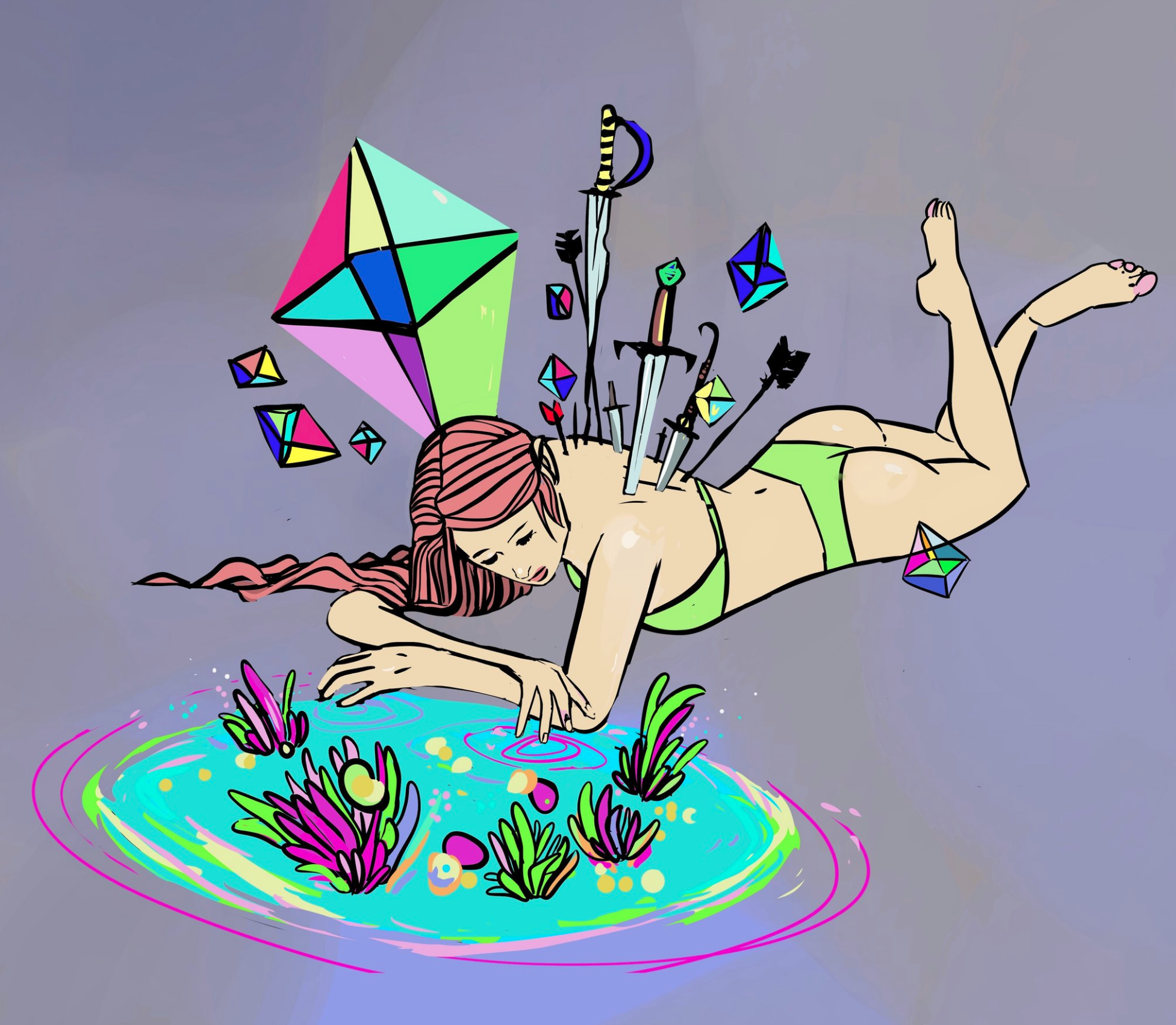
August brought many ups and downs for me in the studio and day-by-day, I made some art, but not a whole lot. I’m still working on relaunching Tilted Sun soon. For most of August I would get home from work and be nearly exhausted, too tired and too hot to do anything but eat Fruity Pebbles and hang out with Geddy. I mostly felt like the girl in the illustration above - knives everywhere, fun crystals everywhere, but at least I still have my pool of dreams.
To just get my art off the ground I made this work of a man with a lotus on his face:

In working on Tilted Sun I am thinking mostly in covers and symbols - which isn’t a bad place to be, it just makes the surface a bit hard to reach if you’re at the bottom of an iceberg. I wish there were more conversational parts of the comic where characters talk to each other and the plot advances, but right now I think it’s like 68 pages of world building, so, my plan is to change that with the upcoming set of pages. Holy smokes. If you ever feel like criticizing a comic try making one for yourself first.

I also worked on identifying more places where I was weak as an artist. Namely, shirt collars. Shirt collars are very confusing to me and I am not very good at drawing them.
Like saying the same word over and over again, the more you repetitively draw something, the weirder it ends up looking.

But, I did learn a lot about collars, and, most of all I learned that it is good to look at references to draw these.
In August I worked on pouring ink patterns - these are not ‘art’ on their own, so what I typically do is cut each sheet into multiple pieces and re-collage them. The ink patterns are like origami paper - they are a material, but they are not yet in their final form.

While pouring out ink, the excess needs to be dabbed with tissue or it will flow off the sheet. This ends up creating very beautiful patterns on paper towels and toilet paper.

I’m not sure what to do with these by-products yet, but my instinct is to save them.
Travel:

In early August I went to my hometown Leadville to get away from the DC heat and relax a bit. On a shakier-than-one-would-like flight, I drew these lotuses which I had seen near the Anacostia river at the Lotus festival, using a pen from Sekaido in Tokyo

The Leadville Trail 100 Mountain Bike race happened to be happening during the same weekend I was in Leadville. It was super to see so many old friends in Leadville, including immense triathlete Alex, Leadville Laurel, and my old cross country ski coach, Mr. Quinn.
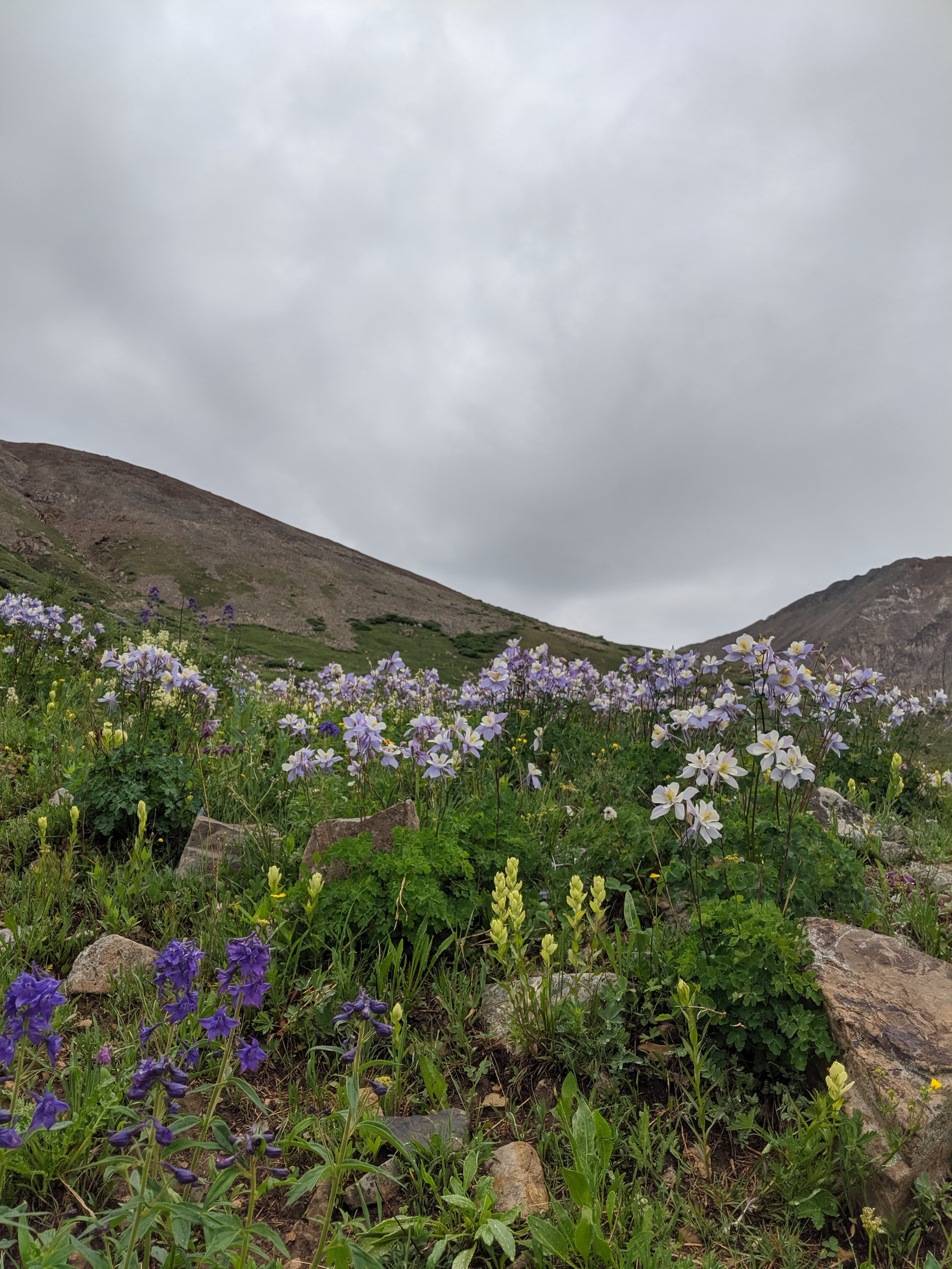
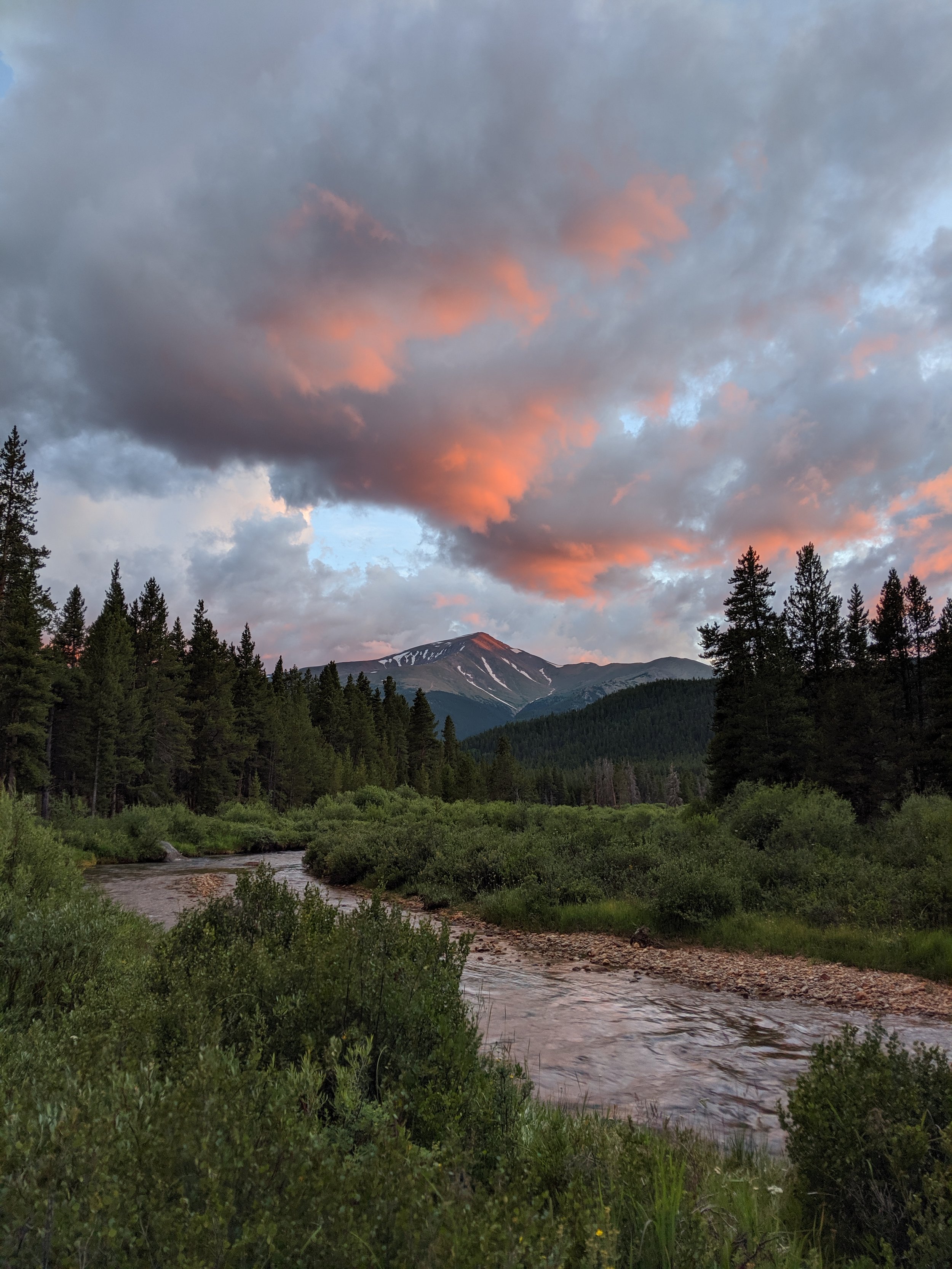
Many people have probably heard of the record snow this year in places like Colorado and Lake Tahoe. All of this snow allowed flowers to bloom in August, in amounts I had never before seen. Here are photos I took of the mountain flowers:






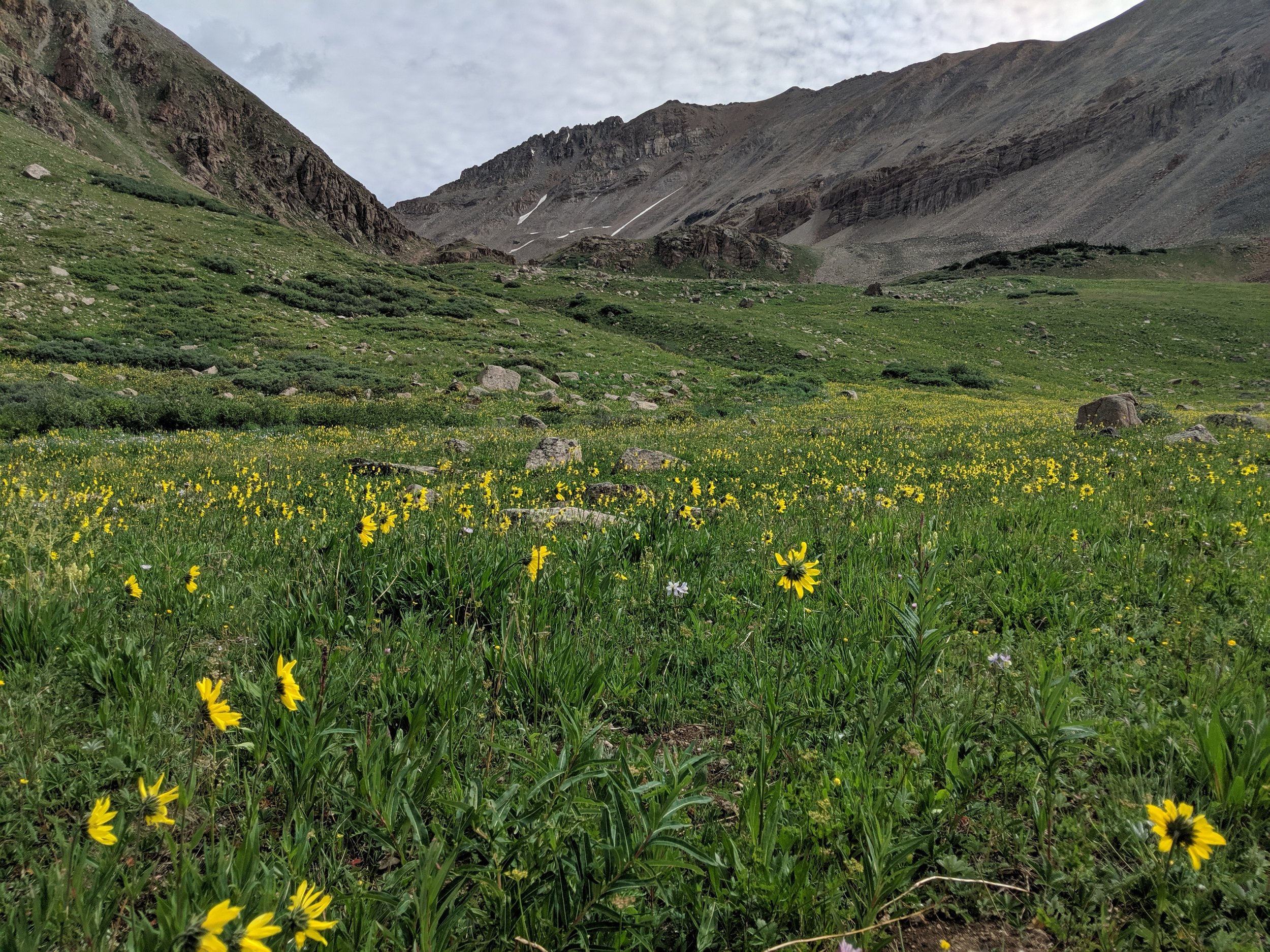
It will be good to go into the winter with these photos as a reminder of summer, and I can paint the flowers from my studio in Maryland.
Reading and Playing:
As an unabashed nonfiction junkie, I read the following books:
Finding Ultra - A great book by Rich Roll, where he harnesses his extreme personality and transcends alcoholism to become one of the fittest athletes and ultramarathoners in the world.
Art Thinking - my boss lent me this book and it is the most meaningful book I’ve read about art in years. The book’s thesis is that art as a practice can be integrated into working life, not separated, an absolutely dazzling argument compared to the traditional narrative of dayjob/artjob splitting. It’s not just that art and life can be integrated, but when it’s integrated, all of humanity benefits. Read this book if you are an artist who is also a lawyer/doctor/software executive/worker.
Unfuck Yourself - An instant classic. I loved the positive affirmations. If you read the entire book in a Scottish accent, it’s even better.
And after carrying the book halfway around the world to Japan and back, I finally finished reading Cryptonomicon - It took me about as long to read this book as Neal Stephenson took to write a new one. 1000 pages of code making, code breaking, treasure hunting.
I played a bunch of Octopath Traveler after my friend Jesse lent me a Nintendo Switch.

I also played Breath of the Wild, which reminded me a lot of exploring the mountains in Leadville and hiking around Colorado. I haven’t finished either game but just getting to play them for a small amount of time was inspiring from a production perspective - the details and artistry in each game gave me some hope for the world.
Related blogs:

Who wrote this:
I am an artist who lives and works in Maryland-shy-of-DC! I make comics, oil paintings, and I travel! See you next time …
-Becky Jewell

Leadville Summer 2019 Photos
In 2019 the mountains and western states saw record amounts of snow, where cabins in Tahoe were buried to the chimney and locals in Leadville were shoveling 4 feet of snow off of their roofs. Watching the snowfall from afar at my home in Maryland, it seemed like everyone in Leadville was shoveling their roof for about 6 weeks.
And the snow just kept coming. An avalanche near Copper Mountain slid down a mountainside and 100 year-old trees sank into the flow like capsizing ships. The avalanche was so powerful that it went down the mountain, into a valley, across a river, and up the side of the other mountain on the other side of the valley. Trying to escape this avalanche must have felt like being chased by a bear and climbing a tree, only to find that the bear is a much better tree-climber than you.
The roof of the bowling alley in Leadville collapsed - not the only roof-collapse in recent years in Leadville, but a pretty major one, where the alley probably won’t be repaired and will likely be taken piece-by-piece to the landfill.
Despite growing up in Leadville, winter is not my happiest time, especially not now that I live in Maryland near Washington DC. Winter isn’t full of fun fluffy snow here - basically it snows, and then it rains on top of the snow. But at least I wasn’t having to create a pulley system to get a snowblower onto my roof - I’d start to feel sorry for myself while standing on an uncovered DC Metro platform in heels in February’s nastiest sleet, and then I’d open Instagram and scroll past a photo of someone’s truck in Leadville, irretrievably immersed in four feet of snow.
If it had been my truck, I wouldn’t have known where to begin. Pray that I’d brought the snow blower into the house, so that I could start right out the door? Would the doors even open?
With all of this record-breaking, tree-slaying, roof-caving snow, stunning flowers emerged in the high mountains this summer at around 12,000 feet. Instead of hiking for miles and looking for the right creek to possibly glimpse an occasional columbine group, columbine bouquets were everywhere. Everywhere.
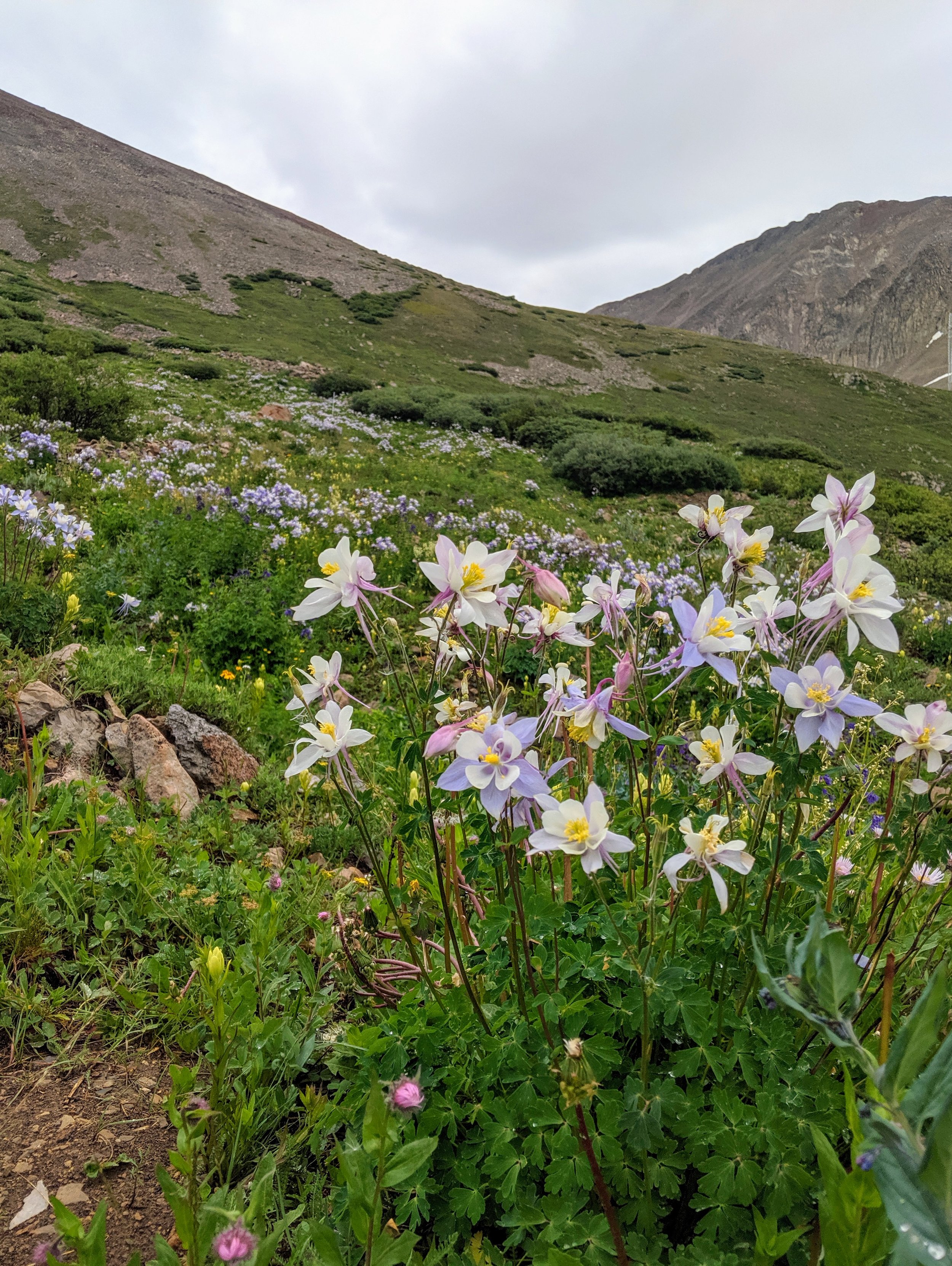
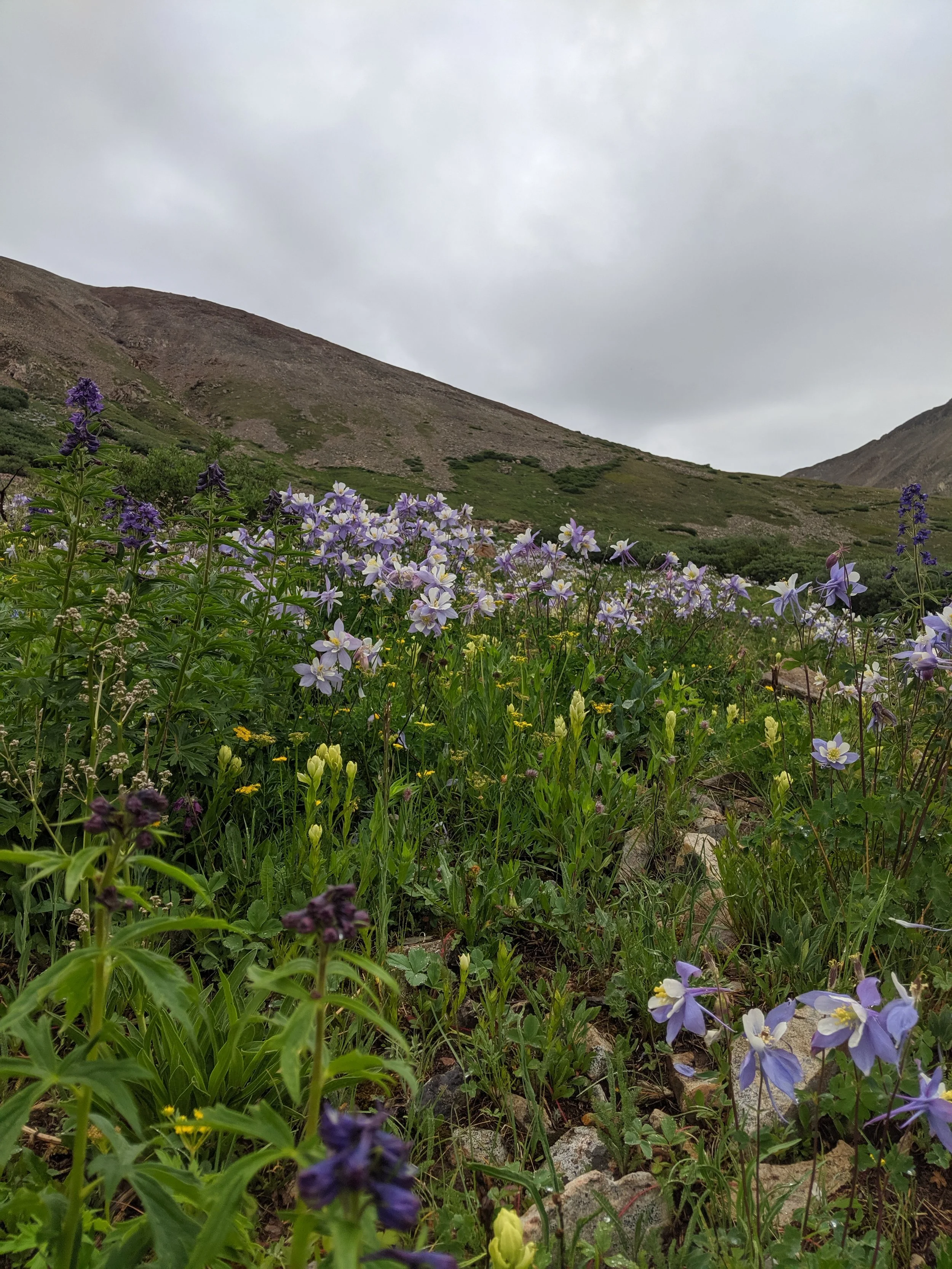
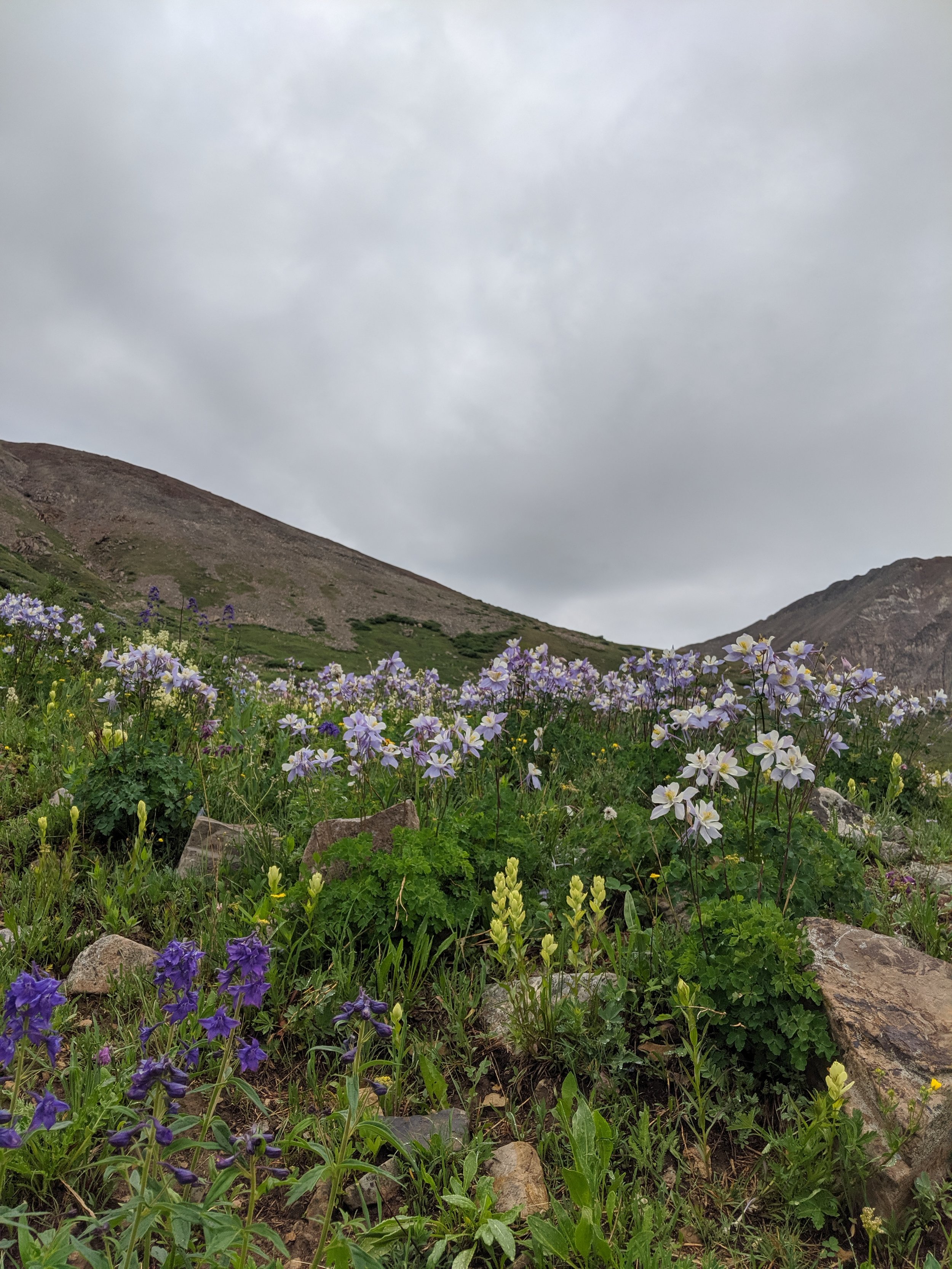


Each photo in this blog was taken on a Google Pixel 2 camera, a machine which seems to be able to see far better than I, with each dewy filament of this thistle standing out as clearly as in life.
Outfitted with the Google Pixel 2 camera, for the first time I feel like I am doing some justice to the beauty of the high mountains in photo form.
Since Leadville has become a more well-known place over the years thanks to the amplification of the Leadville Race Series, I’ve done what I would call a C-minus job of explaining how beautiful Leadville is to my friends in Texas and Washington D.C.
You can talk and write about mountain life all day, but ultimately nothing I say ever feels on point about Leadville - nothing really sums it up. At a certain point, words just don’t work. Only the best writers among us ever come close.
Maybe photos come close, maybe paintings do.
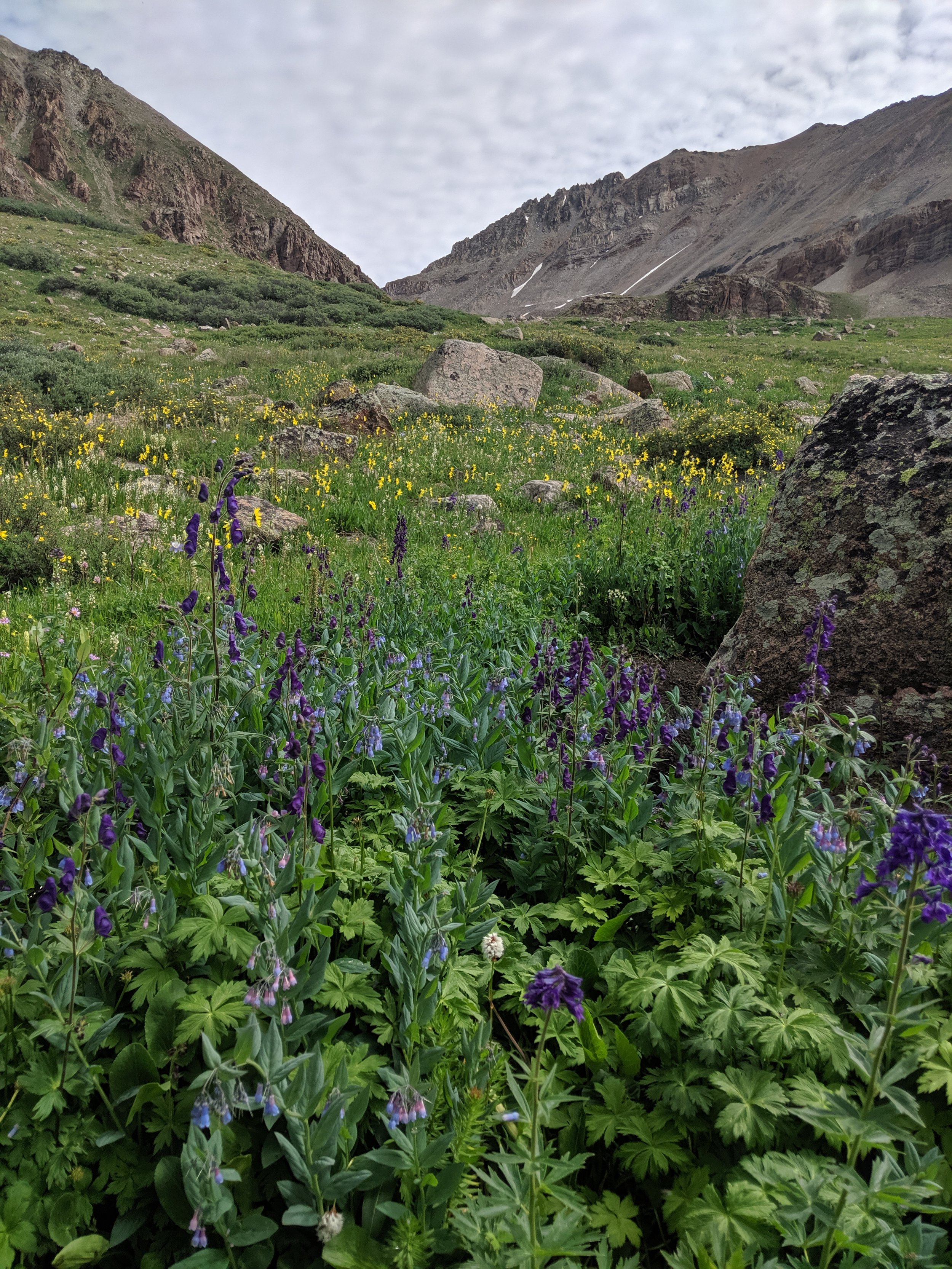

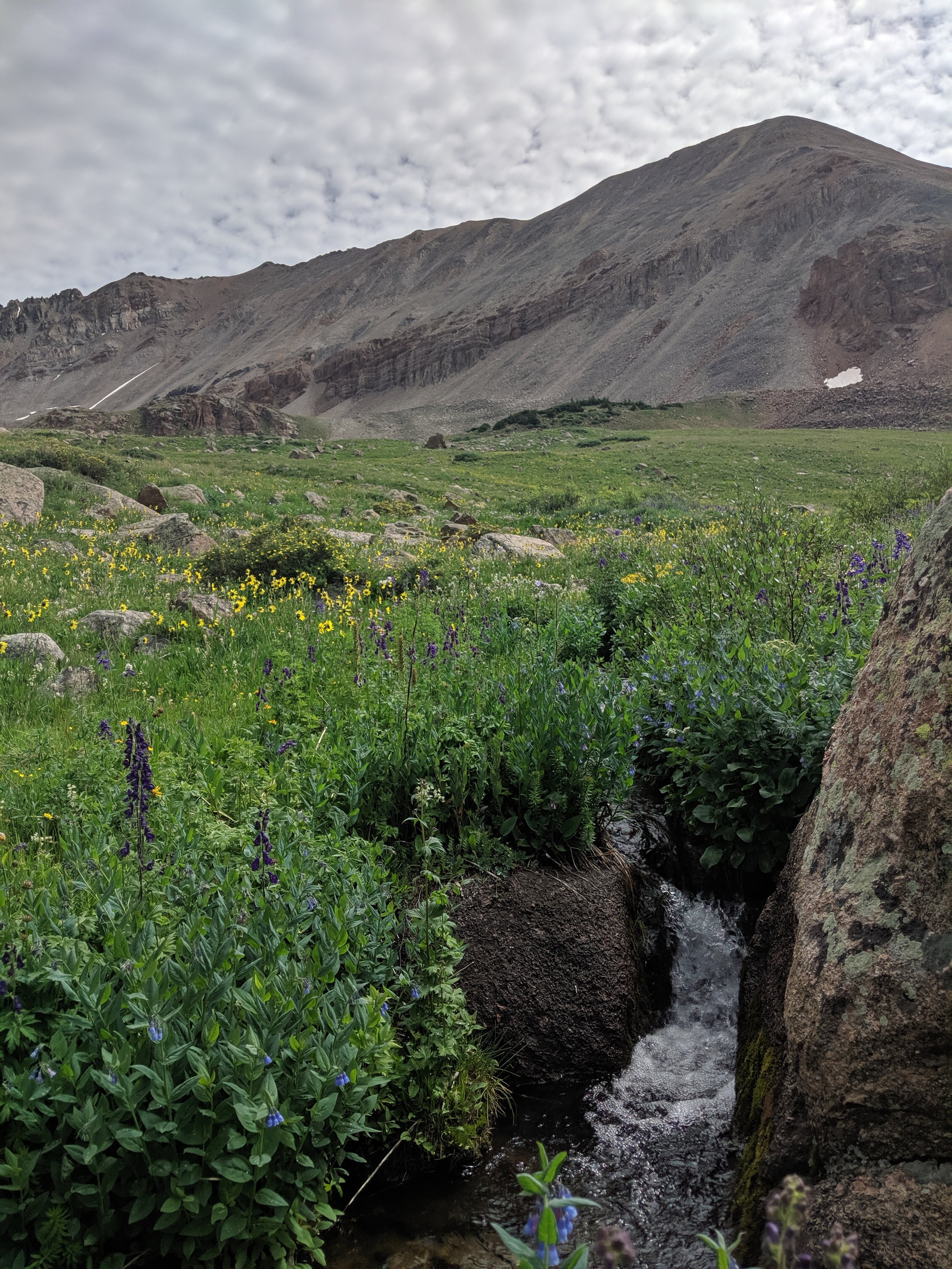

The flower peak is usually around July, this year it stretched into August. With temperatures dropping in September, these flowers won’t last too long, but who knows - the fall should at least bring gorgeous colors and possibly some snow, too.





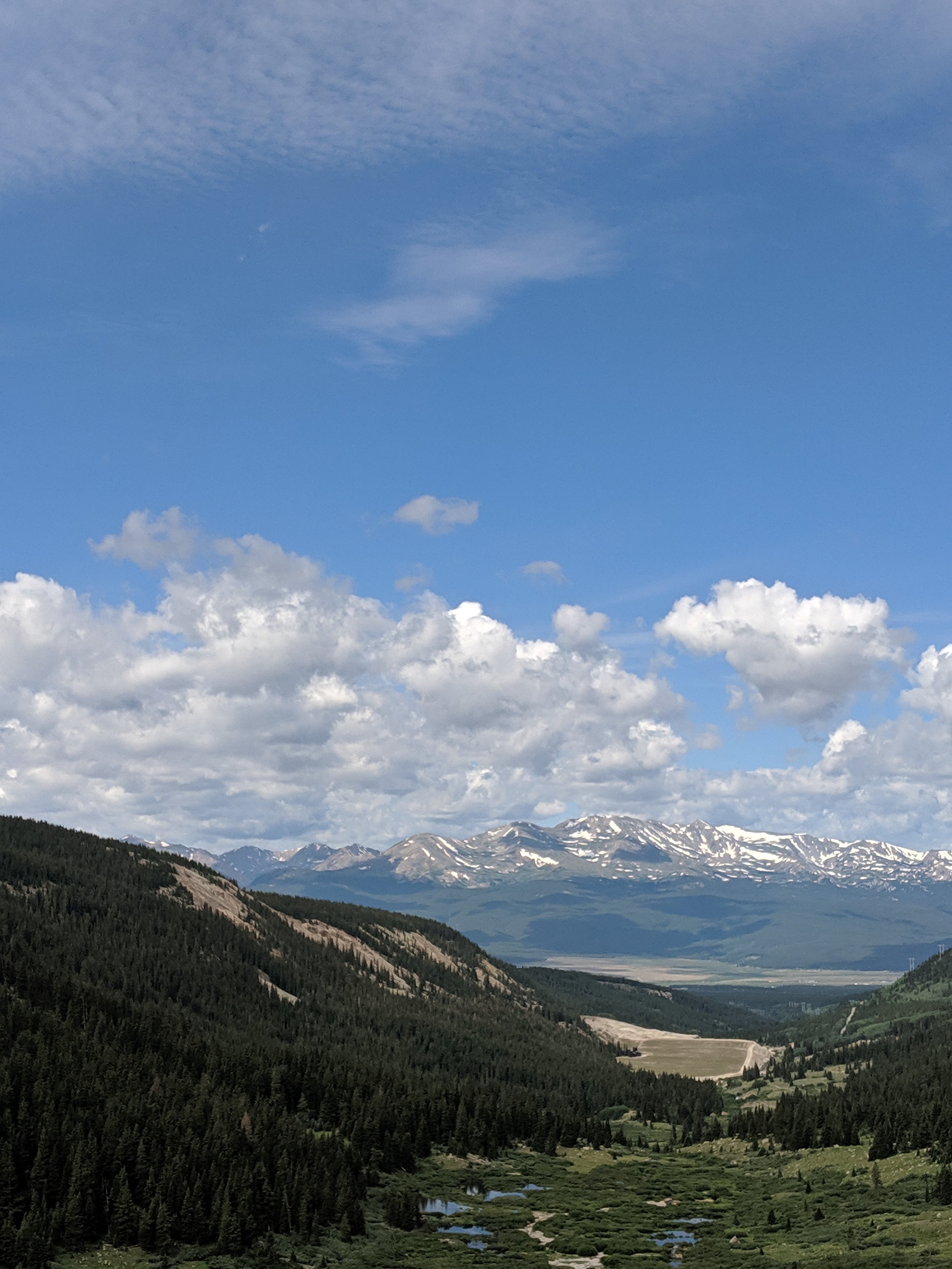
Leadville was a Superfund site for a while in the 90s, and the remnants of mining and exploitation of the land can still be seen everywhere. You can also see why people kept digging - look in any of the mining tailings piles and the diversity of rock that is there is unlike any I’ve ever seen.


Some of the wrecked mines of Leadville are still explainable, where remarkable success happened and wealth boomed out of the earth. Still others are like ghosts, where there is no explanatory plaque, no historical marker, no mention of anything in books. What were people doing here? What was all this? Considering that the above would be buried in wintertime under 12 feet of snow, the desperation and hunger of it all just oozes out of these structures.
Someone was here and they wanted something, badly.
I was trying to understand what this once was - it's at about 12,000 feet at the Mt. Sherman trailhead near Leadville pic.twitter.com/2ND6DhrsuO
— Becky Jewell (@beckyjewell) August 25, 2019

But even before major cleanup of the mines, life was finding a way - like these flowers and many more.


Who wrote this:
I’m a visual artist who lives in Maryland - I blog about art, I make art, I make comics, and I travel! I also like poodles, mountainbiking, and technology (most of the time). More about me here. Until next time, catch you around the internet.
- Becky Jewell
Sketchbook Confessional July 2019

How do you talk to someone on the bus about your book you’ve been writing for two years? How do you even talk to your spouse or best friend?
How do you talk casually through monumental creative challenges?
Can you?
The creative world would benefit from some kind of confessional ritual, a place where you can go to speak your deepest artistic truths to someone behind a curtain, someone who can sort of forgive you, who is likely just as flawed as you, but invisible.
For this reason, I’ve created the Sketchbook Confessional, a post where I confess what I’ve been up to lately. This is an attempt to keep myself accountable and also try to reel in the absolute chaos of creativity that is otherwise off the chain … if the chain ever existed in the first place.
I have this feeling that if we don’t talk about what we go through as creators, if we don’t get it out somewhere, it’s no good.
That said, I have no idea if this will work. I’ll try it out and get back to you.
Confessions for July 2019:
Confession 1: I went to the Critical Role panel at Denver Comicon in June and was charmed and awed at how great the D&D community was. What’s cool about D&D is that it brings people together - and with a common goal. I started offering to draw D&D characters for my friends, and was quickly buried in over 20 requests! For some reason, I thrive on absolute chaos and was able to crank out a few D&D characters - if you’re still waiting I’m sorry, I’m hustling!
Truly, drawing D&D characters is really fun and a great way to improvisationally make characters. The great rule of Improv is saying Yes, And … - and saying Yes in art and life seems to work for me. I will make many more!


Confession 2:
I mowed a lot this month. Dear reader! The plants in Maryland are insane, growing something like seventy inches every year. I am very certain that my neighbors want me to mow even more, and that they perceive me as a very lazy mower. Despite my best efforts, I am the proud owner of some kind of local citation for having too many ugly overgrown plants in my yard. I promise you that I am trying my best to both mow and make art.

While mowing my criminally-overgrown yard, I thought a bit about plants in art that I’ve made and I really haven’t focused enough on plants. Similar to mastering hands and interior design, plants are the next drawing challenge on my plate to charge at.
In other plant-related news, I went to the Lotus Festival in DC and had never seen so many amazing lotuses. I took some photos to bring back to the studio. The lotuses were over 6 feet tall. Something to write home about!
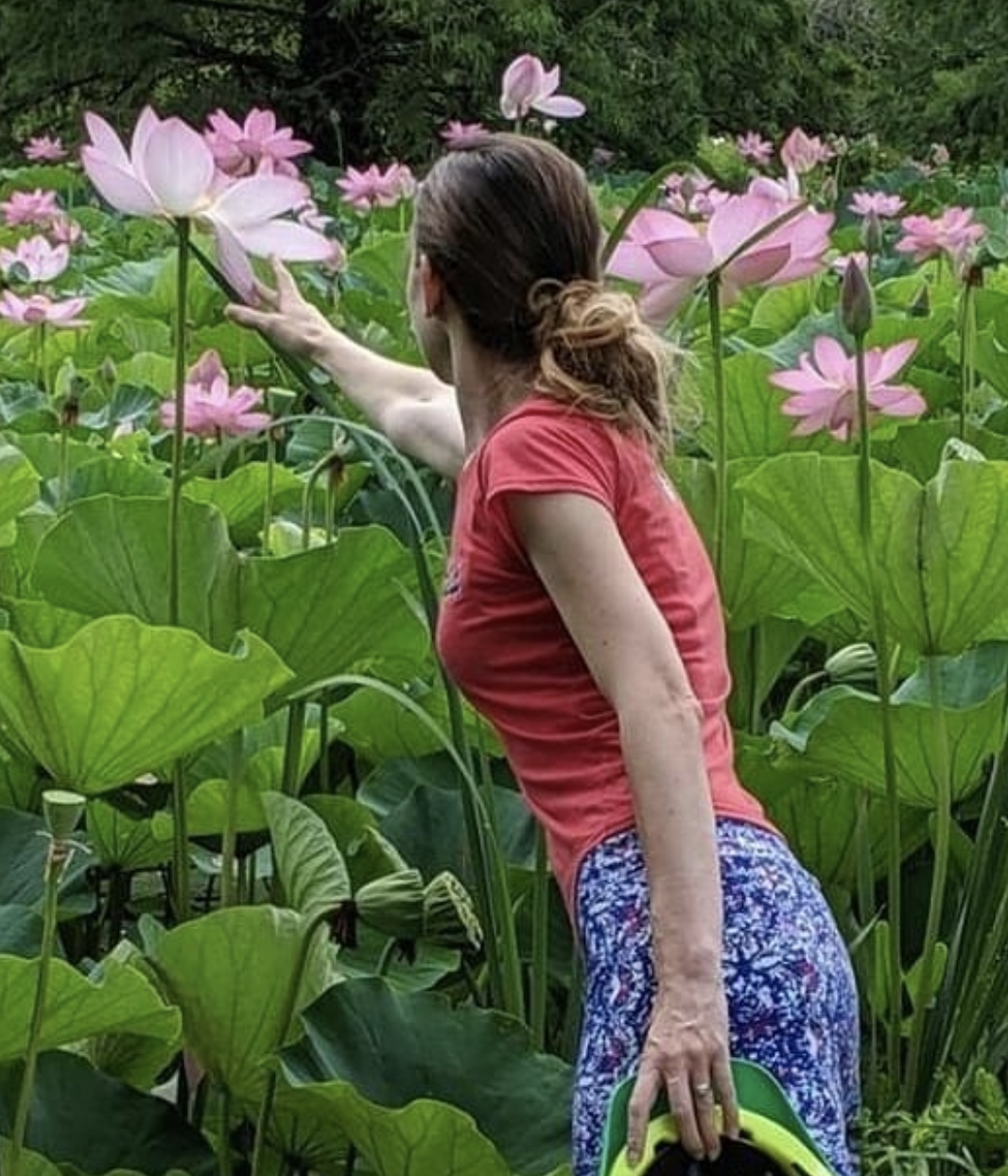


It’s weird that I ran into giant lotuses in real life after working with lotuses as a theme in Tilted Sun, but, it might also be that lotuses are an eternal art symbol that you are bound to run into from time to time.

Confession 3:
Tilted Sun is almost back up and running! There are 20 pages bumming around on my iPad Pro, just waiting to be launched, but …. I’m being so possessive and cautious about them! It’s at the point where if I do not put out these pages, my iPad will surely get stolen or cracked or something, so I’d better do it soon. I’m thinking end of August.
Here are work-in-progress sketchbook images from my iPad in Clip Studio Paint for Tilted Sun


I’ve also made a few process GIFs - all the pencilling is digital, so it technically doesn’t exist. I wish it did. This is the only bad thing about making comics digitally.

Confession 4:
There are a lot of moments in Tilted Sun concept art where I don’t exactly know exactly when or where the concept is going to fit into the plot of the comic, but I want to get the concept onto paper anyways. Some of the concepts take more or less framing and set-up than I expect, which is part of the fun of making comics!

Confession 5:
I started drawing romance again. How romance works for me is, the worse the world gets, the meaner it seems, the more I tend to start drawing dreamy-ass romance scenes. If someone yells at me while I ride my bike or harasses me on the internet, I usually go home and draw romance that day. They spring from some kind of unkillable hope within me, I sort of wish it would die, but it’s like the white whale that cruises onward through the ocean even though he’s taken several spears.


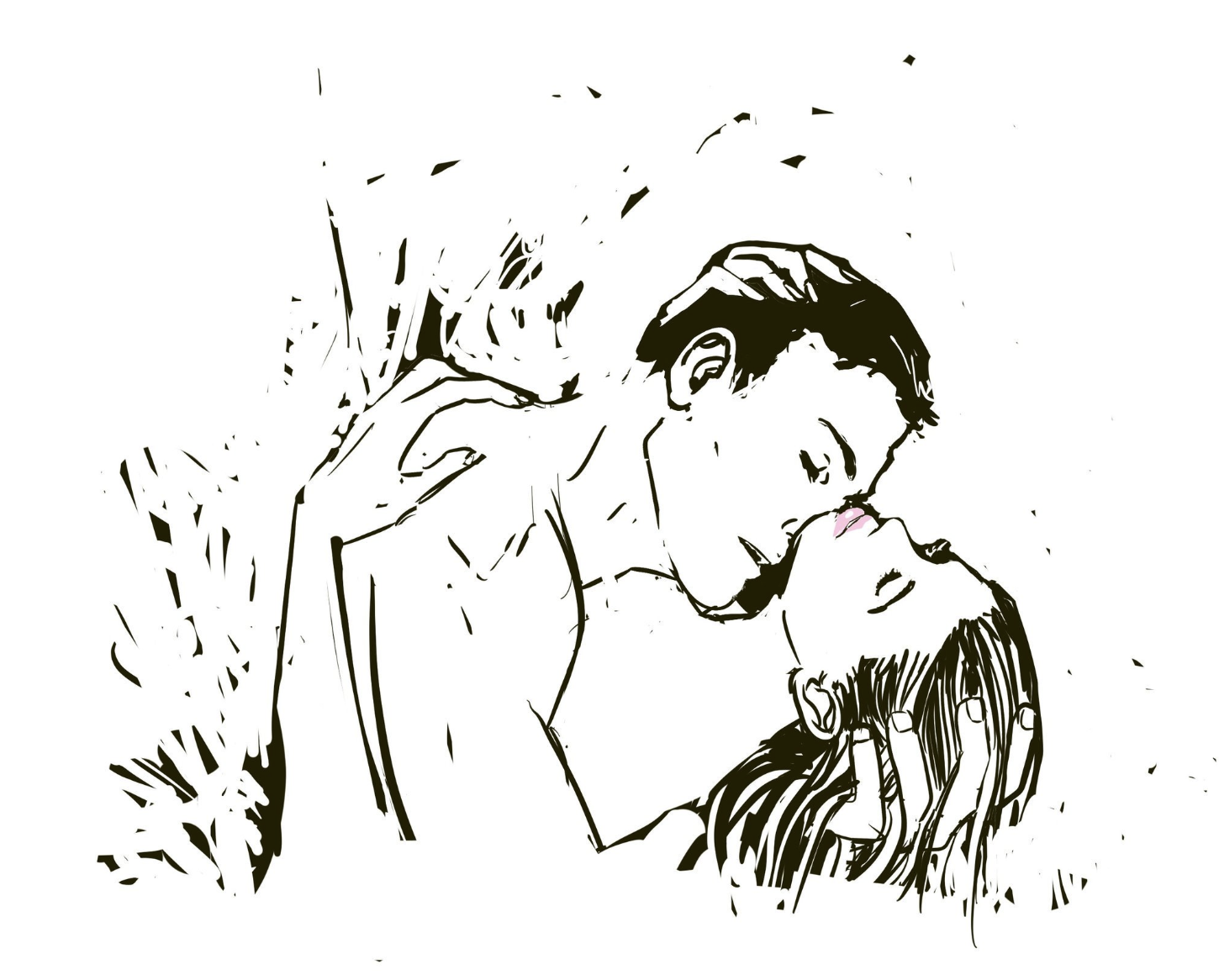
Confession 6:
I am working on an amazing new project with my buddy Audrey! It’s super secret, but it has to do with cats.
Confession 7:
Crow Magnum is still underway! This is a comic I am working on with author Laurel McHargue. After drinking a Red Bull at 6 pm and staying awake for 36 hours I finally got to the right place in my head with this comic.
Confession 8:
I was exhausted over 4th of July weekend and couldn’t muster any energy except in drawing anime, like this recreation of a cel from Cowboy Bebop.
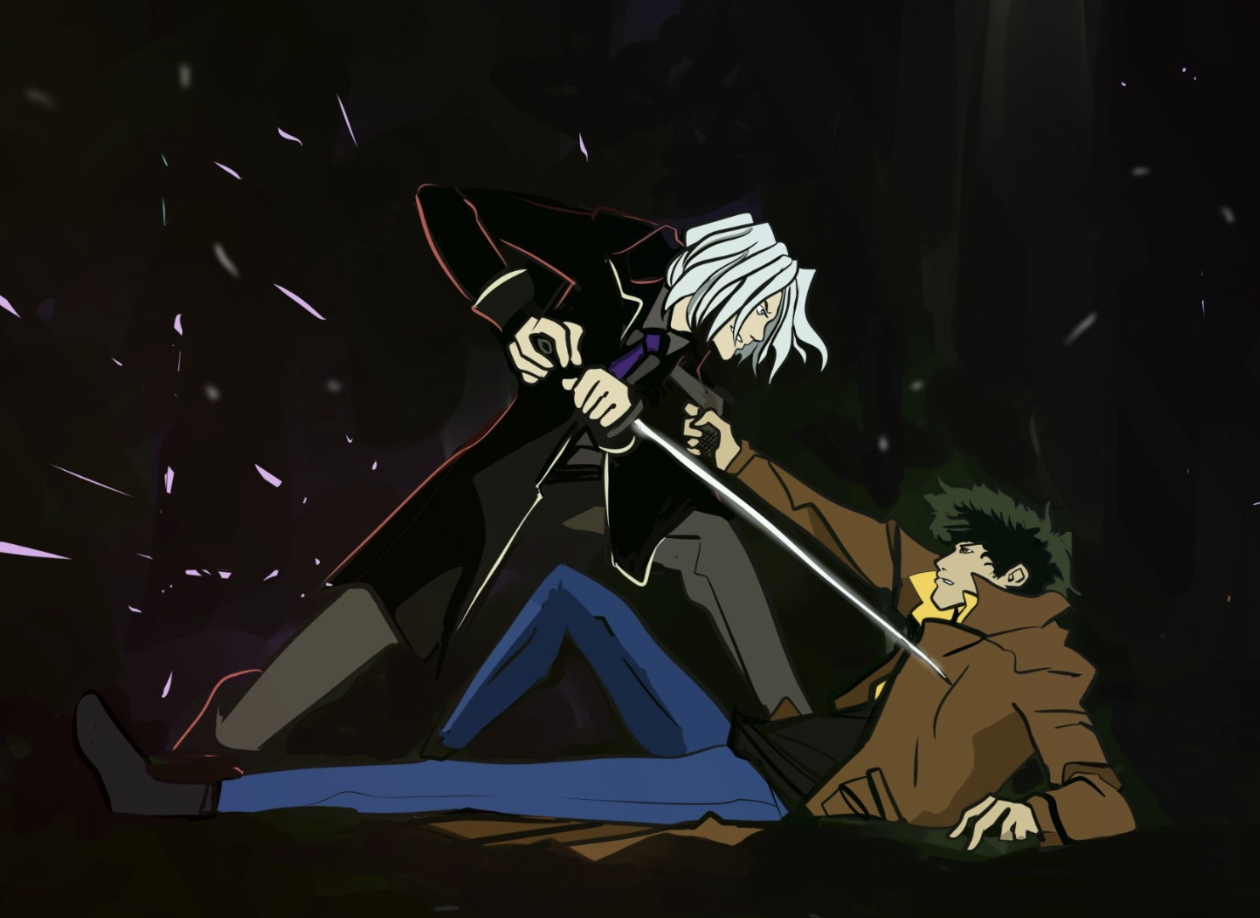
Confession 9:
I was able to crank out a couple paintings of Mt. Elbert. Mt. Elbert is like Mt. Saint Victoire - I’ve painted it at least 20 times and will paint it many, many more times in my life. I’m at the point where I almost believe I understand Mt. Elbert. Mountains are incomprehensible and grand.
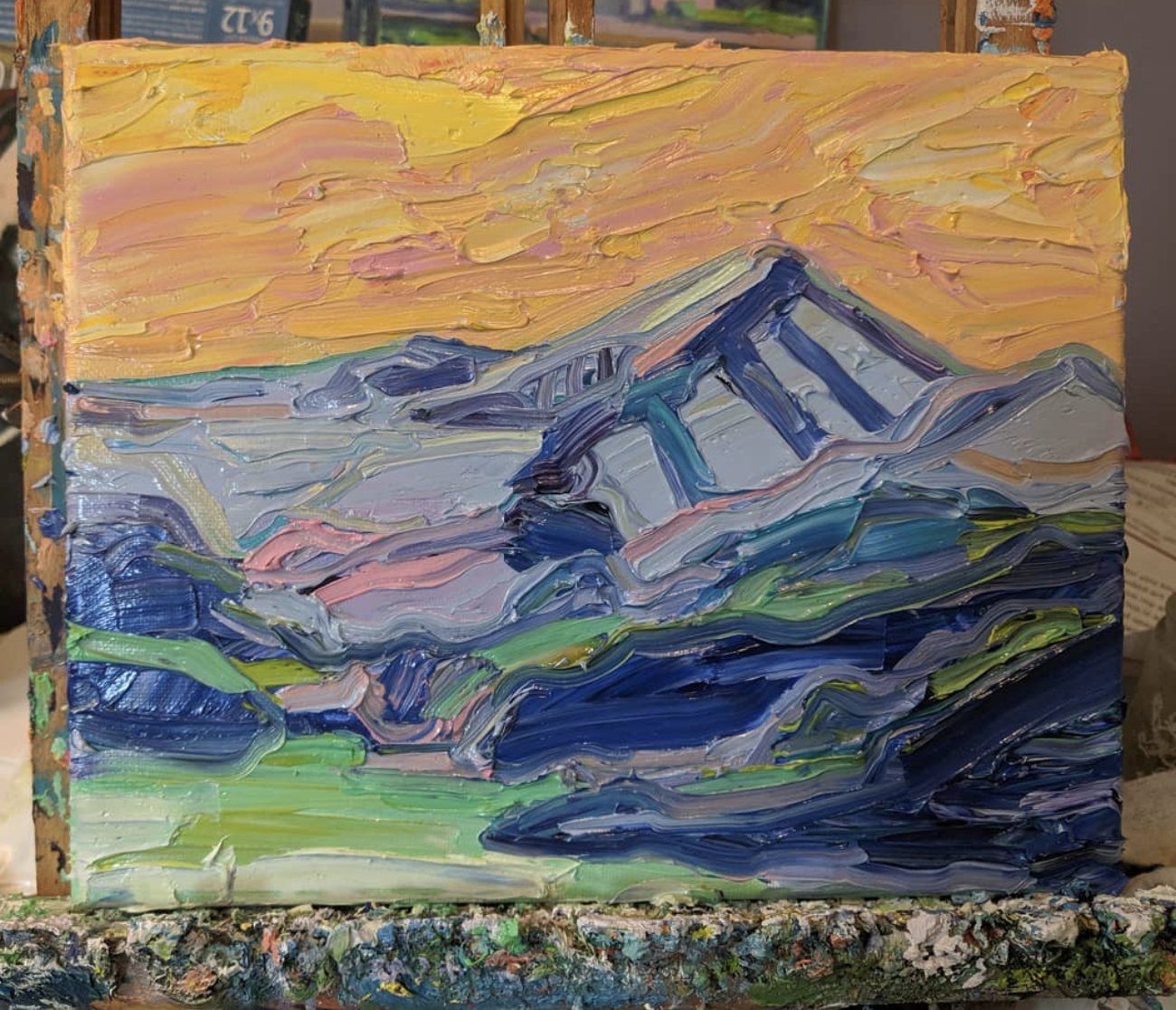
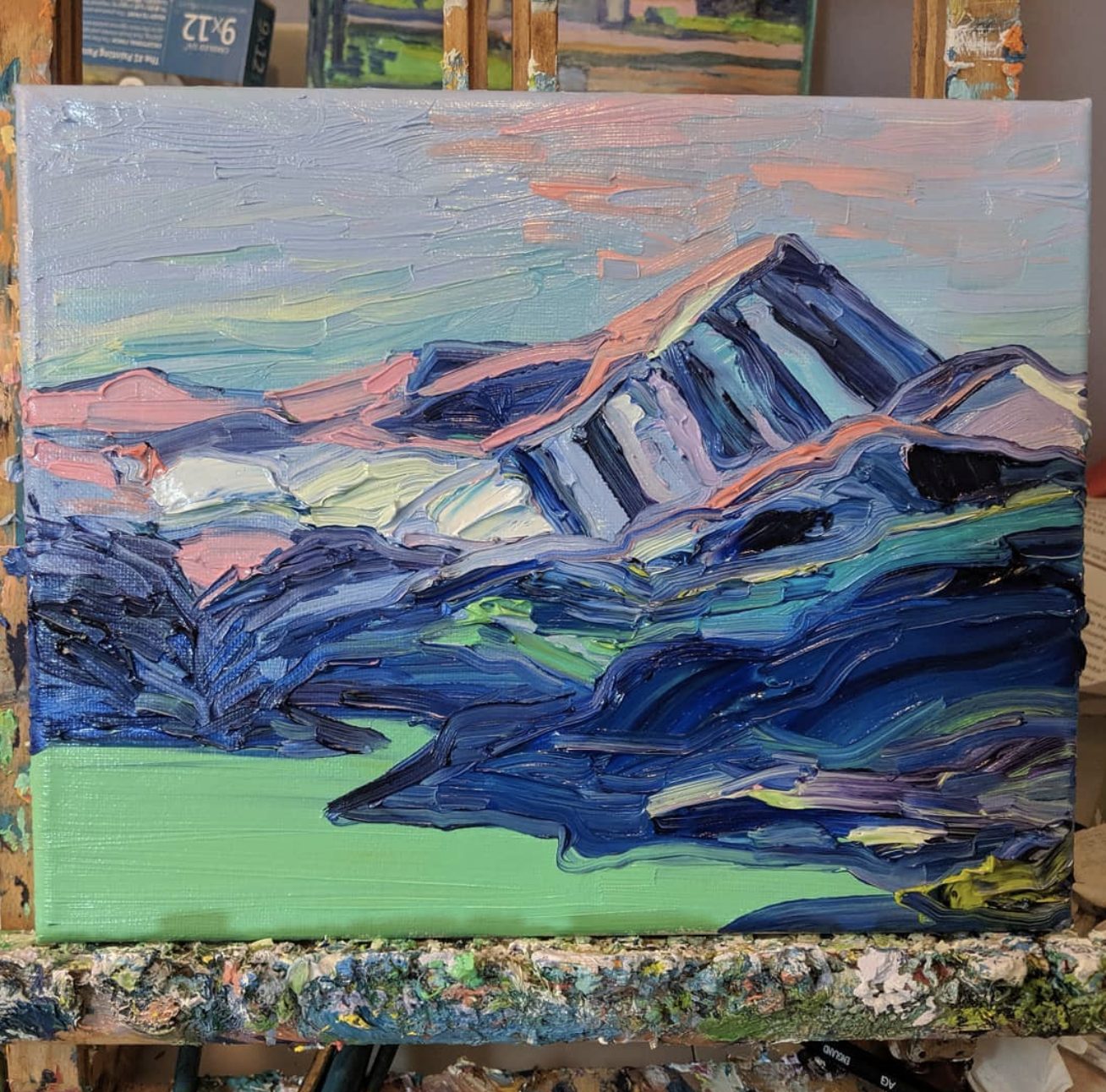
I don’t know if I will ever stop painting Mt. Elbert.
Related blogs:
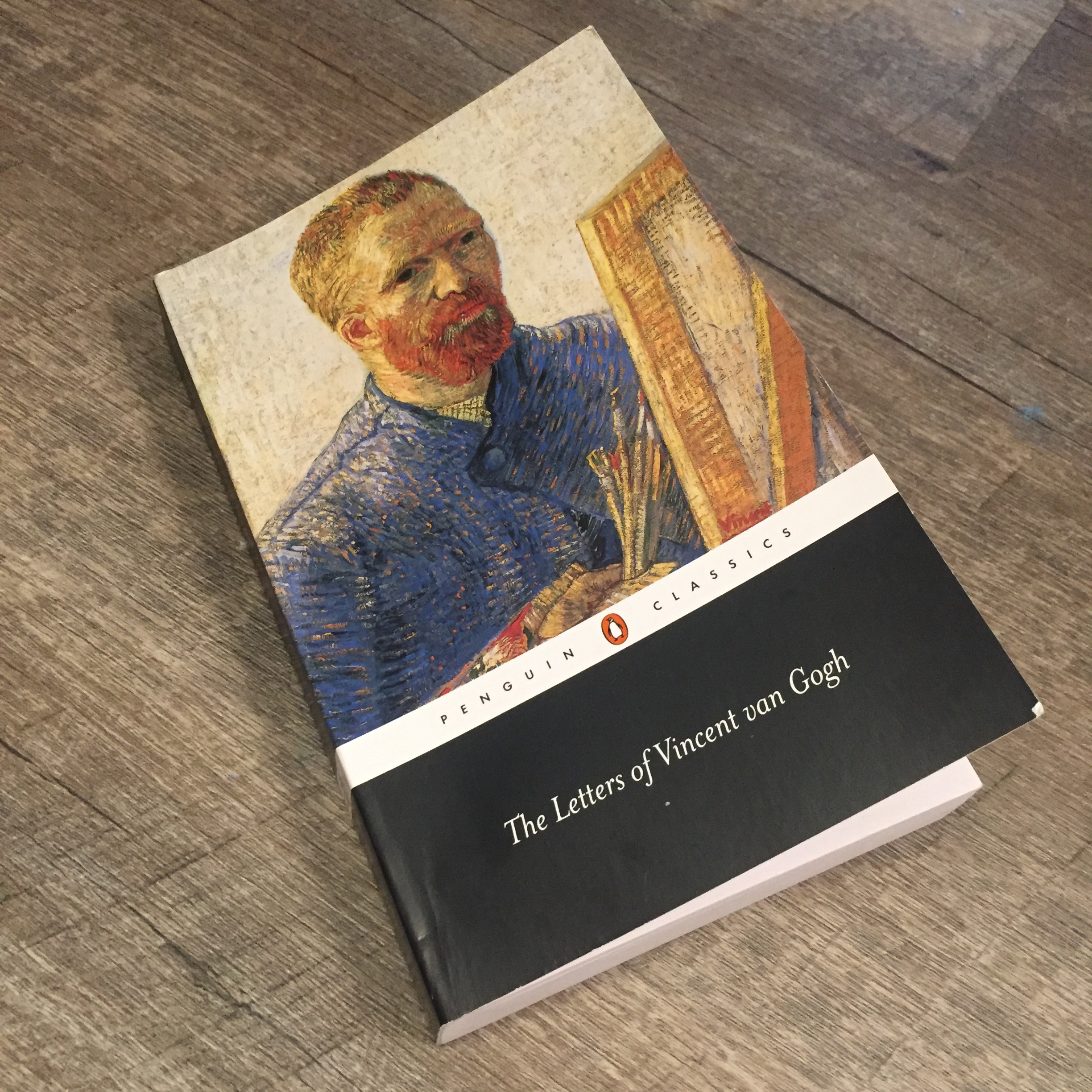
Art Reads: The Letters of Vincent van Gogh
On a long enough timescale, all art has to stand alone. Eventually, there are no explanatory placards, no audio guide, no artist’s statement. There’s just a painting on the wall and nobody knows where it came from, who made it, or what it means. There are pictoglyphs in Utah and nobody knows who made them - they’re 3000 years old.
So why read the letters of an artist if the works are iconic enough to stand alone? We already know Vincent van Gogh is great. Do his paintings need words to back them up?
Why dive deeper into eternity?
In the case of Vincent van Gogh, the letters tell us that he was not just the best painter, but one of the best people to ever be on the planet.
Most people know about Vincent’s mysterious end, but few could summon thoughts about his more optimistic early years. In his younger years he seems to be full of hope, so much that he is ready to give life advice to his younger brother Theo. In his letters he talks about polishing his boots and encourages his younger brother to eat well, especially a lot of bread:


He polishes his boots, he eats bread, he keeps up with his brother and anticipates future letters. He writes to send letters, and writes to get letters back.
The letters arc like a novel, where Vincent starts out relatively orderly, optimistic, and powerful (eat bread!) and he ends up in a place where he has to ruthlessly defend his choices against his entire family, like in this passage where he falls in love with a single mother, Sien, and brings her into his home.
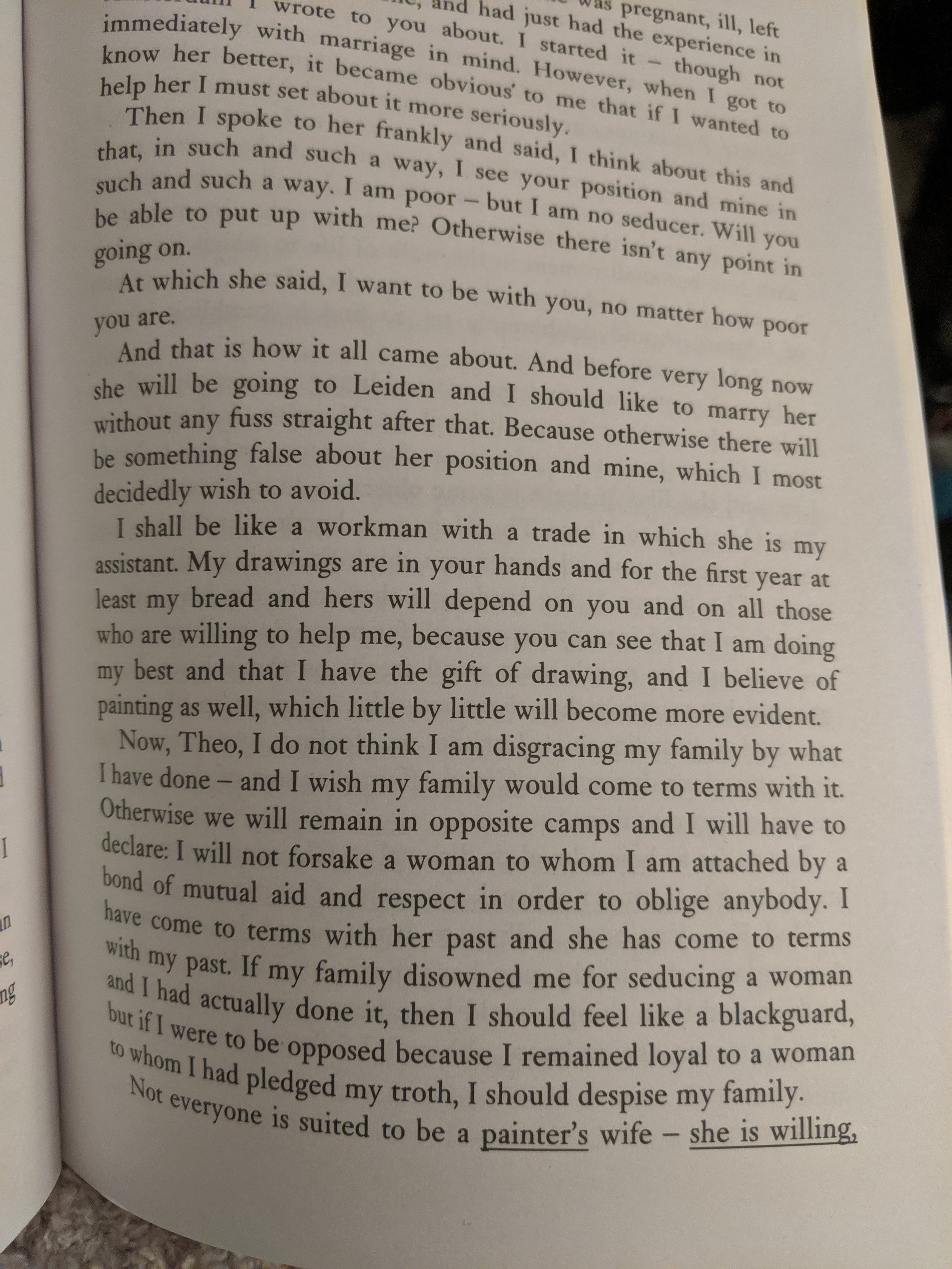

At the end of the passage above, he is truly like the ideal man in the Spice Girls song “Wannabe,” where Sporty Spice croons: “If you want my future, forget my past.”
We’re almost in a world that won’t judge our Vincents or our Siens. I’m not sure.
Vincent’s world didn’t leave him unjudged. In fact, it barely left him alone. It barely let him do anything, and it’s a miracle he made any work at all.
Vincent dedicates a heartbreaking amount of time to defending himself against his father in letters to Theo. He writes like a man attacked, writing to his only friend. He doesn’t depict himself as a saint, either, he admits he knows he is being stubborn upon several occasions. It’s funny that he writes only to Theo - maybe Theo is the only person in the family who was worth talking to, or, Vincent’s letters to his father were torn up or lost. It’s hard to imagine Vincent writing even MORE than this, but I wouldn’t put it past him.
Vincent seems stubborn at best in his letters-of-self-defense, and not too accusatory of those who antagonize him. And what if he’s right about how terrible his family is? What if his father and mother are stuck in their ways, and the rest of the world is moving on. The rest of the world isn’t aghast at loving a single mom.
When Vincent’s father finally dies, the concerns in the letters transform - Vincent is set free and can finally talk about, well, painting, in his letters instead of defending himself against his father.
The edition has only one letter from Theo, the Dear Brother, for the first 150 pages. The tone of the letter comes off as “Stop doing what you are doing and calm down, and say sorry to father.” At this point, Theo and Vincent are so upset that they are itemizing each of their argumentative points with numbers (1), (2), ect:
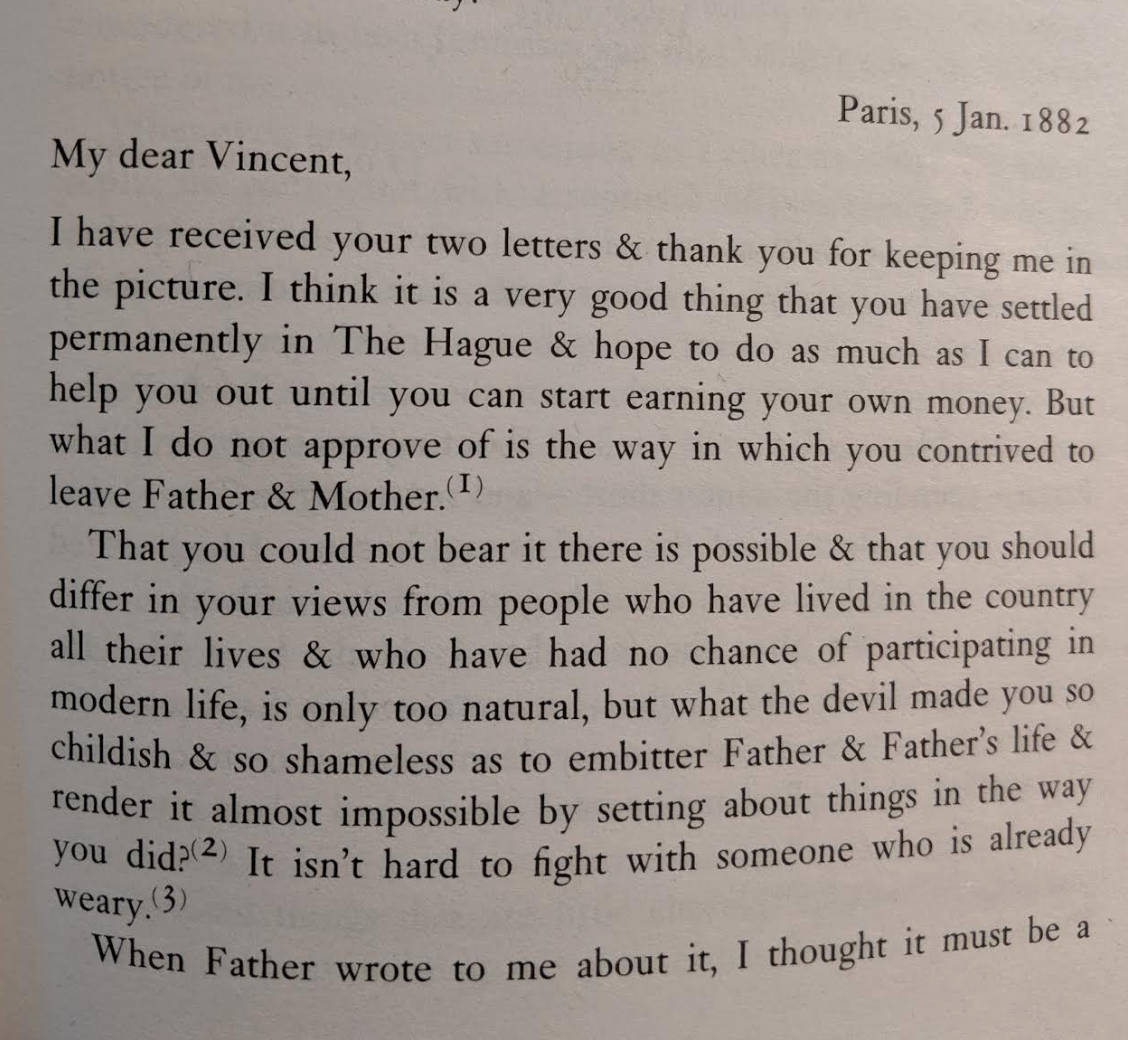

In response to this missive from Theo, Vincent writes back something like 5000 words, each itemizatized response to points (8), (9) ect as long as Theo’s entire letter. It would have been like writing a tweet and getting a novel in response.
Since the entire book is so one-sided - we get dozens of letters from Vincent and only one from Theo, Vincent is easy to sympathize with. You fall under his spell, and it’s a good spell. It’s not like reading the deranged journals of the protagonist in Pale Fire, or reading the diatribes of other mentally-understocked unreliable narrators. Yet, I wondered, what did Vincent do or say that made his colleague Mauve say to him “You are a vicious person?” Whatever it was, Vincent sort of leaves it out of the letters.
It’s more like reading a surprisingly reasonable defense against social crimes that are not nearly as bad as those of Paul Gauguin. Unlike Gauguin, cough, van Gogh never took a 14 year old as a wife - in fact all he wanted was to help a single mom. Van Gogh is like the Samwell Tarly of his time - he's already outcast from his family but falls in love with a single mom and loves her, gives her and her baby a home, and his father berates him for this and for many other shortcomings that Vincent seems to have. Vincent even refers to himself as a ‘nobody’.

If the world had more Sams and Vincents rather than fathers of abandon, imagine where we could be. In fact it’s probably the Sams and Vincents that keep it all together for us, the real fathers who know how terrible life can be for both men and women, and for all people, and who step in where nobody else will. It breaks my heart.
Reading these letters, you start to overly agree with Vincent - the world is actually very dumb, everyone sucks, Vincent is right about everything! But nobody can be that perfect, right? Citing suspicion of perfection, you can find the devil’s advocate on your shoulder wondering over these letters: What if he’s lying?
What if Vincent is casting himself as some sort of saint, where he’s really not?
But then - why would he lie? At best he could embellish, but he’s not interested in looking cool or being a savior. He’s not a land owner or a merchant, he self-identifies as a nobody. The letters are going only to Vincent’s little brother Theo, who isn’t impressed with Vincent at all. If Vincent wanted to preserve and glamorize himself in the eyes of his overbearing family, he would have never written about Sien at all. Instead, he nails himself to the cross.
In my whole life as an artist, I don’t think I’ve ever seen anyone represented more unfairly in popular culture or more misunderstood by non-artists. Van Gogh’s ear and suicide stand out as some of the most contested facts of art history. Was the ear a chapter of deranged self-harm, or was it Gauguin who chopped off the ear? Was Vincent’s death a suicide or was it a misaligned murder?
I’m not sure if these murder-mystery questions matter as much as we think they do. No matter what hurt van Gogh, we didn’t want it to happen. We didn’t want Vincent to get his ear cut off or for him to cut it off himself. We didn’t want him to kill himself or be murdered. We wanted Vincent to be around for a bit longer.
At one point, Vincent is beaming about how his doctor mistook him for an iron worker, and in other letters he carefully plots out how many years he had left. (Some artists live to 60 or 70!) Yes, carrying an easel all across the landscape will make you pretty buff.
Stress was plowing down on him from all directions - family, finance, occupation. He spent so much time defending his thoughts and choices. Sitting in my bed and staring at the letters, my poodle snoring and a TV show playing in the other room, I thought to myself: “What was the point of all of this fighting with his father ... what was the point of these thousands of words scrawled out across hundreds of pages. What if all of this time could have been spent on painting?”
Ultimately Vincent’s defense of himself and his ideas in his letters did matter for his painting - anyone else would have given up, not just on art, but on everything. His world was just crowded to the brink with antagonism. Vincent’s art didn’t happen because of his painful life, he made art despite it, and it’s simply amazing that it happened at all.
So, with all of his tenacity, why did van Gogh’s life end at such a young age?
I didn’t know what to make of the ending of this novel-of-letters. If we believe Van Gogh shot himself and was not assaulted, it’s as if Theo’s moment of weakness along with Vincent’s worsening epilepsy is enough to send Vincent over the edge. The moment that Theo shows weakness is the moment that Vincent gives in.
But I barely buy the suicide belief because Van Gogh was so interested in staying alive throughout all of his letters. The letters don’t even strike me as unhinged in a slight way, they’re simply very expressive. It wasn’t insane that Vincent could respond to Theo with novel-length itemized lists of arguments, it was just exhaustively comprehensive. Vincent spent his entire life defending his choices, accepting his choices, and believing in his work. Near the end, he even moved to a new asylum in the hope of getting better treatment.

Nobody could have cured Vincent’s epilepsy, but his hope was there. Why work so hard to get better, why be so intensely in love with the world, why defend yourself, and then just throw it all away? I think Vincent didn’t do himself in. It had to be something else.
The Letters are ultimately a mystery novel where there is no answer.
We’re lucky if private writing like Vincent’s letters surface every quarter century. It’s rare to find and even rarer for it to be interesting. Much of Vincent’s letters are brilliantly alive with feelings, and some of it is… Vincent is in the hospital, or he is dreaming about paint going on sale.
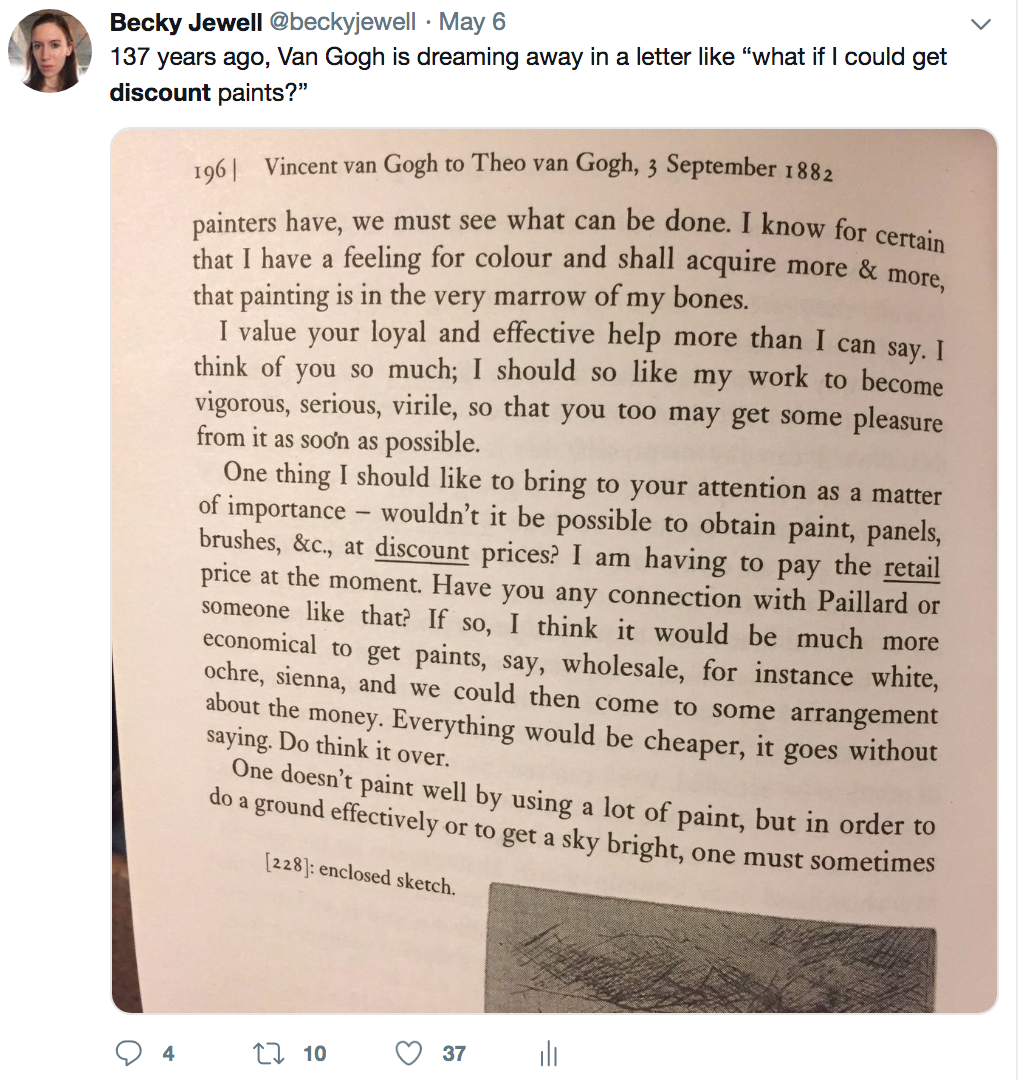
So, yes, the letters contain some mundane pieces - it’s not not forsaken romances and family feuds all the way down. Vincent is troubled by the same issues we might run into today - he voices his mistrust of clever lawyers, he gets expensive dental bills.
It’s Vincent’s unrepenting honest love for the world that is a treasure. Seeing Theo’s letter, honesty isn’t present in private letters all the time - letters can be as carefully buttoned up, as repentful, as punishing as life on stage.
Imagine the scholars of the future finding a private Youtube account on a server somewhere - all of it could be a heartbreakingly accurate revelation of our time, or it could be nine-minute reviews of Monster Energy Drinks.
Which could be, yes, it’s own revelation - but not as touching as Vincent scrawling off missives to his brother like “I’m dating a single mom, I don’t care what dad says!”
Where else can we find this honesty? Marcus Aurelius’s Meditations are best thought of as private journals or notes-to-self - Aurelius never meant for the writings to reach the world. Like Meditations, the letters of Vincent van Gogh were meant for the eyes of only one person, yet here we are reading them, translating them, publishing and republishing them, lamenting an untranscended 150 years of dental bills and expensive paint.
Aurelius’s private writings wouldn’t be so odd if other writers in his time weren’t marketing their work as savagely as Don Draper. The Roman poet Ovid was writing highly-sought, wildly popular advice to women on how to look beautiful and sexy in the Ars Amatoria one-hundred years before Aurelius was penning his notes-to-self on how evil never dies.
Even when van Gogh was writing his extremely private, thoughtful letters, Dickens was cranking away at words that would be cast out to thousands and later, millions of people. In our strange little time, we write furiously on Facebook walls and on Twitter, and each scribble has it’s own performative bent - we’re trying to look cool, or be funny, or do… something? Who really knows what we are doing when we share a thought on the internet, but it’s all very on-stage.
Reality exists, privately, and we only get to see it in letters like this. Perhaps the key to truth in art and writing is that we should all create as if nobody will hear us but the person we love most. It might be the only way to be eternal aside from painting.
Related blogs:
Vincent van Gogh at Houston MFAH

Fan Art Friday: Utena and Cowboy Bebop
Grant me the power to bring the world revolution!
A young girl’s parents die, and at their funeral, she is consoled by a prince. She’s so touched by the prince’s kindness and regal bearing that she vows one day to become a prince herself.
Normal girls would fall in love with the prince, right? But why love a prince when you can … be one?

Utena could come off as an ultra-weird anime, but like any anime with something to say, it frames itself too well to be confusing. It luxuriates in it’s own mythology. I don’t know, you just have to watch it.
The orphaned Utena grows up, goes to school, and insists on wearing a boy’s uniform to class. There are no rules against it! 45 seconds into the first episode, beats the boys at basketballs and makes the girls swoon. She’s well on her way to accomplishing her goal of being a prince. In fact, by episode 1, she already is a prince.
All of this is well and good but there are people in the world who can’t deal with Utena being a prince, and the rest of the series sees Utena fighting through unimaginable forces as well as high school gossipers. When she decides to save the Rose Bride and be the prince of the bride, almost everyone antagonizes her.

The Rose Bride belongs to the strongest duelist, who, in this case, is Utena. Nobody expects the winner of the bride to be a woman, but again, there are no rules against it.
I wanted to draw the moment in each Utena episode where Utena pulls the sword from the chest of Anthy, the Rose Bride. Why does the bride contain a sword in her chest? It represents both power and death, and pulling the sword out is only for the worthiest.
Stranger things have happened in the world of love and history, where Helen of Troy was the Face who Launched 1000 ships, Anthy’s body is capable of producing thousands of dueling swords. There is a sword inside of Anthy for as long as anyone wants to fight over her.

There are a lot of problems and painful moments confronted by Utena too, in the same way that Game of Thrones confronts skin-crawling themes like incest, abuse, death - Utena goes there. You know those quizzes online that are like “Which My Little Pony Character Are You?” and you’re pretty okay no matter what - if you get Twilight Sparkle or Fluttershy, it doesn’t matter, because both are pretty cool ponies.
You can’t do the '“Which Utena Character Are You” quiz without feeling extremely uncomfortable, in the same way as characters in Game of Thrones. Sure, Tyrion is the one cool guy, and Arya works well, but would we ever really want to be Jon Snow, Theon, Jaime? We all love Game of Thrones, but nobody wants to ‘be’ a character like Jaime Lannister in the same way they would be okay with being a character like Sam or Frodo. You’re Sam if you’re ever faithful, you’re Frodo if you’re okay with self-sacrifice, but who the fuck is okay with getting with their aunt? Who is okay with pushing a kid out a window? It’s somewhere nobody really wants to be. Utena feels that way, with characters who look cool on the outside and who are well acted and voiced, but most of them are absolute scum.
Utena isn’t the only good character in Utena, she’s just the only great one. You sort of only hope for and root for Utena and the Rose Bride, and everyone else kind of sucks and antagonizes or stands by.
Even if Utena Is The Best and Everyone Else Sucks, the question asked by the anime is still interesting. Why can’t girls be princes? Grant me the power to bring the world revolution. In some dream where I become a prince and I become a successful director like James Cameron, Utena will probably be my Battle Angel Alita. Even if it fails and nobody else likes it, I’d still do it.
Since we’re falling into a giant pipe dream, let’s talk about another anime and make some art about it.
Cowboy Bebop
Cowboy Bebop is an anime of creative freedom because it only has everything - hacker kids, sentient artist satellites, spaceships, a deadly love triangle. In between all of the serious stuff about crime and death and love, the directors take a mental siesta and produce an entire episode where everyone accidentally gets high on psychedelic mushrooms. Sounds a bit like life, actually.
In thinking about Cowboy Bebop, I wanted to make a recreation of this cell:


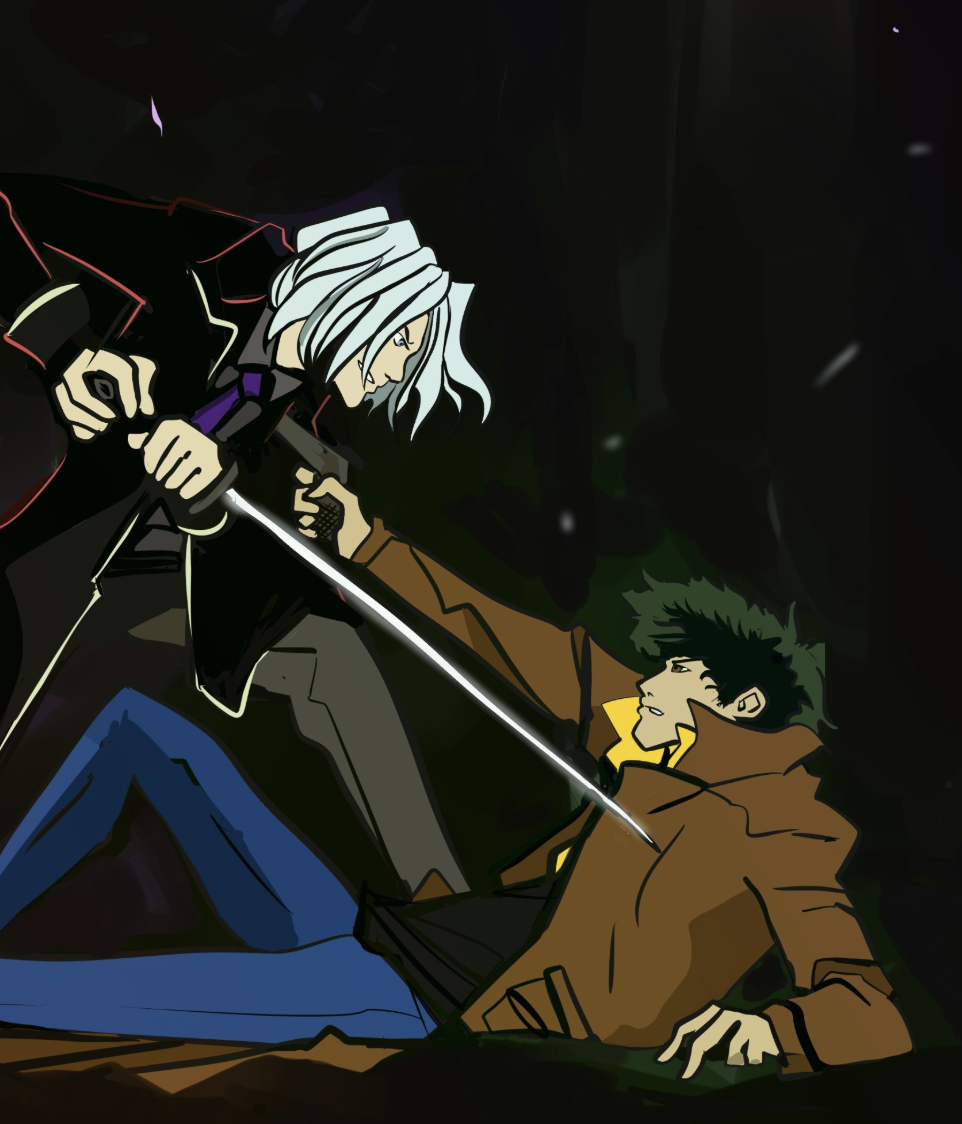
The anime works its own kind of special magic when you try to replicate these cells - you realize Spike’s feet are clubby boots and that his legs are way too long to be right in any anatomy book. But none of this matters, Cowboy Bebop doesn’t just have style, it has swagger. It has belief in itself.
It’s the right balance of funny and serious. I believe in Spike - Spike is driven to figure out a few things in life, but mostly he is driven by his next paycheck, and, well, food.


Akihabara - Dragon Quest Lawson Store
In Akihabara, I happened across this Lawson convenience store dedicated entirely to Dragon Quest.
This is it, this is the whole blog.


Medium Moment: PaperLike for the iPad Pro
Imagine giving a kid a basketball for Christmas on a lark because you found the basketball in a discount bin, and then the kid turns into LeBron James.
That’s sort of what happened when Apple created the iPad Pro - it wasn’t exactly intended for artists, but when artists use the iPad Pro, it transforms them into the LeBron James of art.
Drawing on the iPad Pro is like slam-dunking Starry Night on your greatest enemies.

But, really? Art on an iPad? Serious digital art is produced on computers, not on tablets.
Despite starry-night-slam-dunking, there is an Achilles heel in the iPad Pro - a tiny weakness which almost renders it completely useless.
For all of of its cosmic computing power and portability, the iPad lacked a critical art factor - drag.
Wait, not that kind of drag! But you know I would never miss an opportunity for a Miss Vanjie gif!
Writing on an iPad Pro feels like writing with a ballpoint pen on glass.
In theoretical physics, everything happens in a vacuum. In reality, you always have to account for drag.
Drawing on the ipad Pro on its own is like doing theoretical physics, like throwing a ball through outer space. Drawing on paper is like a ball falling through air - there is resistance and drag, and it all comes down to earth.
The iPad Pro theoretical physics vacuum has suprised and frustrated artists who are used to drawing with a pencil and feeling more of a fight, more resistance from the paper. We just aren’t ready to produce on glass.
So, what to do about the drag problem? Here we have this amazing device that comes at us with bangin’ software like Procreate and Clip Studio Paint, and yet moving the pencil across the device’s surface is like bowling a penguin down a slip and slide.
Paperlike, an attachment that sticks to the iPad’s surface, solves the slip-and-slide problem of the iPad Pro. I cranked out a couple drawings and didn’t even notice or think about the surface.
While applying the Paperlike, worried “I’ve been drawing on this iPad with no cover for three years will PaperLike undo all of that brutalized learning?”
No, it actually helped a lot. In fact I like Paperlike on the iPad Pro better than all of the tablets that I own, all of which are gathering dust underneath a dresser in my bedroom, along with a bunch of Magic the Gathering cards and clothes that don’t fit me.

Paperlike in indoor lighting. It’s a drawing of http://www.bersama.com/ !
The how-to-apply video from Jan on the Paperlike website was very helpful. iPads are running anywhere from $800 - $1200, people aren’t going to want to put any attachment on such a machine without clear directions. Artists are cost-sensitive customers. Paying even $30 can be a lot, so the video helps. Watching the video, you realize that the folks at Paperlike have thought of everything - they really have their customer’s best interests at heart.
It was also nice to get two Paperlikes in my order. I was a huge dummy and, while I near-perfectly applied my first Paperlike, I put my coverless iPad in my DUSTY BACKPACK and on the DUSTY WASHINGTON DC METRO it ended up not being a good idea. I should have added the cover after the Paperlike, but alas. I’d definitely recommend a cover.

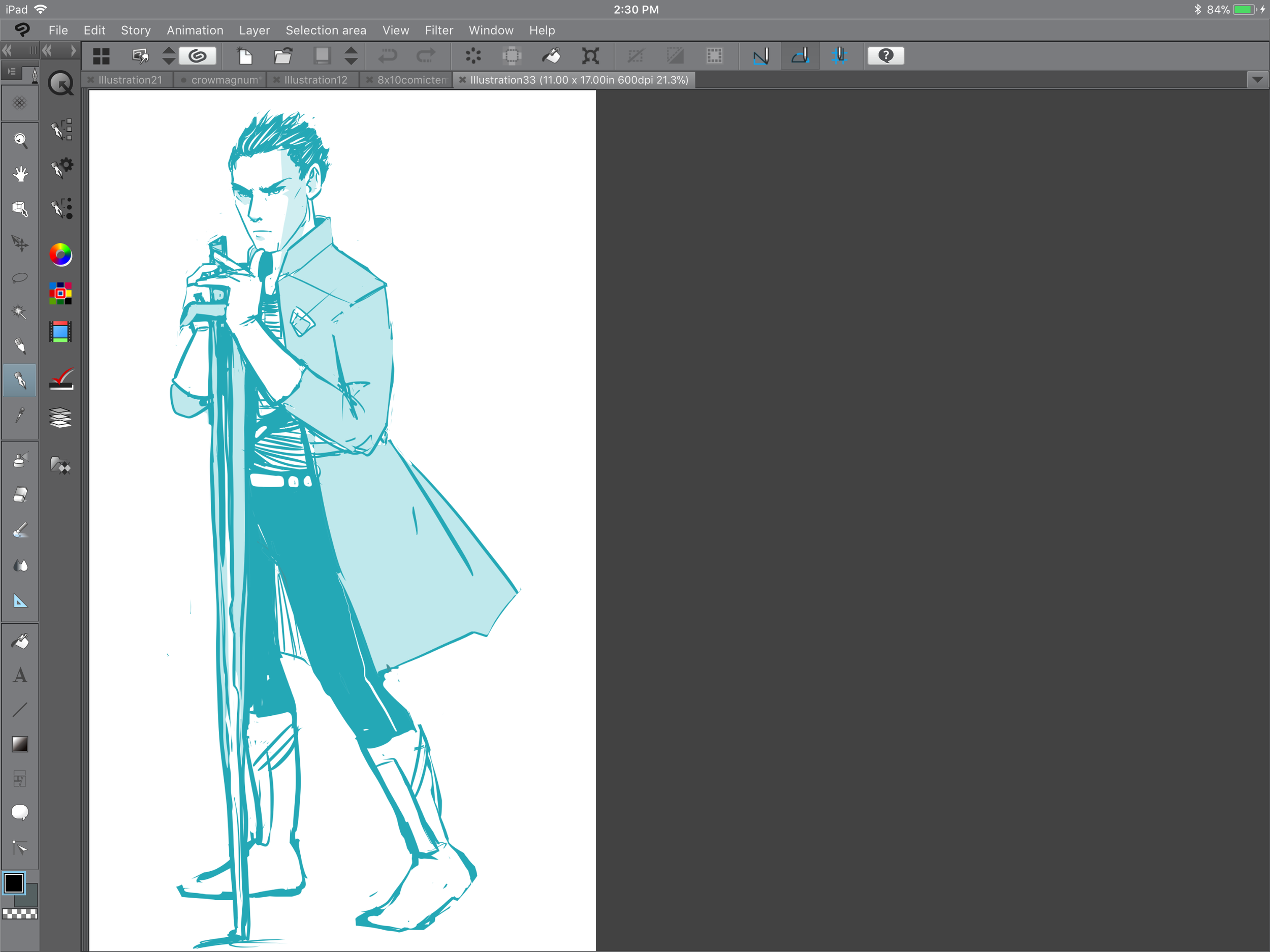
I drew some dreamy fantasy art to practice with Paperlike, it was an interesting feeling. My art was better than usual because I went through less frustration to make it. The final product was realized faster.
An added bonus of the Paperlike is that it makes it easier to look at the iPad Pro for a long time. After staring at non-PaperLiked glass-covered comic pages and gleaming illustrations for hours on end, I’d find my astigamtism-addled eyes straining along in my skull.
Suffering from eyestrain is like never caring about your pinky toe until your pinky toe gets a cut on it and suddenly you’re hyper aware of the pinky toe’s integral role in life. Paperlike softens that nasty glare and it’s soooo nice.
At night or in low light, you really can’t see or perceive the Paperlike at all. Here is a shot of the Paperliked iPad Pro at night:
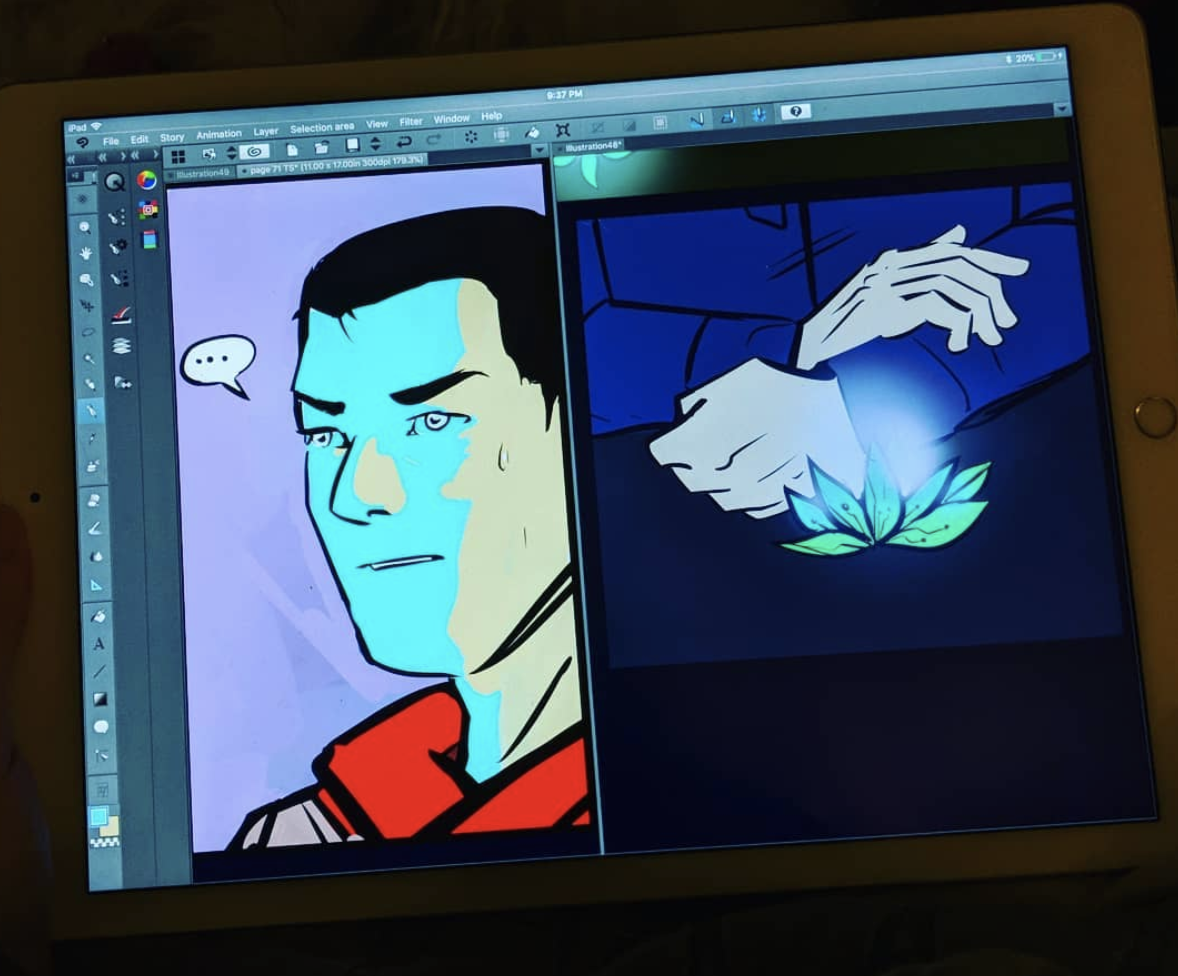
A couple panels from Tilted Sun under the Paperlike on the iPad Pro
So, is this a good thing to buy? Could Apple release a matte iPad and make Paperlike moot?
Apple could release a matte, drag-happy iPad, but I don’t think that Apple cares that about artists or art production to do so.
Plus, phones and ipads are all about shinyness these days - shinyness and brightness.
When Apple created the iPad Pro and the Apple Pencil, they didn’t know how much artists would love it or how powerful it would be for artistic production. Apple only seemed to retroactively understand the extreme love that artists had for the device. They probably won’t build out from this understanding. Visual artists are, what, 0.5% of their customers?
The ideal user of the iPad is just about everyone, and as much as I keep saying that Art is For Everyone, artists are still a tiny segment of everyone. Either way, I hope Paperlike stays around for a while and that they continue to help artists with this extremely specific problem. Get thee a Paperlike!
Paperlike website: https://paperlike.com/
Related blogs:

Plein Air Painting in Washington DC
Plein air painting is about being fine with pure chaos.
Read More
Cherry blossoms in Nihonbashi
Tokyo Mix: Gundam Cafe, Godzilla Store, and Maruzen Nihonbashi
The best thing about any city are the things that don’t fit neatly into a listicle or a 5 minute youtube video. The best things a city has to offer are secrets, places that aren’t perfect, and off-the-grid moments that aren’t going to get any likes on Instagram.
Gundam Cafe in Akihabara
The Gundam Cafe isn’t great for food. It’s not going to win any awards for service or cuisine. But, it is a fun place to rest your feet after going up and down multiple reps of six-story buildings. There’s no line, no weird reservations and no wait.

Sadly the noodles I ordered were lukewarm, I wasn’t sure if they were supposed to be served cold, or hot, or if I was just an idiot, but I didn’t care that much because I was able to watch Gundam theme song intros on repeat with several of my fellow easily-bedazzled Americans.
As a 14 year-old I watched Gundam Wing secretly on my grandparents’ tv in Houston via Adult Swim. Our channels in Colorado didn’t even have Cartoon Network (which is also how I got hooked on Pokemon, but, different blog for that). Anyways, at the Gundam Cafe, I didn’t care if the noodles were cold, in fact, the cold noodles made sense. They felt good in a desperate way, like eating McDonalds in Kansas after driving a thousand miles. Even though the drive across Kansas sucks, you’re still a million years ahead of the pioneer who died on the plains trying to get to San Francisco. You’re still taking Xanax instead of getting thrown into an asylum.


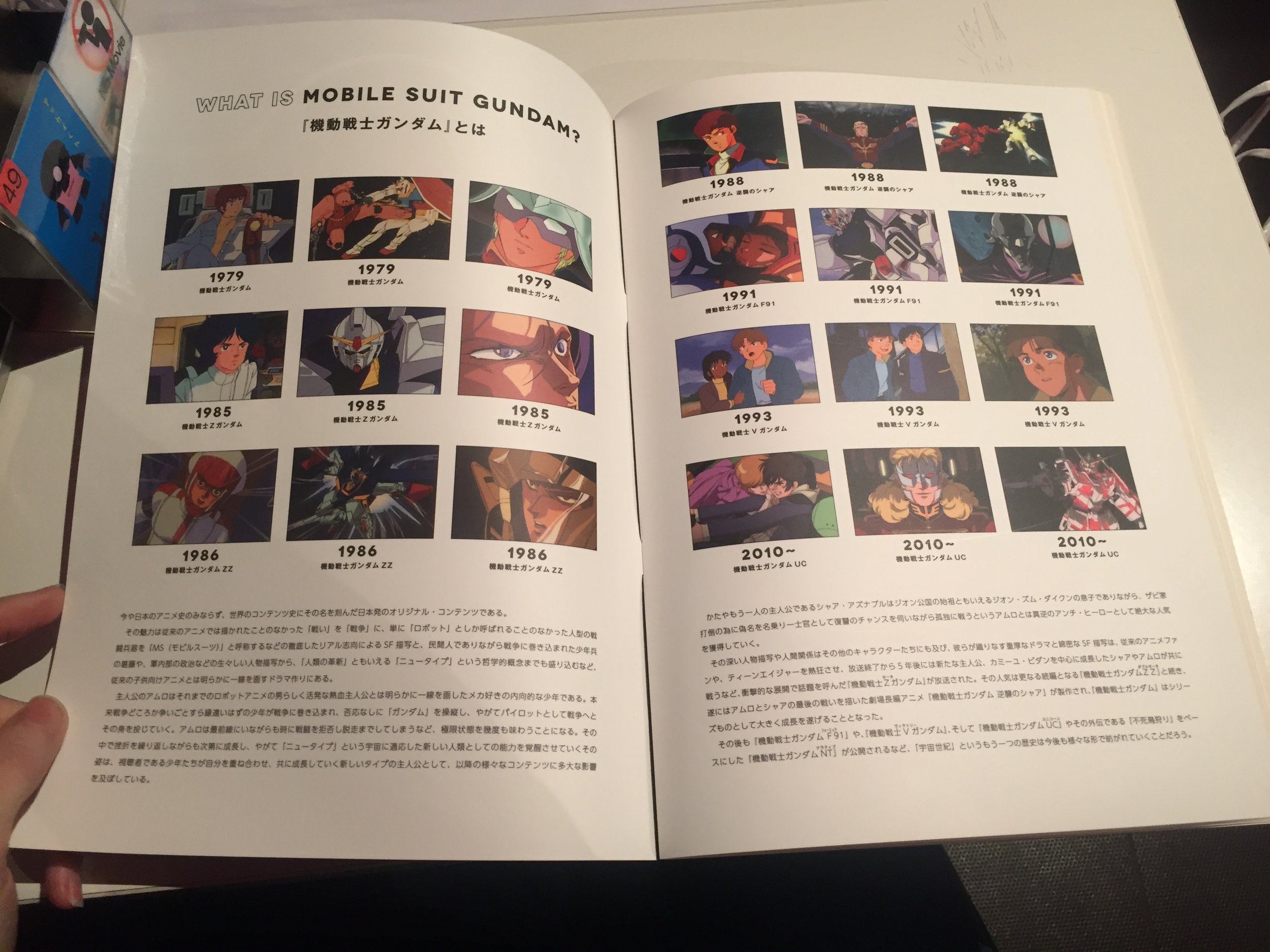
The menu design and coasters are the reason to go to the Gundam Cafe. Art and your Gundam Memories are the reason to go to the Gundam Cafe. Just order whatever, swoon over the menu’s design, not the food, watch the Gundam theme songs on the big screen and call it good.

Ideally Gundam would be better served by a museum somewhere, but there can’t be a museum for every anime.
Or can there? Prove me wrong … ;)
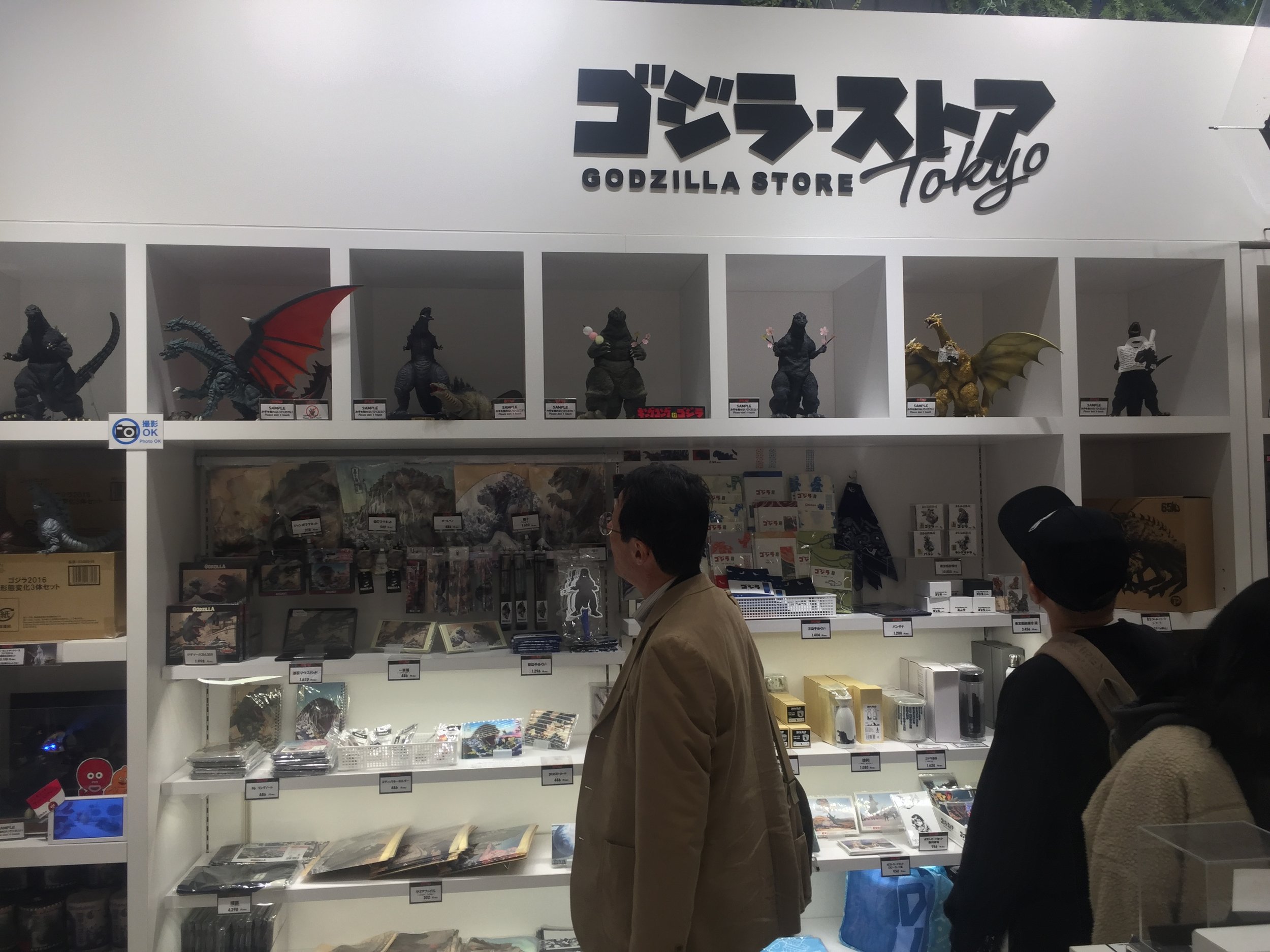
Godzilla Store Tokyo in Shinjuku
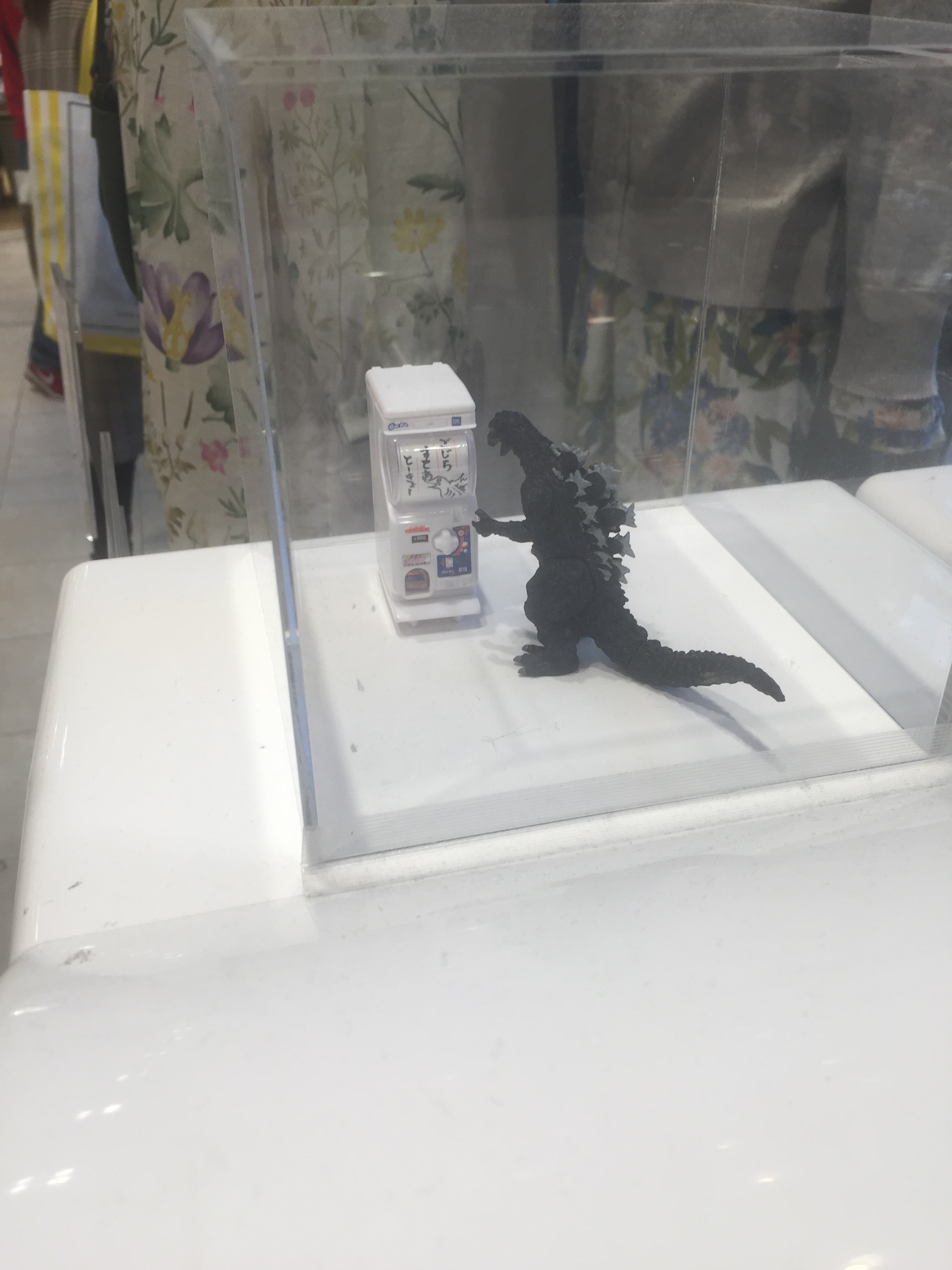
I thought I had seen all of the Cherry Blossom fever, until I was floored by this cherry blossomed-themed Godzilla diorama at the Godzilla store in Shinjuku.


One of the coolest things about Tokyo is the hyper-specific stores. There isn’t a Godzilla shelf in a Target, there is an entire Godzilla store for all of your Godzilla needs, hopes, and dreams.
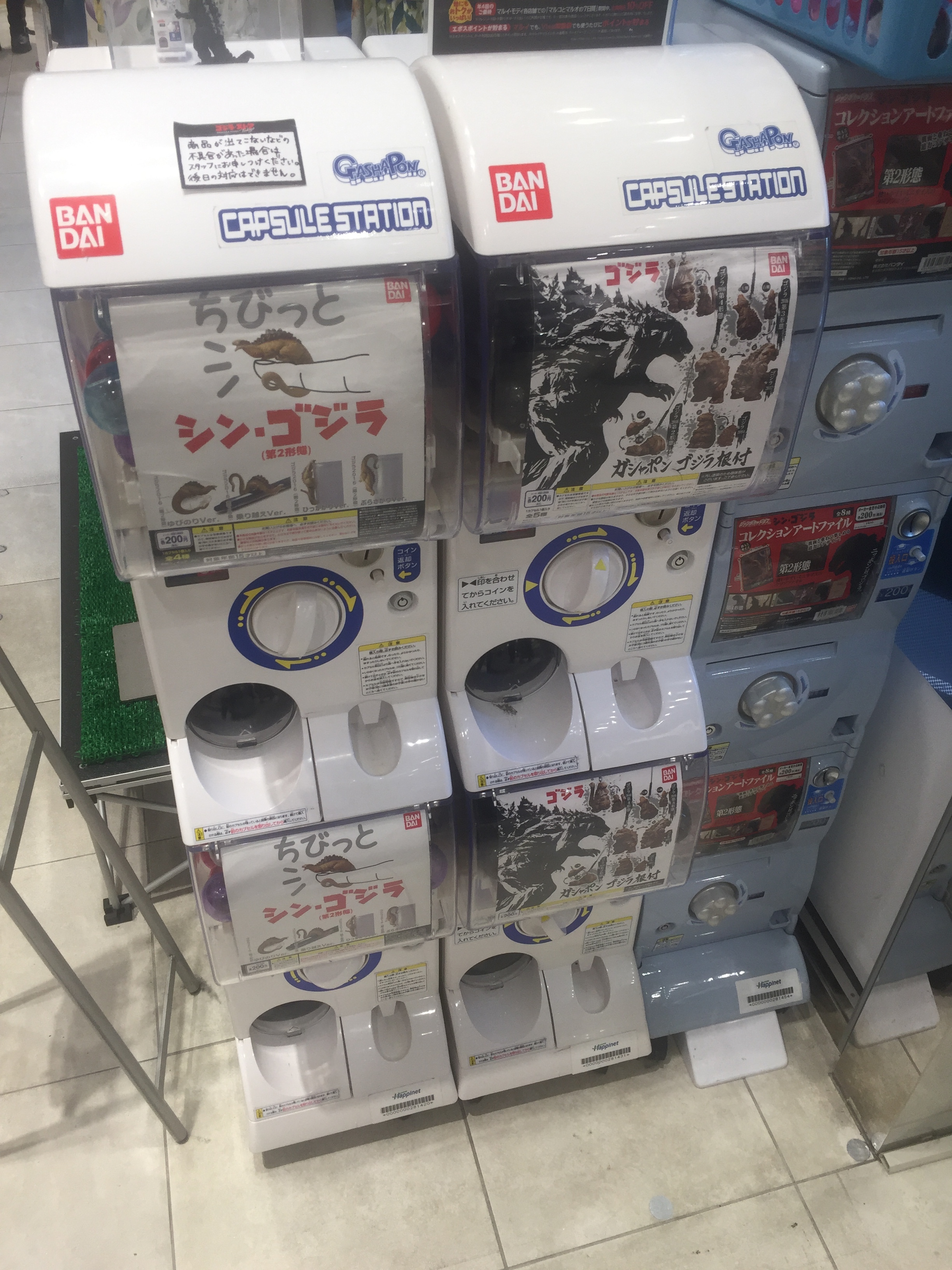
The diorama above the gachapon machine is pretty cute! Even Godzilla loves gachapon!
Maruzen Nihonbashi
Maruzen, a bookstore chain, is worth checking out in any location. It was fun to visit Maruzen in Nihonbashi and catch up with what everyone was reading.

I loved how books for adults had illustrated covers. The most serious subjects had cartoon covers.
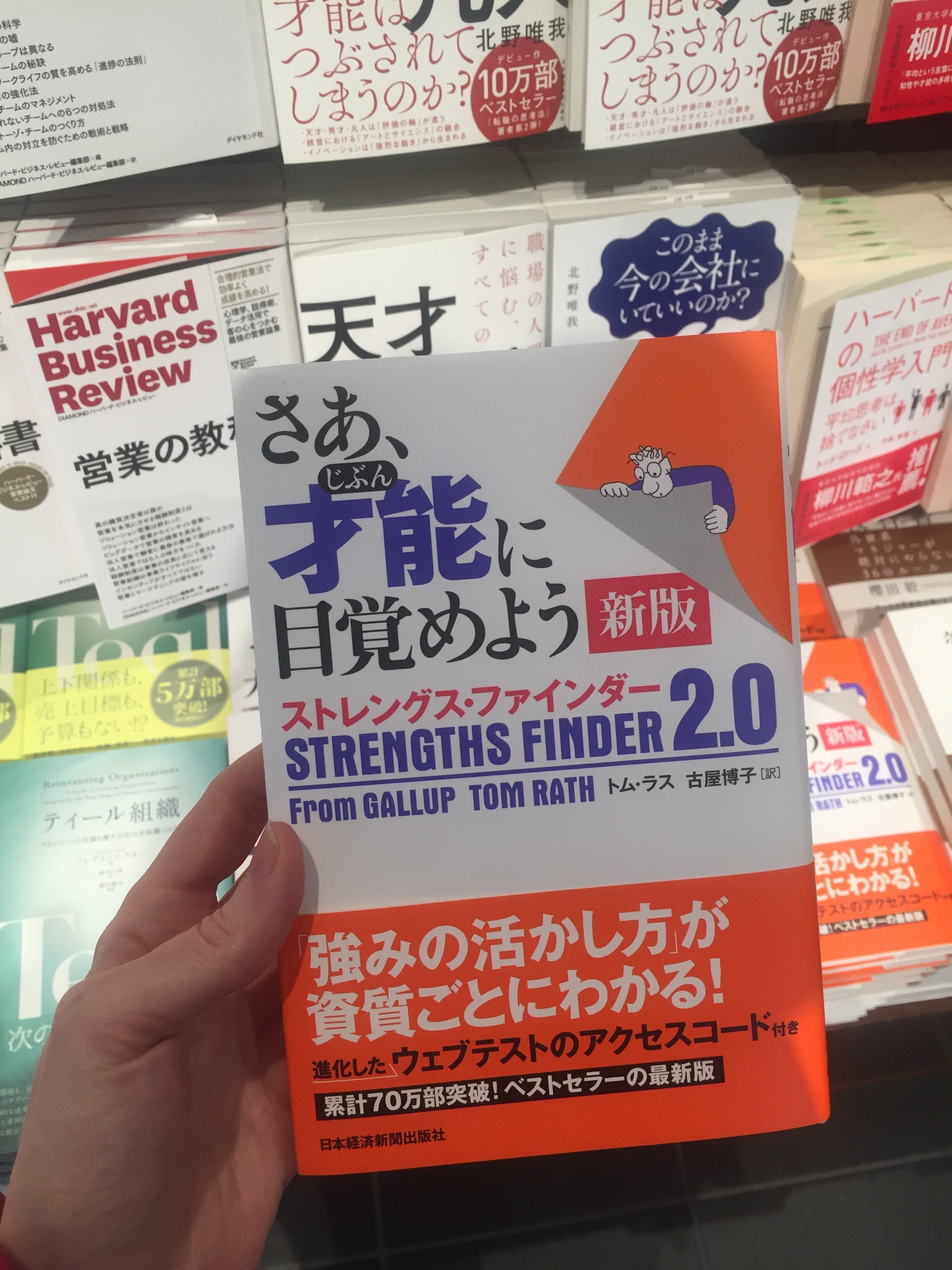
In addition to Harvard Business Review and Radical Candor, Strengths Finder is in Japan!

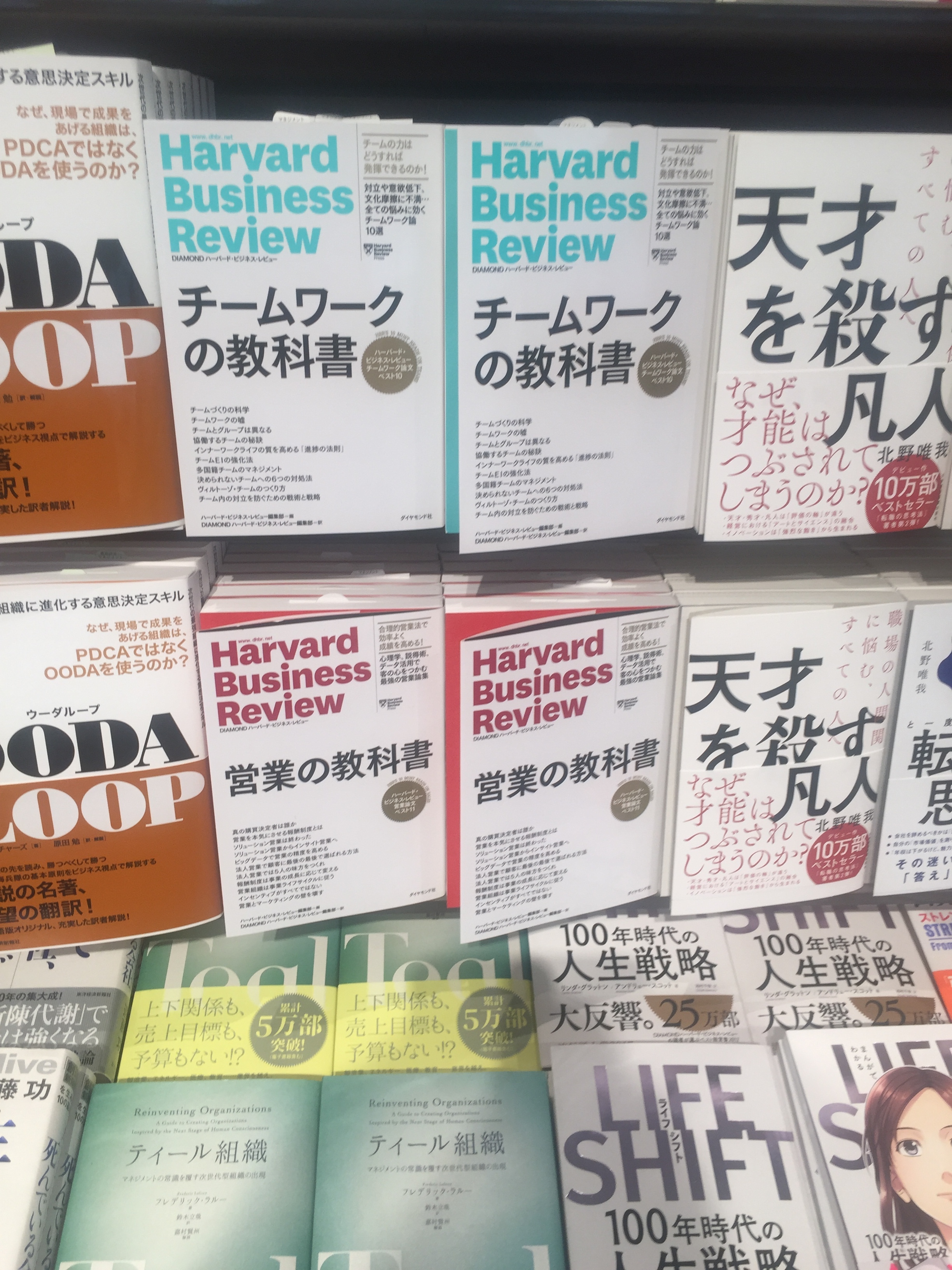
I saw the ‘Life Shift’ book several times on bookshelves in Tokyo and thought several times about picking it up. I thought it was the Aleta St. James book, but, I couldn’t figure it out for sure.

The most interesting shelf of books was this one, dedicated entirely to manners and grooming for men. There were similar areas for women, but I’d never seen such a focus on this in any Western bookstore. Where other cultures might be trying to say ‘looks don’t matter!’ right now, urban Tokyo is unafraid with admitting that looks do indeed matter - the hallmark book on this being “Class Act: Appearance Matters for your Success”
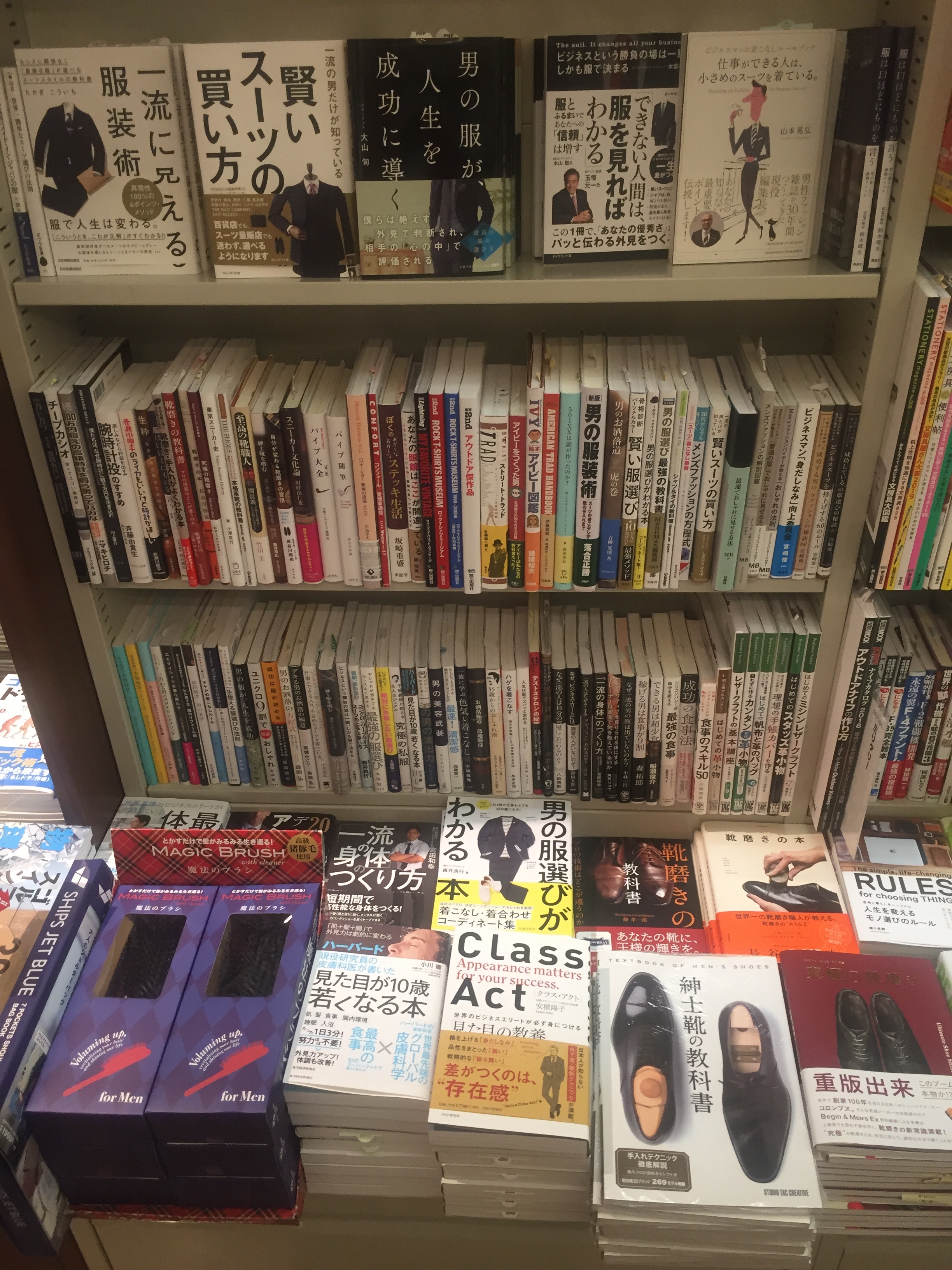
The lint brushes and shoe brushes almost did me in, but they’re not as surprising as the entire 200 page manual dedicated to shoe care.
Women’s magazine’s were pretty par for the course, they looked to me a lot like women’s magazines in the States or in most of Western Culture.


The main drag in Harajuku. You can get color contacts here, sports gear, cotton candy, crepes, and the dopest shirts you’ve ever seen.
Harajuku Shirts and Shops
A few years ago I was visiting an art fair in Aspen and a big dude on a trick bike trundled across a busy intersection. Like the charmed hippo in Heart of Darkness, it was a miracle he wasn’t struck down immediately by several Lambourghinis, a Hummer, and a series of Range Rovers. He sort of looked like he was on the drug bender of his life, but, maybe he just did this every day. With some people, it is hard to tell if they are lucky or skilled, or an uneven mix of both.
As I walked through Harajuku in Tokyo, I pretty much felt like Aspen Drug Bender Bike guy. Walking through Harajuku as an American, you can feel your brain oscillating between thoughts of “Am I lucky or am I skilled?” The scores of fellow shoppers in Harajuku sort of avoid you, they don’t immediately plow into you, but you also have to work for it.
My inner self glaring up at the diffused sun, for reassurance, I wandered into a Harajuku store with several stores in it, an unfolding Russian Doll minimart where each brand had a dedicated floorspace and cashier. Unseparated by walls, the brands ran together, yet they didn’t. If the streets of this place felt crowded and too small, the shops watered down some of the chaos.
Here, the real mind-oscillation begun. Harajuku has the funniest, most zen shirts I have ever seen in my life.

Step by step, have a time

Keep ideals, spite of all. At first it doesn’t make sense, then it is zen
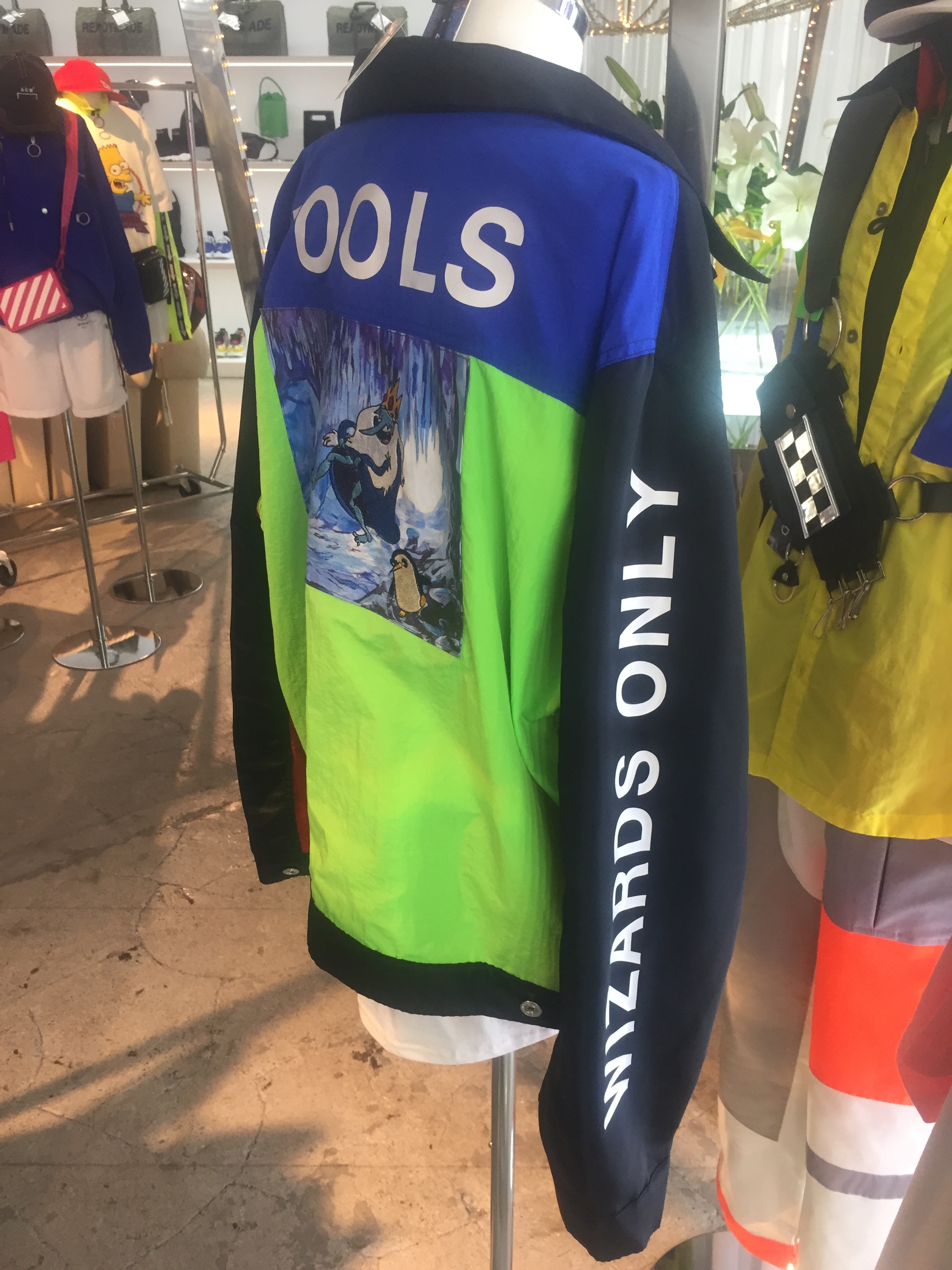

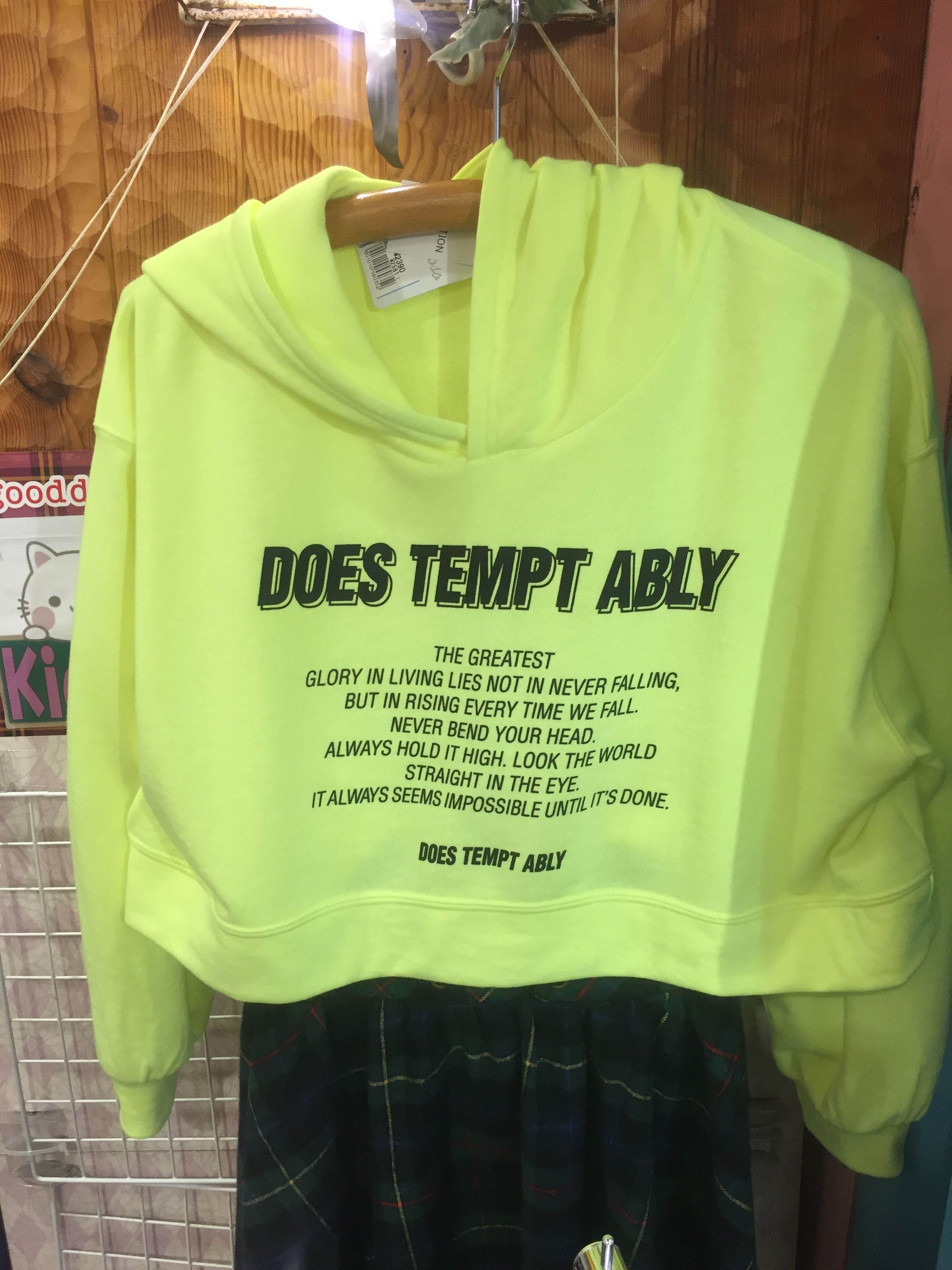
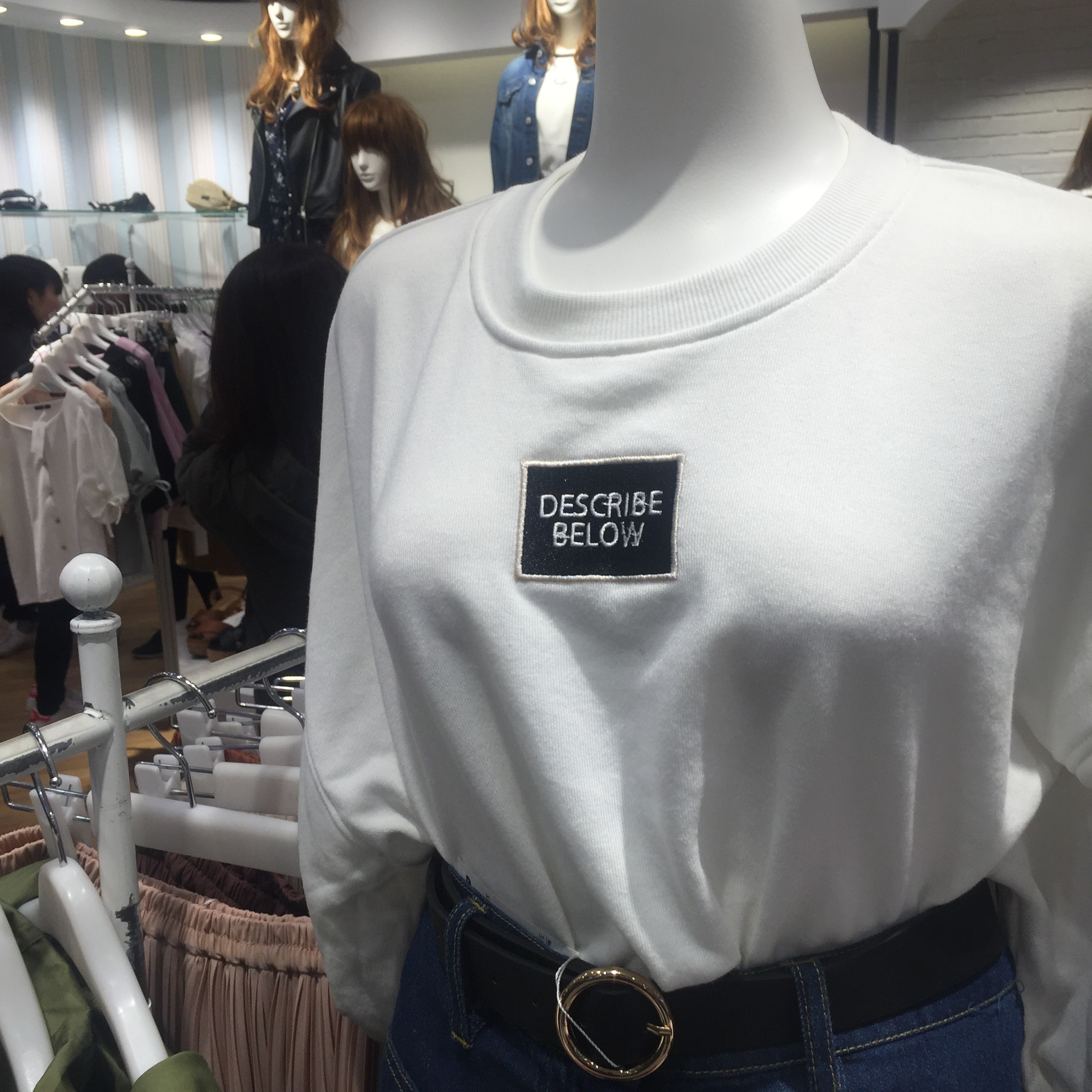
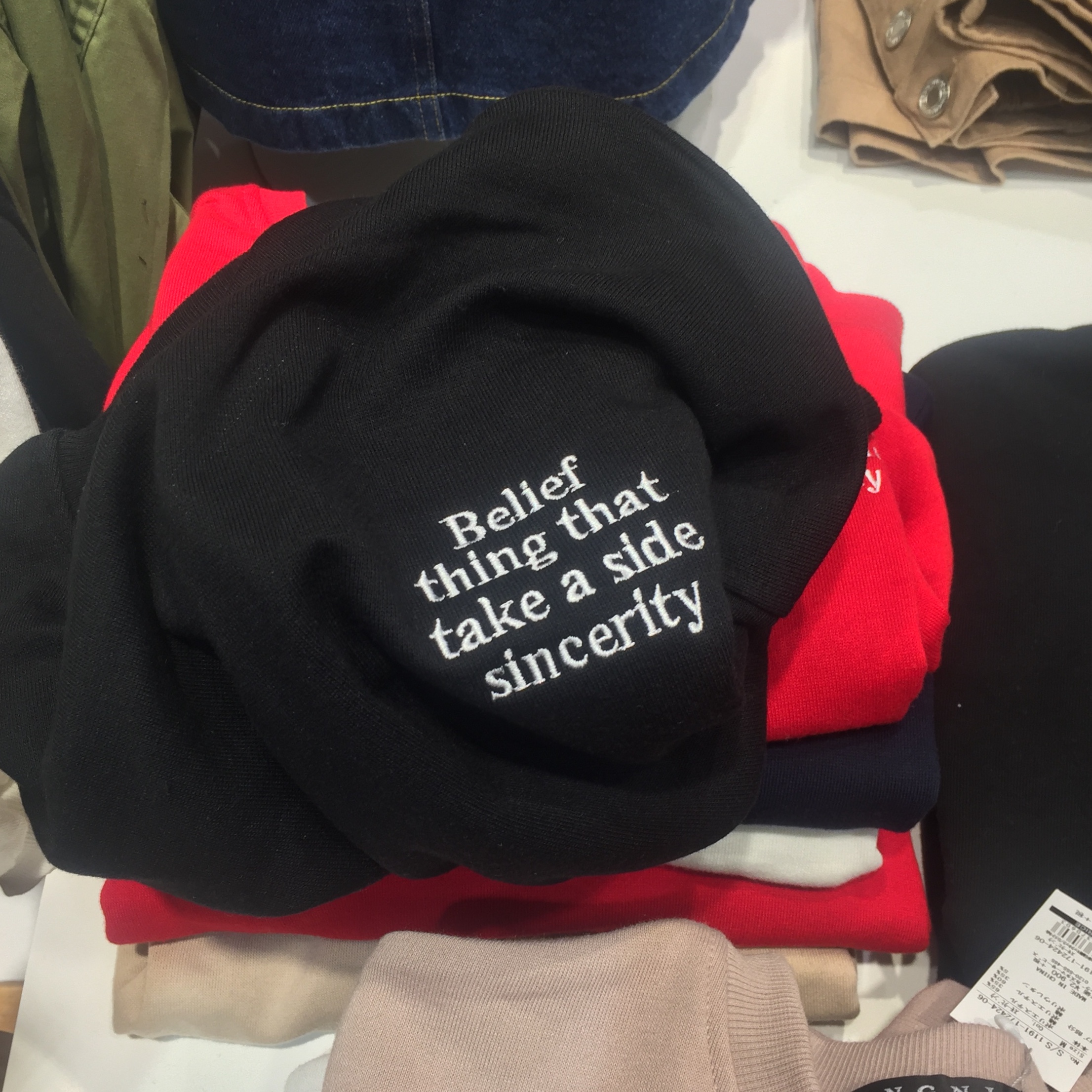

Seen above: Does Tempt Ably, Army (Not the real Army), a $2000 leather jacket based on an episode of Adventure Time, Describe Below, Belief Thing That Take A Side Sincerity.
I stared at the subtext of this makeup store for an awkward amount of time. To my jet-lag addled brain, the words seemed to shine, emblazoned on the vinyl signing like some kind of modern Charlotte’s Web:
Self confidence and liking yourself greatly benefits the process of becoming beautiful.
It felt like reading a weird translation of Ovid’s Ars Amatoria, where an ancient and wise person was dishing on some eternal beauty facts that transcended any issue of Allure or Cosmopolitan. This store contained the secret to being beautiful, but the biggest secret was to like yourself. … What?
So (In Jerry Seinfeild voice) What’s the Deal With These Shirts? I really don’t know, but I loved the elaborately-written sentiments much more than I loved, say, a shirt with parrots and pineapples on it in the youth section at an American Macy’s. I’ve never seen shirts with so much to say.
Even if the zen-garbled sentiments aren’t fully understood by the person wearing the shirt, it’s not like every person in North Dakota with a Kanji tattoo knows the true meaning of the characters. Most Kanji tattoos probably translate to Belief Thing That Take A Side Sincerity.
Before visiting Harajuku, I saw a lot of other, more techy neighborhoods in Tokyo and a lot of western society’s problems solved: fast trains, omni-available healthy food, and safety in the form of unlocked bikes and polite policeman.
Yet, Harajuku solves one of the biggest Western plagues of all: the samey Hipster.
The helixing vicious cycle of Hipsterism is that it’s a movement toward individuality, yet, at a certain point, all hipsters start to look the same. There are only so many flannel pieces and tight-fitting jeans and boots you can buy, only so many carefully-sourced Anthropologie sweaters you can throw on yourself before you look exactly like the person next to you.

The vibe in Harajuku scatters away from the curve towards sameness. It’s on some other kind of graph altogether.
While the main walk in Harajuku pops with funny shirts, colorful contact lenses (legal!) and crepes, the real fashion gems of Harajuku lay enclosed by LaForet, a multi-level mall. LaForet has the magic of small, super small, and hyper-curated items that don’t appear anywhere else. Each store is like viewing an independent art show. These aren’t famous labels or famous names and they probably never will be, but they’re really fucking cool.


In addition to clothes each shop has hand-curated accessories, like the hip-things section of Urban Outfitters, only with the cultural memory of a person you’d actually want to hang out with. There’s Kermit the frog in a mini shopping cart, for some reason. Drawings that seem like they were made by your little sister. Pez dispensers? A Toy Story book straight out of 1998.
LaForet is home to the Sailor Moon store as well! One of the greatest things about Tokyo are the popup shops in malls that are dedicated entirely to just one anime, show, or pop culture phenomenon.

United States malls are great at pumping out aggregate pop culture fashion aimed like a laserbeam at youth culture and the even-more-lucrative geek culture - Box Lunch and Hot Topic are sure to have your favorite Godzilla T shirt. At Hot Topic, somewhere between Linkin Park tees and Full Metal Alchemist wallets, you’ll find Sailor Moon stuff, yeah. Tokyo draws in enough fandom, enough otaku, to have an entire Godzilla store, several stores just for Kirby’s Dream Land, and countless popups dedicated to new short runs of Anime.

It’s easy to see Harajuku and Laforet as a place just for young people. While there were mostly younger people in the mall, Laforet caters to one kind of person: those who want something both new and good. So, Harajuku proves to be another place in Japan that goes all out. Expression is everything and uniqueness is everything. Though I spent enough time in Tokyo to eventually see a sweater repeated in Shinjuku and in Harajuku, in both places, you get the feeling that if you don’t buy the piece today, you’ll never find it again. Harajuku is a bit punk this way. It’s not a thrift store, not Prada, not Macy’s - it’s a kind of fashion shopping experience that could only exist in Tokyo.


Possibly the best one

I feel this

I knew I’d reached peak Harajuku when I found a shop with what seemed to be every ski jacket that my family and I wore in Colorado in the 1990s. At this point, I exited the store, texted my friends in the States who might have still been awake, and bought a crepe to relax and watched the crowds roll by until finally, all of the teenagers evaporated into the metro and I could go home. I metroed back to my Air BnB and flipped through my camera roll on my memory-starved iPhone, reliving the shirts one by one, laughing and texting them to whoever I thought might still be awake in the world, throwing them up on Facebook and Twitter to prove, somehow, that all of the shirts were real all along. Truly, there is a Harajuku shirt for everyone, every personality type can be found in the mystery of a shirt in Harajuku. I went back to Harajuku the next day.


Steal The Show
This book probably falls on a spectrum for most creators and most professionals - depending on how much time you’ve spent in drama classes or at Toastmasters, the approach in this book could be anywhere from totally new to you, or advice you’ve heard before.
But wherever you fall on the spectrum it doesn’t matter, because Michael Port’s writing is fun to read and isn’t accusatory or pompous. He’s like a cool dad who wants you to rock the presentation, get the job, ace the keynote. He’s like your drama teacher without the drama.
The pieces of advice might be things that, deep down, we knew were true, but it’s nice to have Michael Port in your corner reassuring you. It’s fine to assume multiple personas, he says. It’s fine to rise to the role, in fact, it’s great! Yay.
Michael Port never pitches the idea of life-as-a-movie or life-as-a-tv-show, but instead he pitches it as life-as-role, and you can take multiple roles. In fact you should take multiple roles. It’s what modern life demands from us and we can rise to this occasion.
I used to spend time with people in entertainment and met a few indie-film actors. One might think of actors negatively in the same way that people think of artists: if they’re good at acting, what if they are good at faking, embellishing, manipulating?
Turns out none of this needs to be a concern. Actors are among the most genuine, sweet people I’ve ever met. They’re studying and creating, and sometimes they get chosen for roles and sometimes they do not. They’re doing their best for a job they’ve been hired to do, for a role they have been selected to play.
While casting directors and job interviewers and bosses can all-too-often be seen as antagonists or gatekeepers, deep down, they want you to succeed. They want you to wow them. It’s your job to make big, strong choices.
Michael Port tells us that if actors can do it for roles, non-actors can do it for the many performances of life. In this mode of framing life-as-performance, Michael isn’t teaching us how to become an actor or how to get famous (thank god). What he is saying in this book is “You already are an actor! Here’s how to get good.” The confidence in this book is infectious. I felt like I had just climbed a mountain with the coolest person I know.
Like a good keynote, the book didn’t drone on and on. At first I found myself wishing that the author had included a few more anecdotes of how he worked with his students to overcome their fear, then I realized he didn’t have to do this, it would have been too much.
For the introverted like yours truly, it’s probably true that just reading a book won’t help us perfect our public speaking goals. Along with Steal the Show, Michael Port has built an entire public speaking empire, a website, classes, and his own keynotes. This book is just a book, it’s just step one. Yet for being ‘just’ a book, it’s a well-voiced, active, stagelike read.
Like some kind of ride, I wished this book were even longer and I was sad when it was over, so I went back and reread several points. It’s the ‘Let’s ride it again’ at Disneyland kind of book. You’d want to lend this book to a friend that you care about, but also buy another copy for yourself just in case.
Related Blogs:
Art Reads: Richard Feynman’s Six Easy Pieces

Shin-Koenji
Like a bead of water on a glass, Shin-Koenji is just one tiny glittering piece of Tokyo.
During a ten-day trip in Tokyo, I stayed near this shrine, the Myoho-ji temple. Across the street is a grocery store and a 7-11, and its near the Shin-Koenji station for a relaxed metro ride into the city. The metro wasn’t even bad during morning rush hour - more often than not I could find a seat.


Graveyards and temples, an art school, a small park - while I can’t say Shin Koenji reminded me of anywhere else in the world, it was the picture of peace and order. Like taking a ski run for the first time and already knowing it like the back of your hand, Shin Koenji is a safe and easy place to stay while visiting Tokyo. It’s not as exciting as other districts of Tokyo, but it doesn’t try to be, either. It was cool place to relax after visiting the city each day, a cool place to make a lot of art in the evenings.
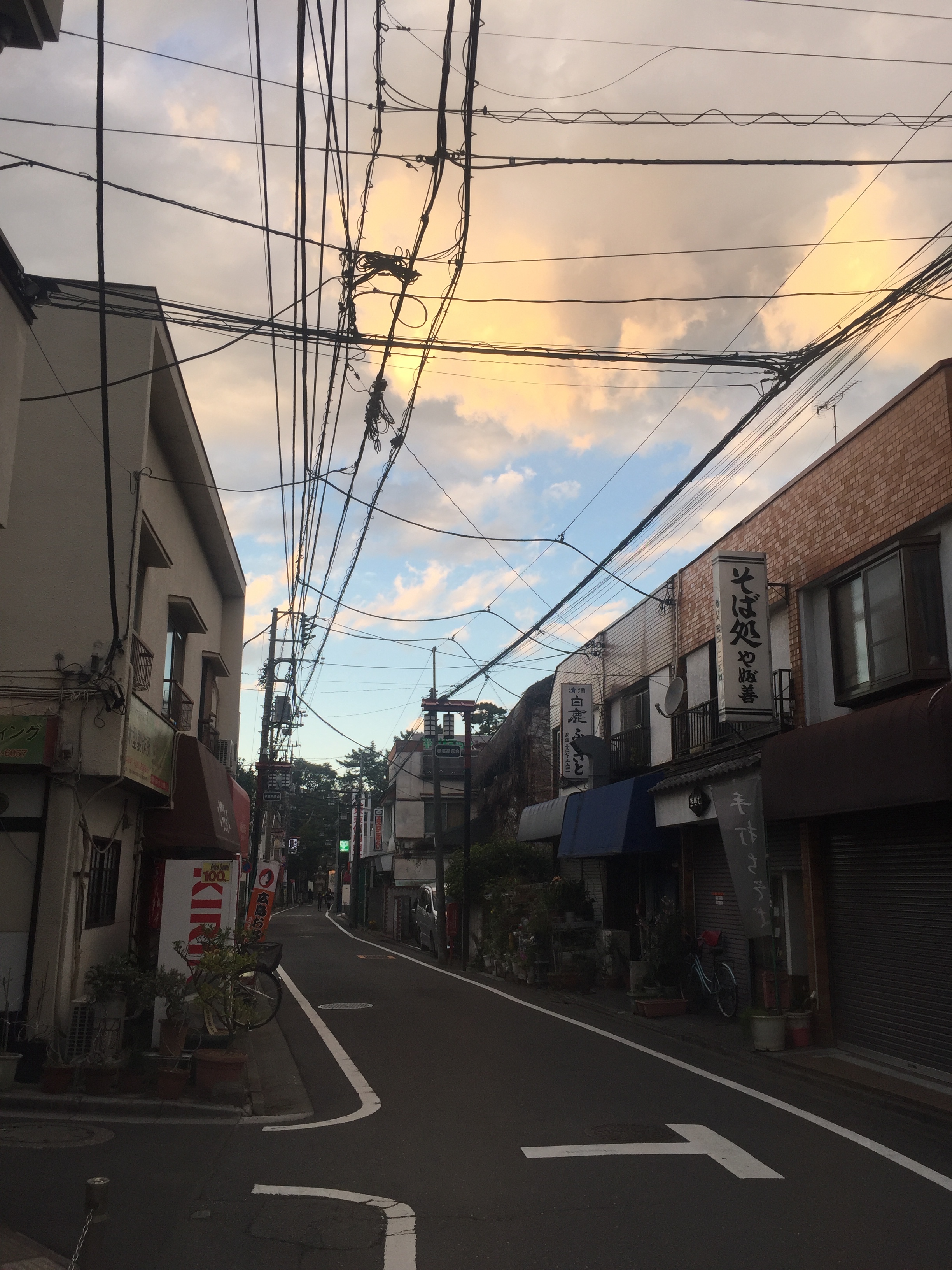
On the last couple days of my stay in Shin Koenji the sky lit up like this.


Narrow streets cut through Shin Koenji and even more alleyways connect the neighborhood. It’s a great place to be a pedestrian or a cat. It’s easy to find your way through this neighborhood as most people seem to have a path memorized to and from the subway.


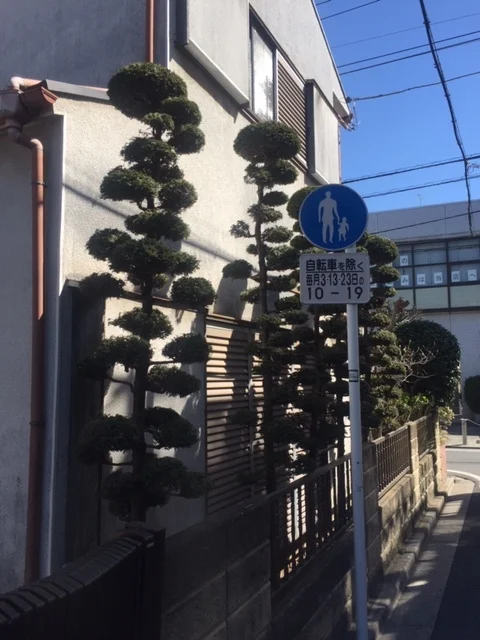

A sunny day in Shin Koenji - mirrors were used to make traffic easier to see throughout the narrow, tightly-cornered streets.


The metro station at Shin Koenji was chill throughout most of the day - the only time to really avoid was the 9 am rush hour where countless workers were jamming in to each car to get to work each day.


Here I am at my Air BnB in Shin Koenji!
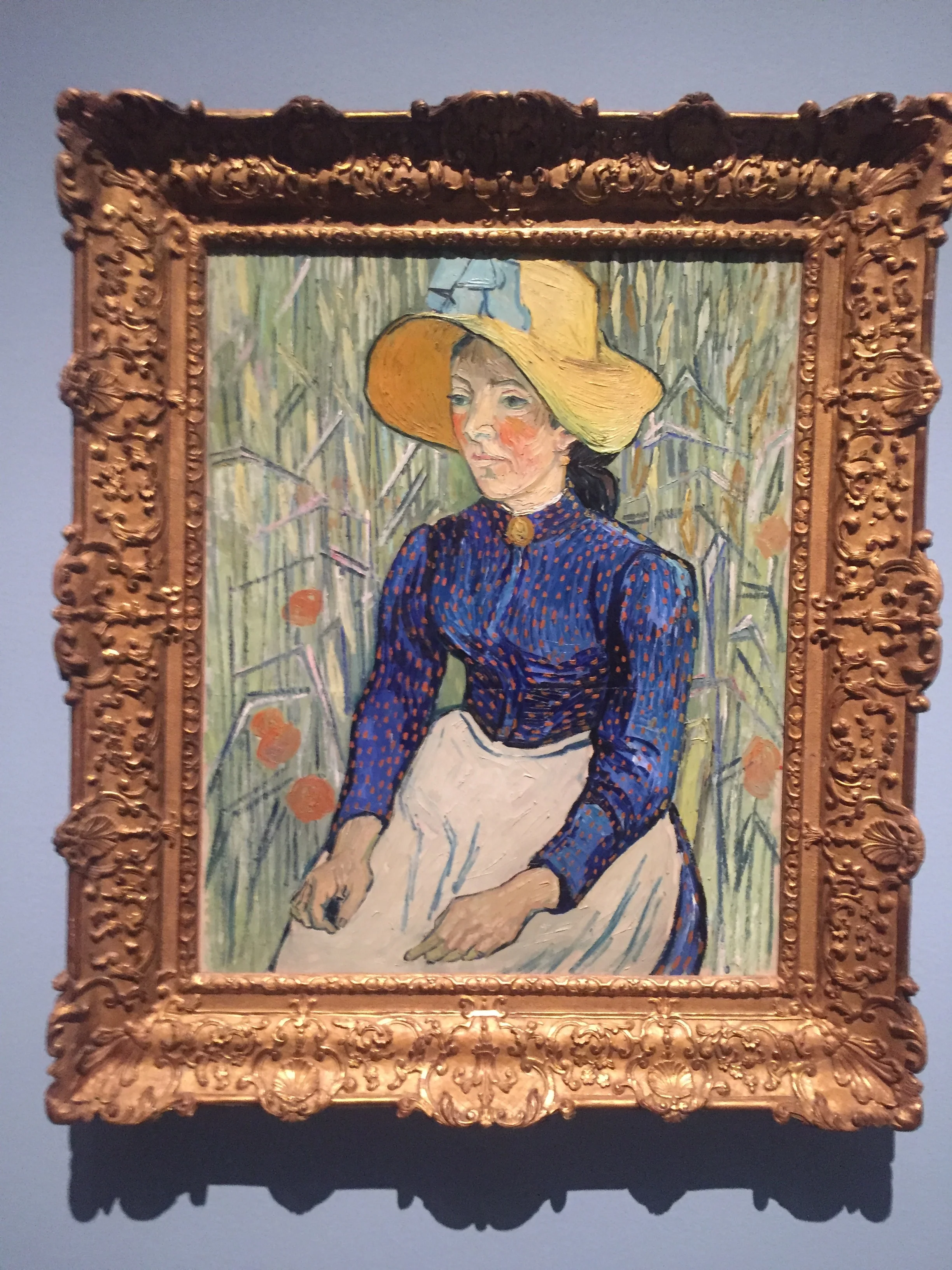
Vincent van Gogh: His Life in Art at the Museum of Fine Art Houston
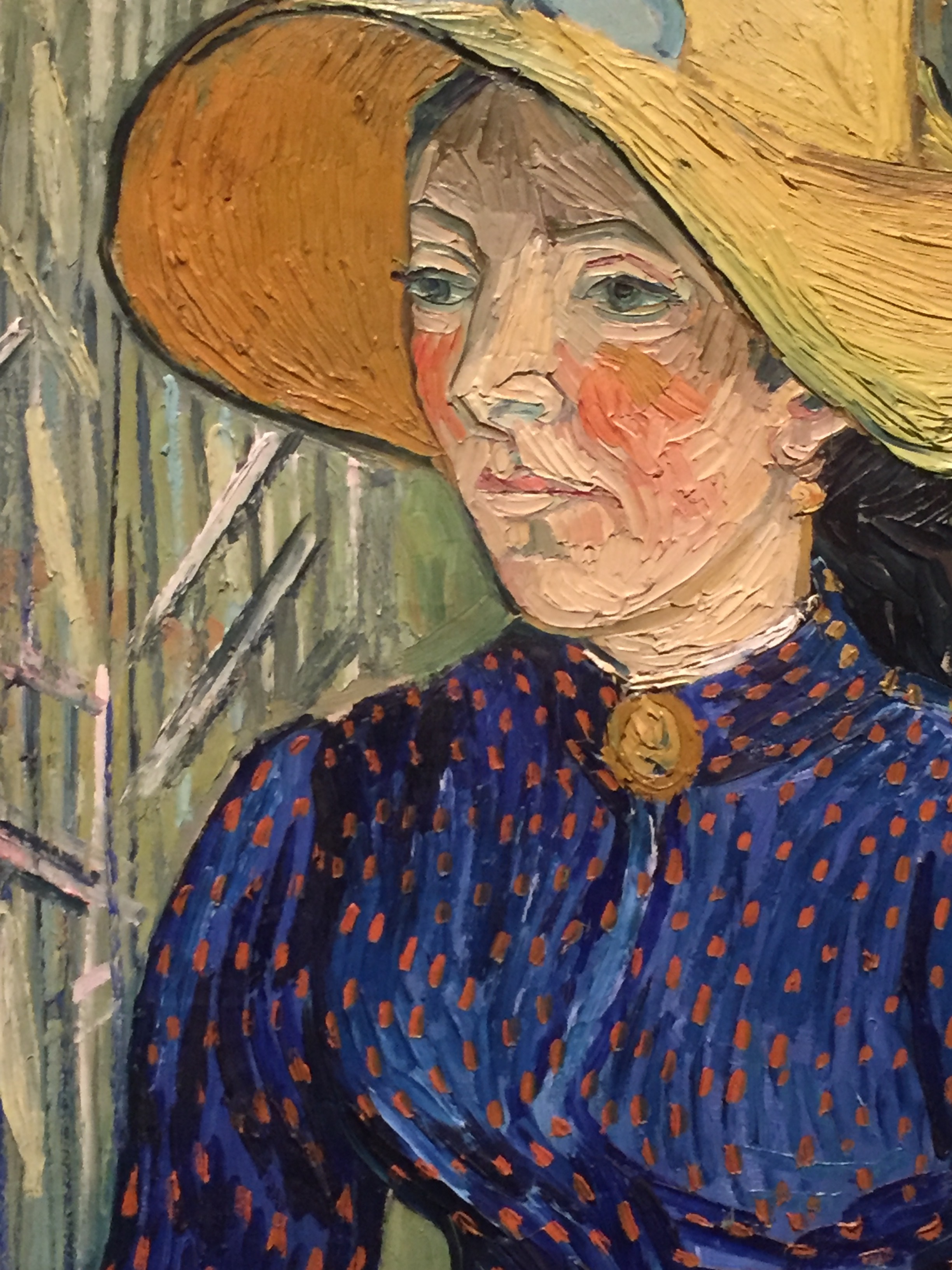
This show of Vincent van Gogh in Houston is one of the best Van Gogh shows I’ve seen as far as diversity of work and the message of the show. Not every Van Gogh painting is here, but there are definitely paintings that are rare, less-seen, and drawings that floored me. Starry Night at the MoMA and Self Portrait at the Musee d’ Orsay are probably the two Van Goghs that we think about most, this show gives us reasons to see lesser-known Van Goghs in an iconic way.
Like the following three paintings after Millet:

Detail of the above painting, where the paint isn’t brushed on so much as applied like patches of bricklaying cement:
To this day I don’t know how Van Gogh painted this way. A brush doesn’t lay down color like a trowel, and to do it with a palette knife you’d have to have the patience of a saint. We all know the painting is a lovingly-made replica of one of Van Gogh’s art heroes, Millet, but how, how the heck did Van Gogh do this?
How did he paint like this, with the volume of the paint jutting out from the painting? Brushes press down paint and smooth it out, palette knifes lay down color, but there isn’t a tool in painting that lays down little embossed swatches of paint like the green swatches above. There just isn’t. Whatever Van Gogh was doing, he was using paint in an absolutely new way. He was laying it down and then shaping it, or he was loading his brush for every single stroke, dipping the brush and hitting the canvas, dipping the brush and hitting the canvas, over and over again. This would be an incredibly hard - but rewarding - way to paint.

In paintings like these, copies of Millet’s work of peasants bundling hay, the paint is applied and shifted in a way that would be less maddening. You can see that Van Gogh laid down colors and then shifted them, sculpted them across the canvas, later adding touches of atmosphere like the purplish haze around the hay and sky below.
Van Gogh never saw these peasants but he was often thinking about them. He loved Millet and cherished Tolstoy and ever since Potato Eaters, was more concerned with peasants than most.

Van Gogh had failed at many other courses in life before setting out to paint - he tried to be a teacher, he tried to be a preacher, and didn’t make it at either. While he didn’t succeed at painting financially in his lifetime, his success as a painter eternally stemmed from his habits of hanging up paintings and prints all around him in his rooms, and writing to his brother about paintings and landscapes. In reading Van Gogh’s lettters, I’ve never seen anyone be such a fan of other painters. In one letter to his brother from 1875, he writes a short greeting and then goes on to list all of the paintings he has hanging in his room:

He was studying these paintings like he studied and quoted The Bible in other letters.
When Van Gogh copies Millet or makes a painting ‘after Millet,’ the best we could analogy that we could make for our time is that Van Gogh made unabashed fan art. The paintings above are homages, or fan art, or both.
Like a kid who loves Spiderman so much that he starts doodling, Van Gogh loved Millet so much he wanted to make Millet paintings himself. He was relentless to learn and studied the hell out of painting and kept painting, and didn’t quit even when he got sick.
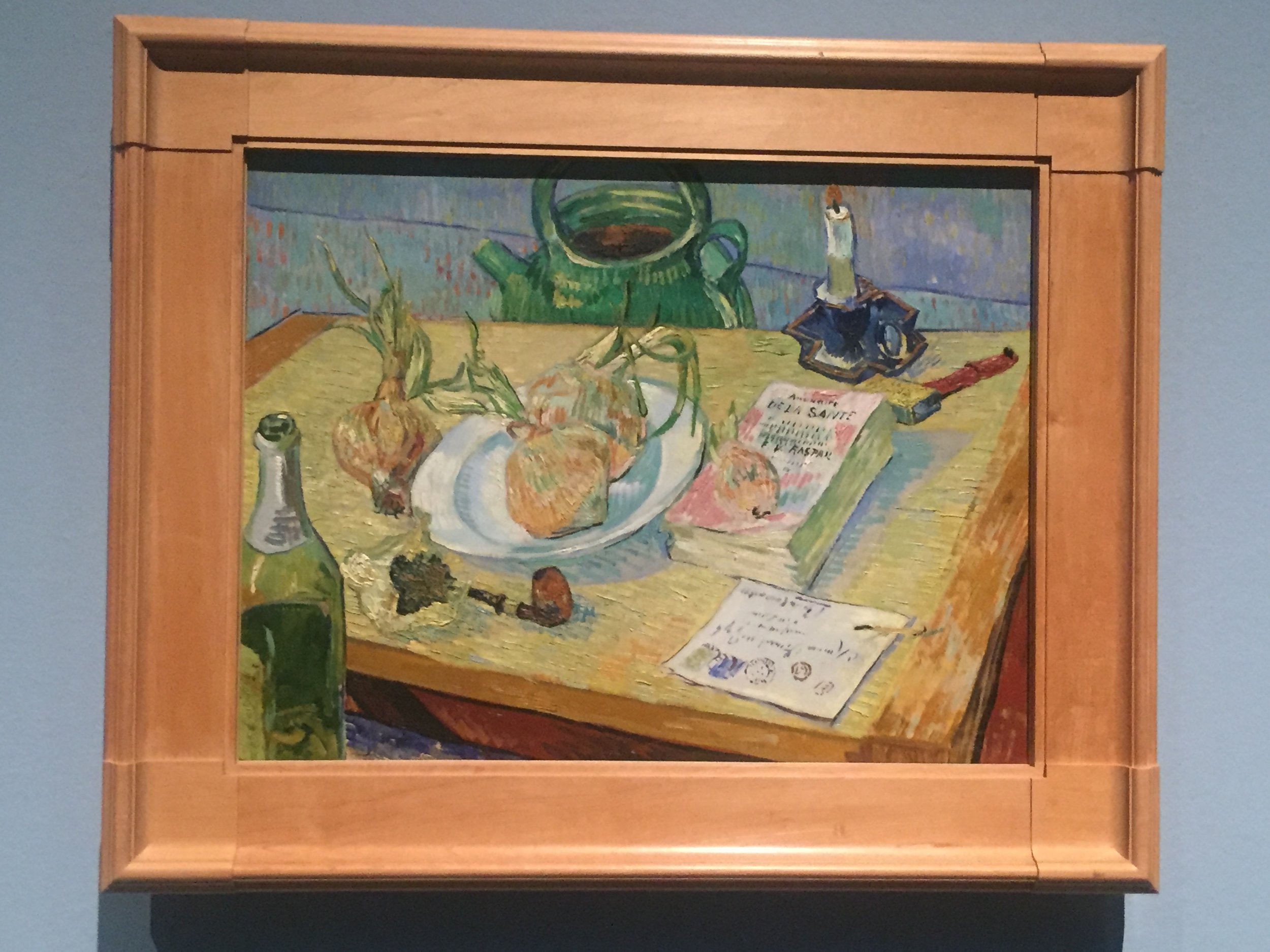

The book is a homeopathic remedy book. What about the smaller onion that has fallen onto the book’s cover? Did it just fall off, is it hiding something on the cover? Unlike a spread in Oprah, It’s not the most organized scene, but the onion is kind of hiding the book.


The lavender shadow in this painting almost did me in. I’ve never seen such a bright shadow. Though this was a painting of an asylum during Van Gogh’s stay there, it looks like a great place to recover. It looks like this place would heal anything.
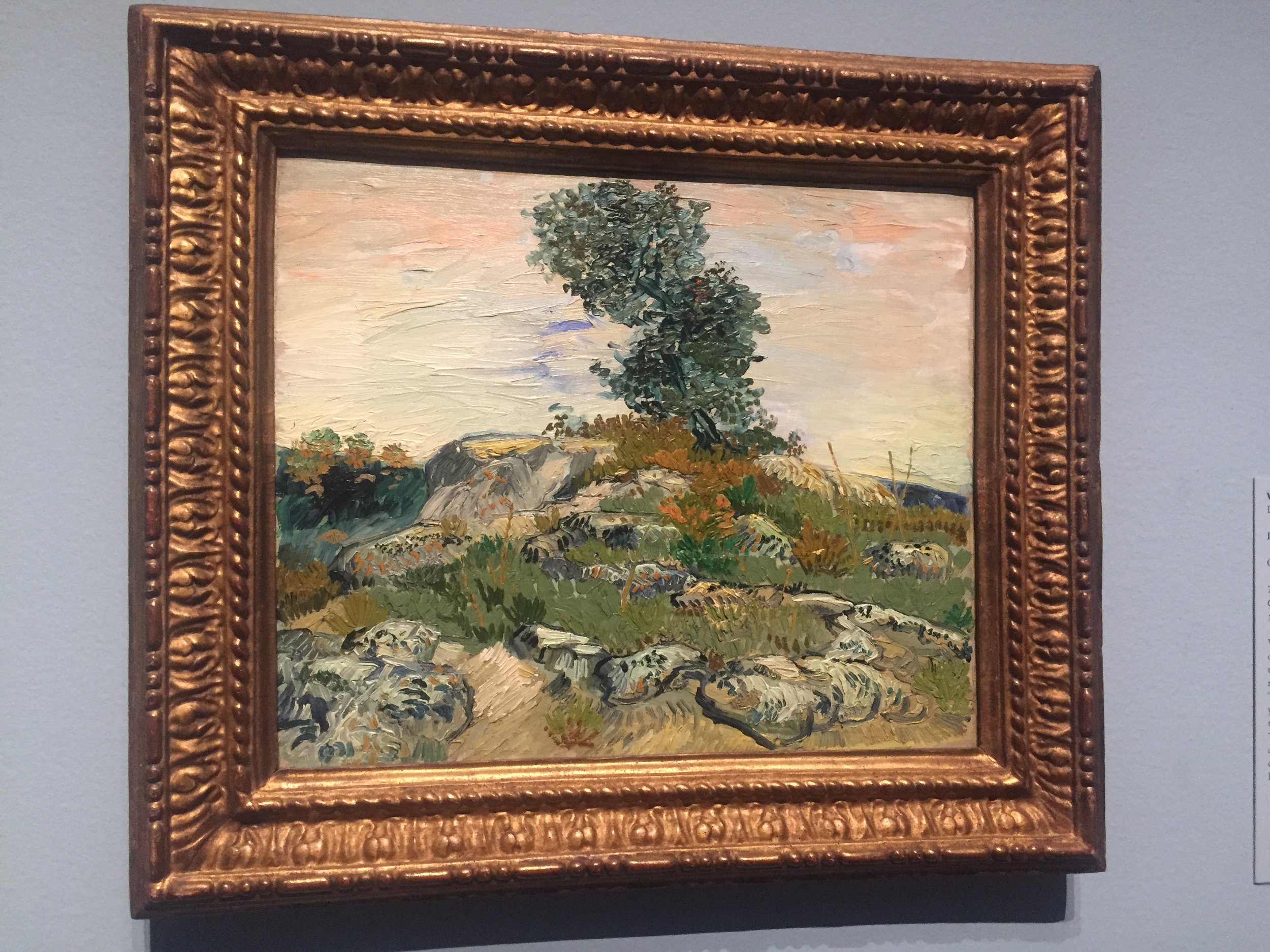
It was nice to see The Rocks at this show in different lighting - though in the permanent collection at the MFAH, The Rocks takes on a new light against a darker wall in this exhibition. Typically it’s on the second floor of the museum and is against a lighter wall, though still encased in an ornate golden frame. I was so entranced by The Rocks when I saw it that I wrote a small mini-blog just about this painting, nothing else. Every time I see it in Houston, there’s something new to see. And it’s unlike any other Van Gogh I’ve seen. The sky relishes with broader, more lengthy strokes than other Van Gogh skies. Pink, yellow, blue cross the canvas and lead you to believe in a wind that shakes the dark tree. I believe in the rocks in this piece. Vincent could look at what would otherwise be someone’s throwaway photo and make something iconic out of it.
Vincent had mentioned The Rocks in a letter to Theo, where he complained about dust and wind. Painting en plein air means chaos seeps in from all angles - bugs, dust, wind, time, people walking up to you and asking you about art - all of these are challengers to making a painting outdoors.
Limited time does compress talent in a good way - you have to see accurately and replicate quickly, before the wind throws dirt into your skies.

In many Van Gogh paintings you can tell when he has acquired a new paintbrush - in the painting of a wheat field above, he has a larger brush by far than in other works and isn’t afraid to set it to work in the sky and foreground, where the smaller details are worked in the strip of trees in the horizon. The painting above could have been made with the staccato, small brushstrokes of Starry Night, but instead, more generous knifings of paint complete the atmosphere.
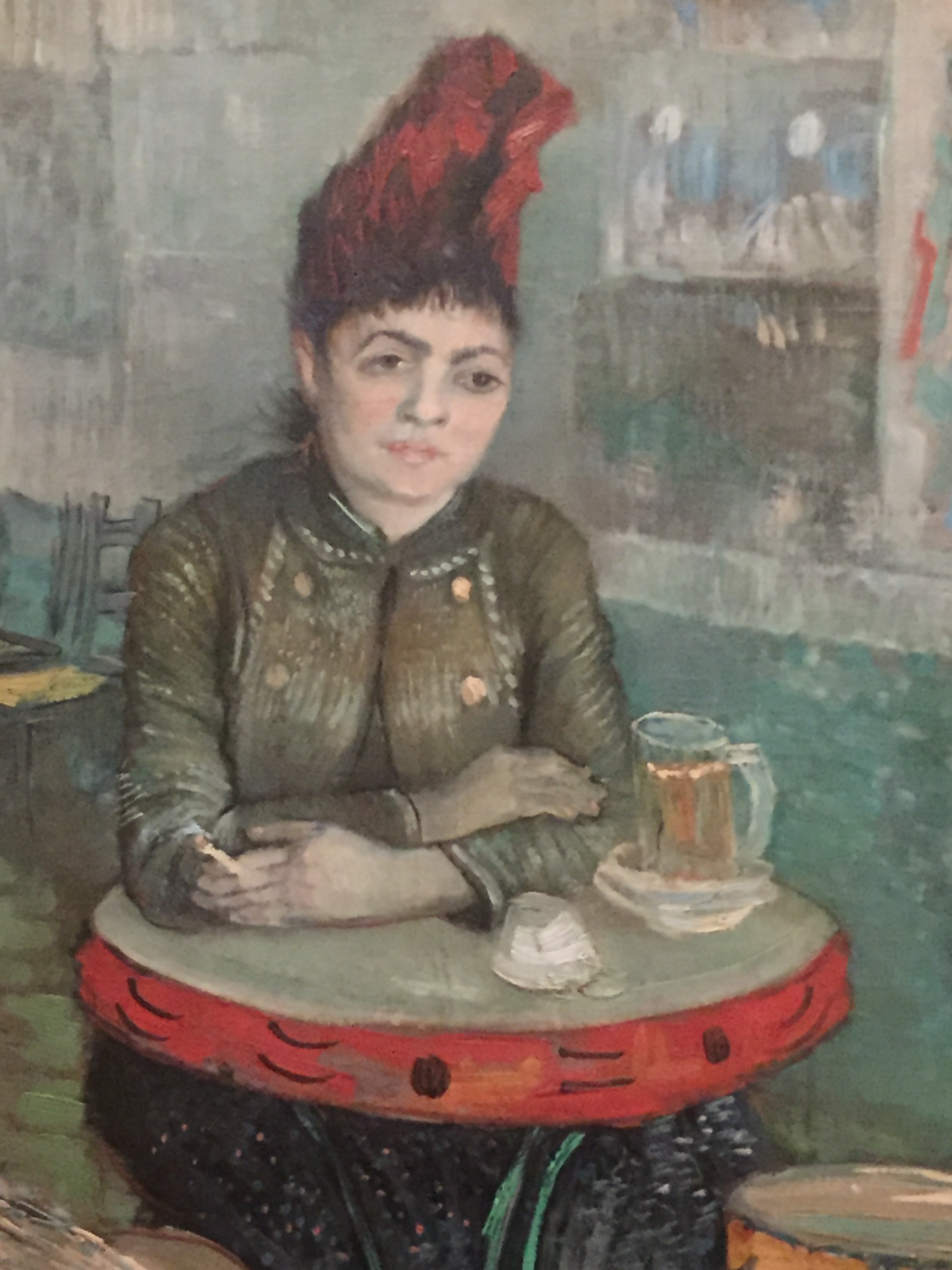
I’d never heard the story of the painting above, or seen the painting. If you’d asked me on who had made this painting I would have said an early Manet, maybe Lautrec on a weird day, someone else, but not Vincent van Gogh.
The painting depicts woman that Van Gogh was seeing at the time. He may have painted her right there or sketched her and painted her later, but either way, boy she looks glum. She looks like she’d rather be anywhere else.
According to the placard, the relationship later took a ‘stormy’ turn. Beer in one hand and cigarette in the other, this is how you get through dating Vincent Van Gogh.
(Okay, maybe that’s not beer, but it sure looks like beer)
The thought is that Van Gogh must have been too much for most people - committing himself to asylums, getting in fights with Gauguin, rejection after romantic rejection, failed jobs, living with his parents at age 30 … people just couldn’t really stand him after a while. But who knows? Maybe we’re looking at a guy who had a lot of the same problems that guys (and gals!) in their 20s have, and 150 years later, romance, jobs, and families are mostly the same. He tried to teach, he tried to preach, but painting was what he was meant to do and while Theo was a saint of financial and emotional support, it couldn’t save Vincent.
Speaking of Gauguin, the sitter for the portrait below had been painted by both Van Gogh and Gauguin in one sitting. This isn’t my favorite Van Gogh - here is why: in it you can see that with Gauguin sitting next to him, Van Gogh was influenced to paint more like Gauguin, which is not who Van Gogh was. Gauguin was a monster to others, Van Gogh was only a monster to himself.

Van Gogh tried on Gauguin’s more abstract style but ultimately rejected it for more realism, one of painting’s best ‘Be Yourself’ moments. Van Gogh is now described as post-impressionist because he doesn’t fit in with the impressionists, either - he was really his own thing.
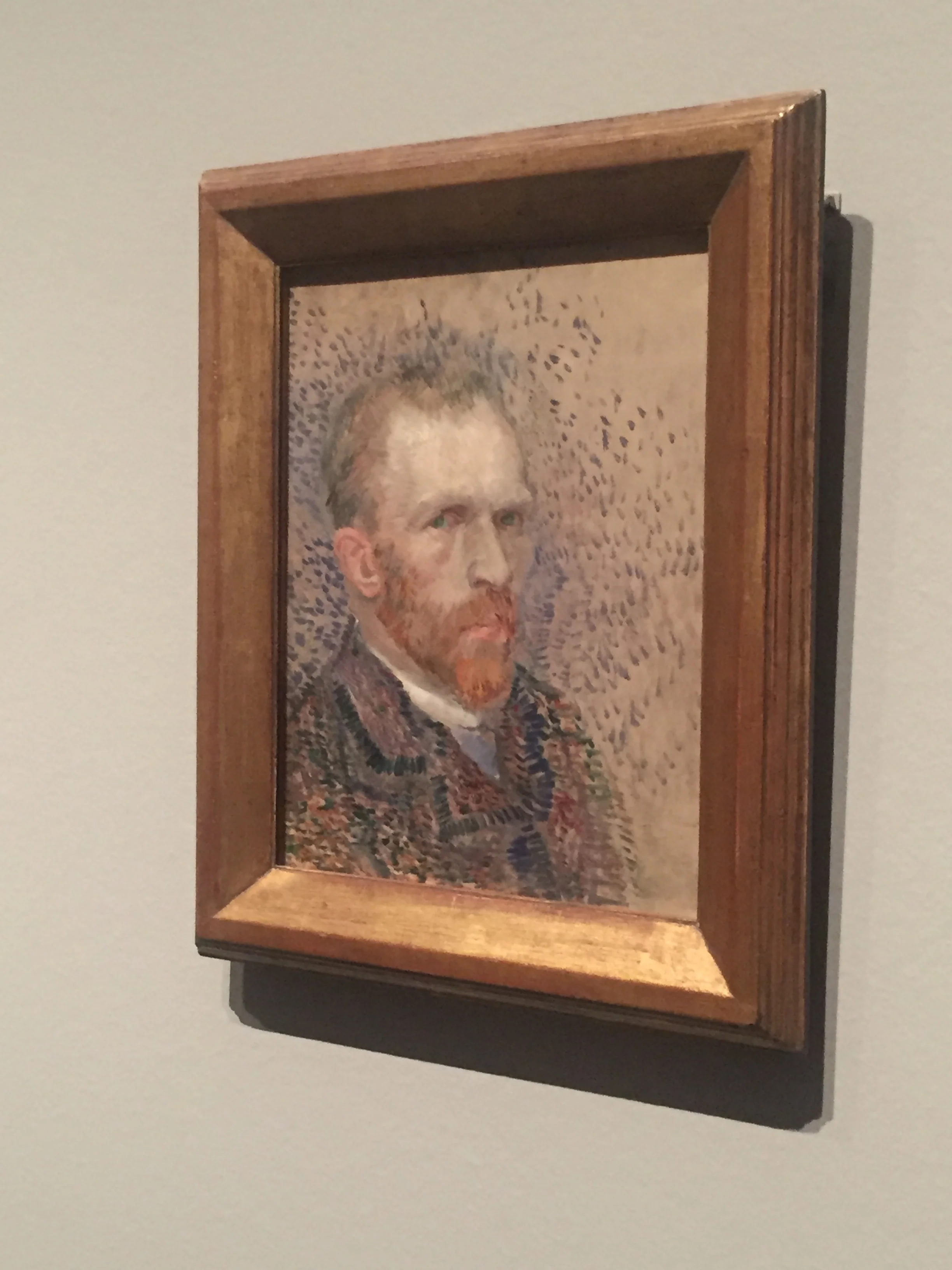
Vincent Van Gogh being real


A portrait that is thought to be of Theo, Vincent’s beloved younger brother.

Impasto-clad peonies.
Many drawings in this show - rare and just as dramatic as his paintings.


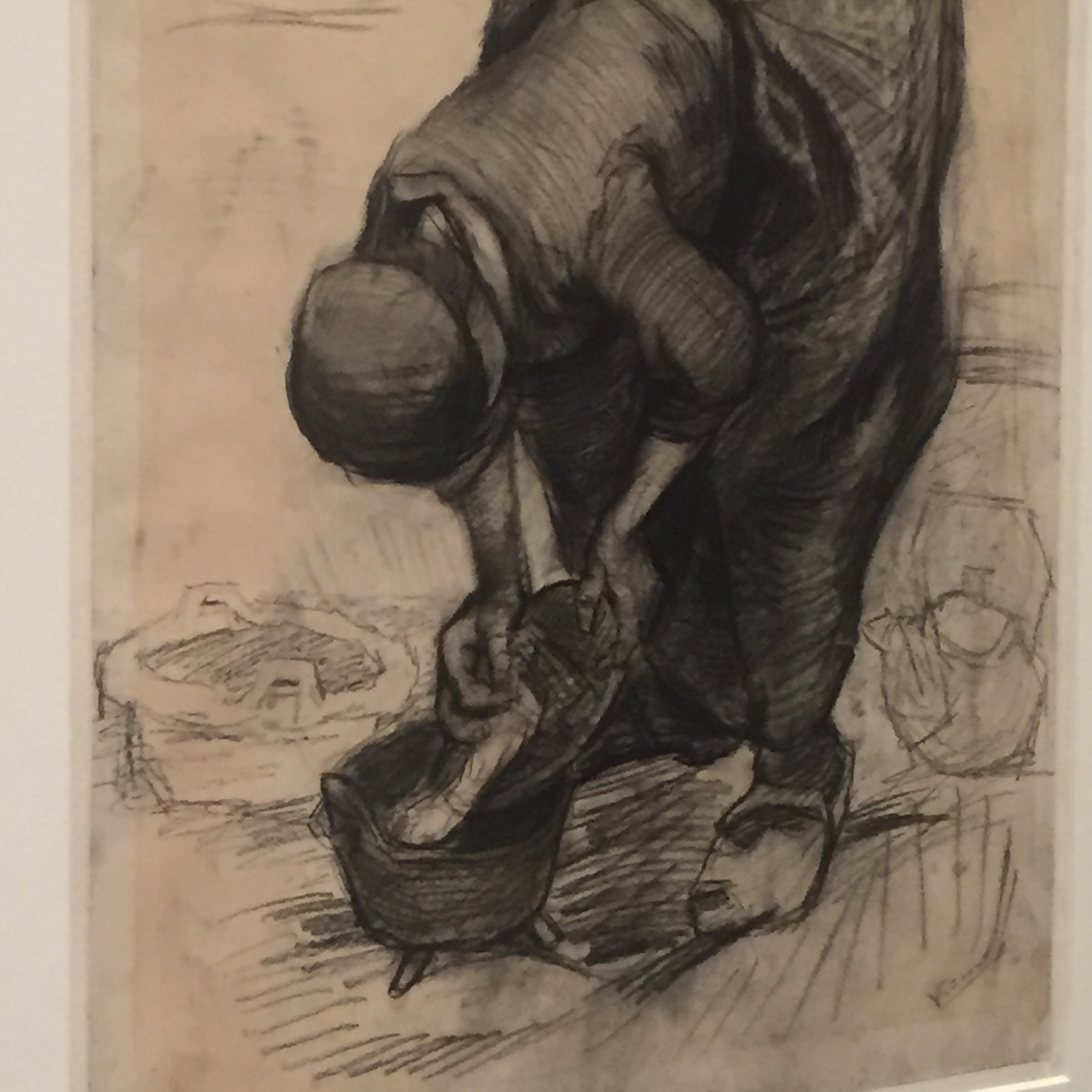
The drawing above of a peasant woman is an earlier work, hung early in the show. I think you’re supposed to see it as sub-par compared to Van Gogh’s later drawings, but it’s full of unexpected promise. It could be early or late and I would have believed you. Like many drawings from Van Gogh, this drawing is not afraid of darkness. Approaching deeper values bravely isn’t something that all beginners do, but Van Gogh did it here and in his other drawings.
The display case below contains facsimiles of a sketchbook at the Van Gogh Museum in Amsterdam.

Far too delicate to move, the facsimiles displayed with the tools that Van Gogh might have used bring the sketchbook closer to us.
There are several displays of tools throughout this show that are well done - a paintbrush or pen in a case isn’t something you see often, and I found myself wondering why this was the case. Why don’t museums display more paintbrushes when museums throw a painting show?
A fundamental theme running through the show, placard after placard seemed to swoon and chime over the fact that Vincent had written so many letters to his brother, 830 in total, and - swoon! - thanks to all of these letters, we know so much about Vincent’s life!
Vincent is the art historian’s cake and cakewalk and eating it too, where other painters move in and out of existence through receipts, documents, lore, apocrypha.
Yet, even after all of his letters and works, we still don’t fully get him. His lovers or would-be lovers rejected him, his friends couldn’t stand him - the only person who seemed to understand him and believe in him was his younger brother Theo.

Van Gogh was an occasional all-caps kind of guy, though some pop-art depictions and accounts of his personality would make you think he was All All Caps, All The Time
If you aren’t bold, If you don’t write it down, if you don’t draw it, nobody will know. Writing and painting, for Vincent, were both equal forms of existing and expression. Loving God and loving his brother.
After the show of paintings and a cruise through the giftshop (a well done giftshop by the way), there is an awesome interactive display called Van Gogh Up Close. My Mom grabbed this photo of me below - someone - a team of designers and fabricators - built this whole replica of a painting and you could sit in it!

There were other lifesize replicas, projections of Starry Night, and paintings on whiteboards that you could try your hand at coloring in, or hijacking.
Stuffy art critics get mad about highly-instagrammable museum displays like this but I think they’re great. There’s nothing wrong with loving art and wanting to be a part of it. There’s nothing wrong with bringing art closer to everyday life, and everyday life closer to art. Van Gogh Up Close is a perfect name. Vincent never could have imagined people in the far future running in and out of his paintings like ghosts slipping through walls, but here we are.
Vincent van Gogh: His Life in Art runs until June 27th at the MFAH Houston
Related Blogs:
Vincent van Gogh at the National Gallery of Art
Caran d’Ache Watercolor Pencils