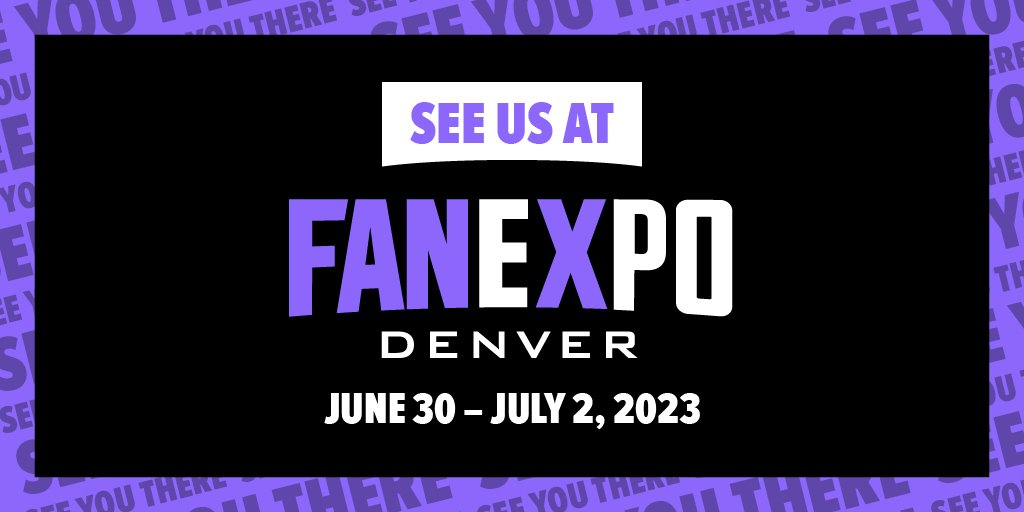
Exciting news, I’ll be at Denver Fan Expo 2023!
Fan Expo is from June 30th - July 2. I’ll be in Artist Valley near some other comics artists.
If you haven’t booked tickets yet, grab some tickets here
See you, Space Cowboy
Exciting news, I’ll be at Denver Fan Expo 2023!
Fan Expo is from June 30th - July 2. I’ll be in Artist Valley near some other comics artists.
If you haven’t booked tickets yet, grab some tickets here
See you, Space Cowboy

Welcome to April 2023’s Sketchbook Confessional - the Sketchbook Confessional is a blog where I review all of the art that I made in a month. Rather than a ‘to-do’ list, the Sketchbook Confessional is a ‘done’ list, where I can objectively see what I made without forgetting or getting too grandiose about it.
In April I started something a bit new - painting in oil on glass. I found some small palm-sized glass samples and thought they would be wonderful to paint on.

Luckily I was right. Funnily enough, some blogs on the internet would have one think that painting oil on glass is a doomed mistake. It worked just fine in my case with these glass samples. I decided with some of the glass samples to make paintings of old mining structures around Leadville.

It always awes me when I am running or skiing up high in Leadville and I happen across some kind of old mining relic. It reminds me how crazed yet methodical people were about mining the earth. First of all, they were at anywhere from 10,000 to 13,000 feet, in the 1800s, digging and exploding and sluicing the earth around. I imagine how hard it is to walk around at 12000 feet and then imagine swinging a sledgehammer or moving rocks around. It’s not exactly the mining scene in Zoolander that plays in my head but, almost? haha.

Anyways, I think all of the wonderful nature aspects of Leadville get a lot of credit and I’ve personally done a lot to credit those wonderful aspects with the mountains in my paintings. Mt. Elbert, waterfalls, animal life, and Leadville flowers are usually my subjects so I figured, why not talk about mining history in my art? It’s not as glamorous a subject and the pollution in Leadville is seen as one of the negative parts of it, but I think it’s better to talk about the whole picture than to pretend the mining aspects of the town and pollution do not exist. After all the entire town probably would not be there without mining - nobody opens an opera house at 10,000 feet for no reason for no customers.
I made around 12 mines total.

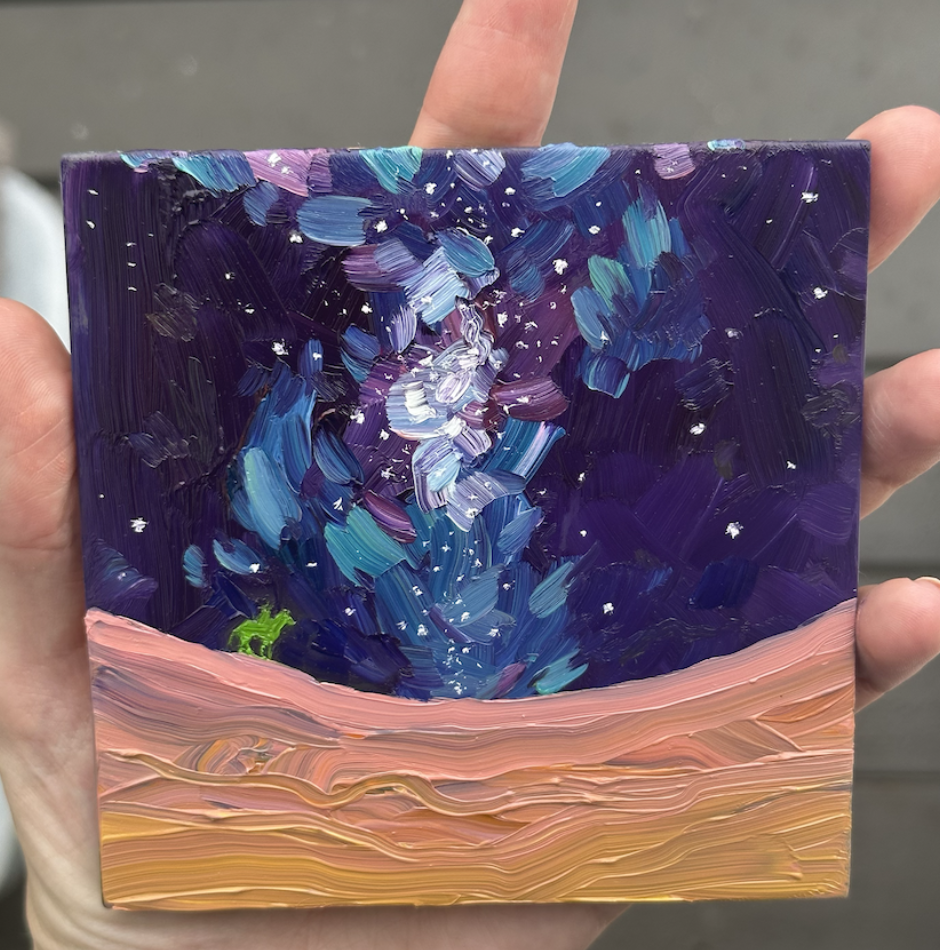
I made a few paintings in my Space Cowboy series. Eventually I want to do a bigger one, for now I made a small 4 x 4 inch painting and 3 x 5 inch painting.

I also made it out several times in April for plein air painting, as it’s finally getting a bit nicer out, and there’s this thing called #Pleinairpril that I was able to get excited about.


I’ve been trying out a new rig with a lighter easel and also using a cigar box as a palette. The cigar box works well because it contains the paint and it doesn’t slide around.


It was truly fun and challenging to get out a few times with my baby as well. Plein air with a baby, for me, involves double the planning and gear. It’s really fun and luckily we don’t have to walk too far to find something cool to paint in Boulder.
In April I also tried out using photos of myself as starters for the AI app Prequel. I saw Prequel in an ad and thought it looked interesting, so, I gave it a try.
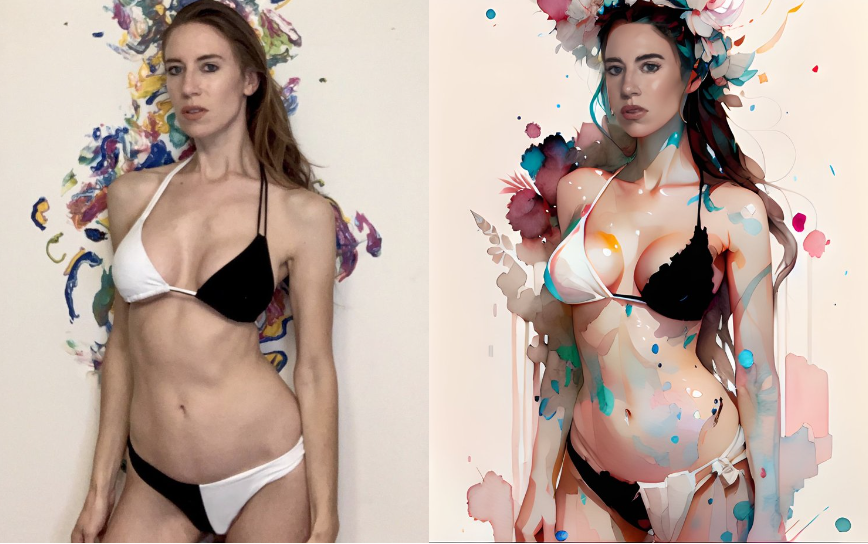
I gave the ai a few photos of me and used what is called the “Watercolor” AI on the app. I thought this was fascinating as an exercise. I learned a lot about how this particular AI and AI style handles faces or what it thinks is pretty - it definitely grabs highlights on my face and makes them brighter, and makes my eyebrows thicker, darker, and more rounded. Which I don’t think is a bad look, only different. I think the AI’s faces can lean towards looking a bit uncanny or ‘overdone’ in some instances, but not all.
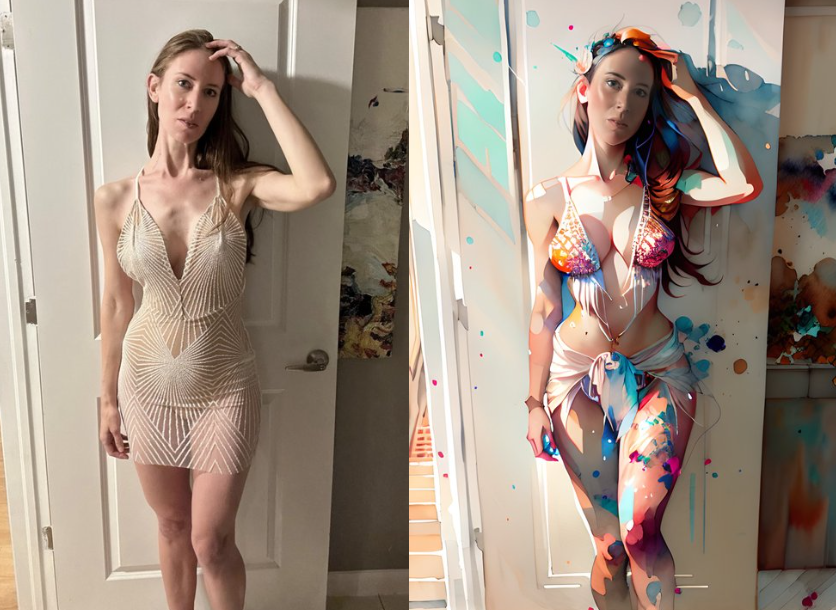

What these remind me of are covers of photoshop and illustrator magazines from about 2009 - present, many of them feature realistic face-bust portraits with, reductively, lines and flowers coming out of people’s heads. Which I don’t think is a bad look. I can’t help but think the AI has trained on covers or illustrations like this. I had a lot of fun with this and it’s something I can do while I’m rocking my baby and I have only one hand free or even 0 hands free at times. It’s more fun - way more fun - than scrolling news sites.
More on my foray into ai swimsuit photos here.
For fun, I made a book of the swimsuit photos and AI photos side by side.

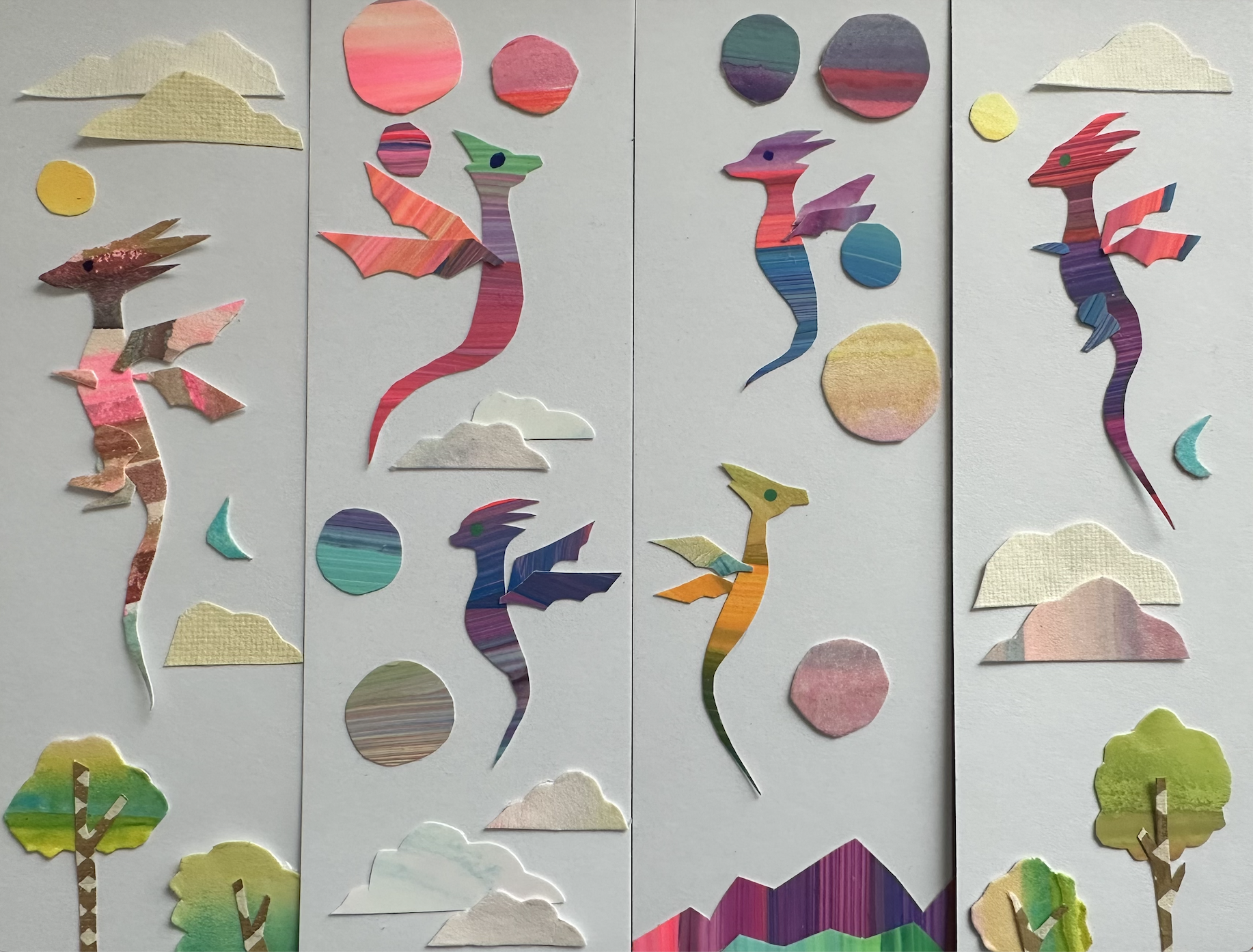
At the end of April, I worked on a bit of paper art involving dragons! It’s been very fun to do this:
Playing:
I took a bit of a break from Gene Wolfe books this month and instead, in my late night hours after my baby goes to sleep, I play Octopath Traveler on Switch. Even before I saw that a sequel was coming out, I was playing it, and then I saw that the sequel was coming out and I figured I should finish and enjoy the first one if I ever got the second one. I also have that thing happening with Gene Wolfe that happened when I played Breath of the Wild - I don’t want it to end, so I stop powering through everything, afraid the thing I love will be over somehow. Of course this is silly and I could just re-read or replay, but that’s how I am, I guess. I leave things that I really love somewhat unfinished.
Octopath and Gene Wolfe are aligned for me because I started both in 2019, put them both down for a long time, then finally got going again. I guess it was hard for me to focus on things like this in 2020 and 2021.
As far as Octopath, I really love this game, it’s pretty to look at and the concept art is cool. I started playing it as Primrose, the dancer, and I empathize with this character quite a bit. I personally think the Allure ability is one of the funniest things I’ve ever seen in a game, and it’s more than funny because the power of seduction is such a real one. Mostly what each character says after Primrose Allures them is the funny part to me.
I thought the final boss for Primrose was truly scary, along with the finals for H’aanit and Ophelia. I won’t spoil it even though the game is like four years old at this time, haha. I ended up playing most of the game with the four women characters as a party. I like them the most, though I also think the scholar character is really funny and pure.
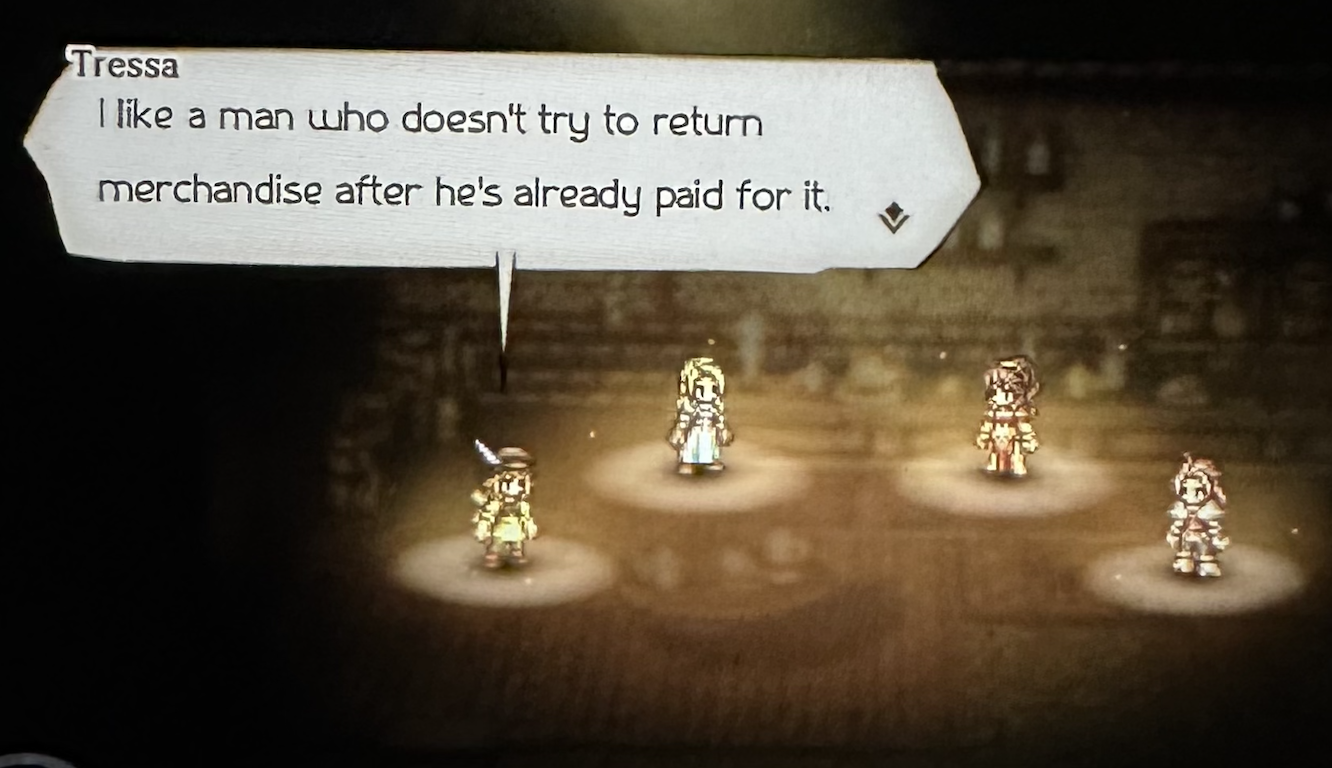
I also love the merchant, Tressa. Everything she says brings me joy, especially when I charge her up to her ultimate and she says “Welcome Back” and when she finishes a battle “Time to close up shop!” idk why this is so funny and perfect to me but it is. I think Tressa’s story was the first one I finished in the game. The part with the travel journal was so pure to me. There’s a lot of purity in her storyline which is a bit hard to find in stories about money and trade.
My other, unposted silly photos of the game don’t do it much justice. Since I played the original Game Boy growing up and I still remember gray and yellow screens, everything on the Switch looks like some kind of holy relic to me, light and color pouring out of it. Every moment in Octopath is so pretty it’s hard for me to get over. I could really go on and on about this game. I finished the main story and hope to play the sequel soon.
Running:

In April I got a few big run expeditions in. The biggest run I got in was 9 miles, and I started stroller running quite a bit more too. It was exciting to do as we move towards summer. I’m still training for the Leadville Heavy Half but the runs are fun to go on regardless of any goal. It’s fun to see everything around Colorado greening up a bit for spring.
I think with AI art I can throw in the towel on some facts. An AI can paint something faster, a robot with little paintbrush arms could too. A horse and a car will always be faster than me. What I am saying is that I climbed this mountain and I made this painting.

The unspoken thing that I, nor any artist, wants to say is that maybe the AI can make not only a faster painting, but a better painting too. But that’s the best thing about art, that’s just like, an opinion, man.
If you’re looking for an alternative to turpentine or expensive brush cleaner for cleaning brushes, I’ve had luck with cooking oil or canola oil for removing oil from brushes.
Also, after being cleaned with cooking oil, the bristles on my brushes are very smooth and soft. They’re not brittle or dry at all.
To clean brushes with cooking oil, here is what I do:
Pour 1/3 inch cooking oil into a re-usable container (a takeout container, a coffee can both work well)
Swish the brushes around in the oil (a coffee can works great for this if it is corrugated or if it has ripples, it has a washboard effect)
Empty the container of cooking oil into the trash
Wipe clean the excess remaining oil in the container with a paper towel.
I personally loved this when I discovered it because - no smell! And the oil is easy enough to get out of the container, so that the container can be used again.
This also works with olive oil, and though I haven’t tried it I bet it works with other oils used for cooking, like sesame oil.
Until next time -
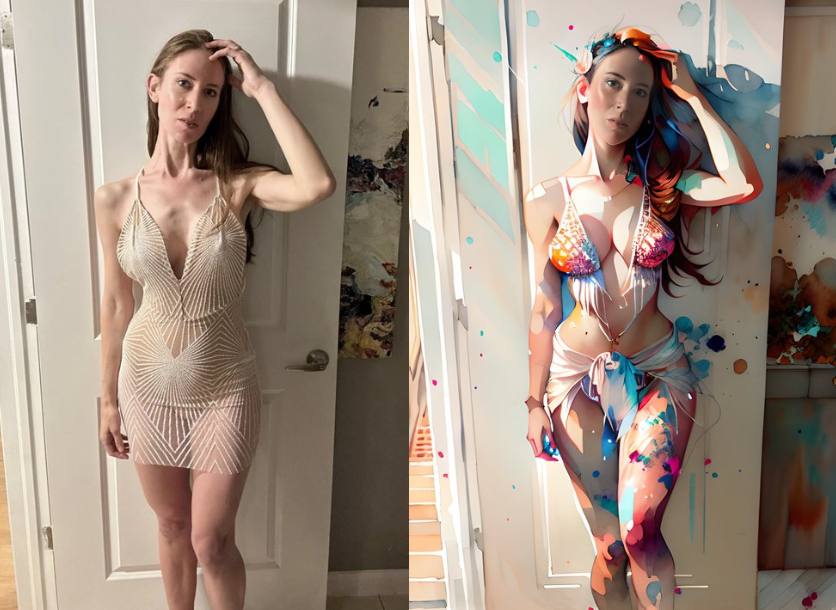
I saw Prequel in an ad and thought it looked cool, so I gave it a download and started playing with it. From the first photo I gave it, I thought the output was fabulous. I decided to subscribe to it, at least for a bit, and give it more photos of myself that I like - usually photos that I’ve been using for swimsuit contests or Instagram posts.

To “make” these, I used the AI Style called Watercolor in the Prequel app. Most of the images here are first-time outputs, so I didn’t re-run the AI over the photo - the first try, I thought, was cool enough.

The faces are a bit uncanny at times, but they do seem beautiful when all I gave it is a face.
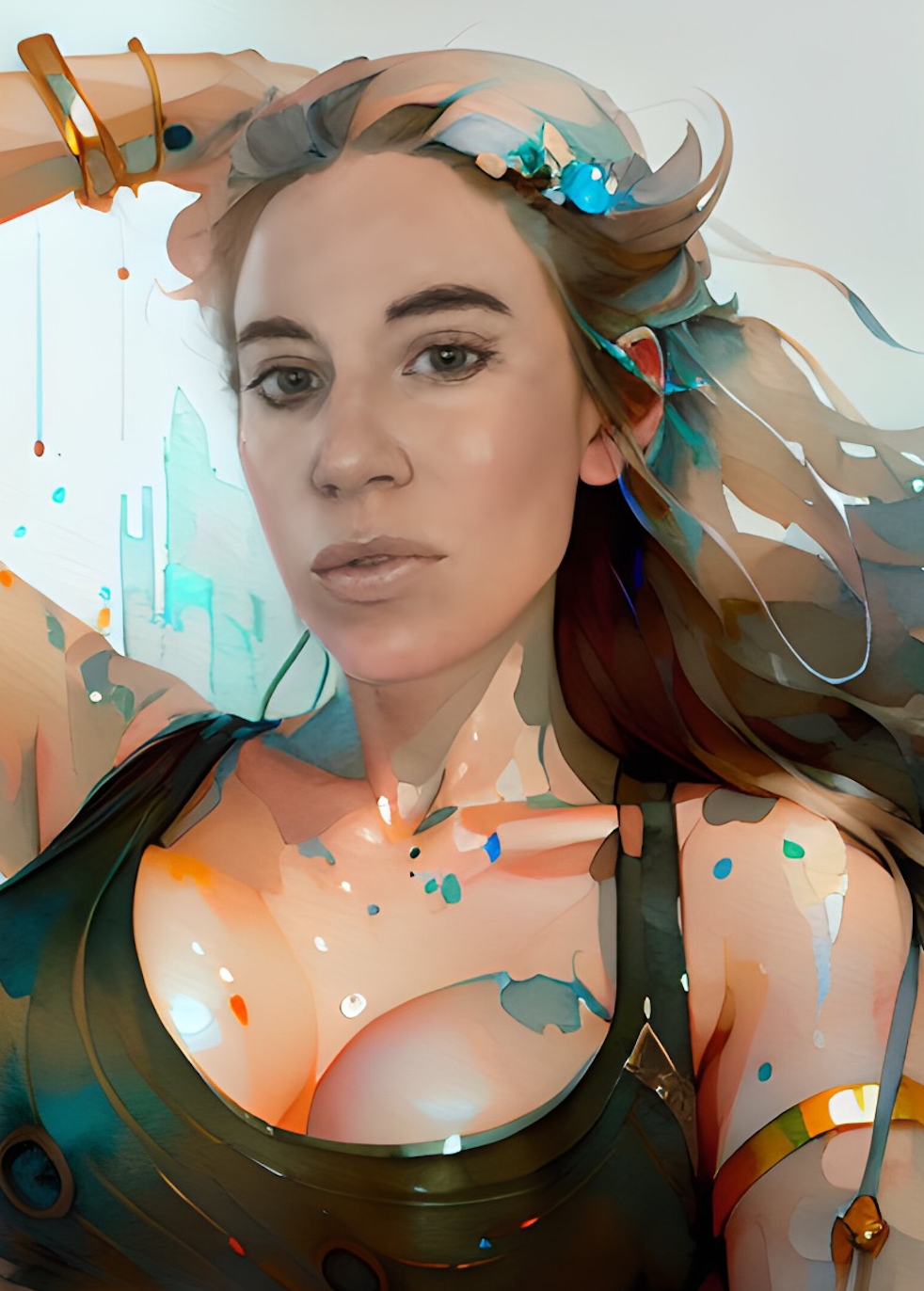
What all of these remind me of are Photoshop or illustrator magazines, where the cover of each magazine features a beautiful woman and stylistic flourishes of color, linework, or paint splotches. Only the AI work is a bit less exact, there are moments where ears, noses, and facial edges aren’t that clear or defined.
I couldn’t find much about how the AI works or how it operates - if it’s highly trained on people’s existing artwork, or less so. I found a few apocryphal blurbs on Wikipedia and that’s about it. Unlike some AI art generators, it’s not based on prompts, only photos and AI filters.
What I notice it seems to do is make my eyes ever-so-slightly bigger, darkens my eyebrows, and it grabs highlights on my face and makes them even more highlighted. After looking at these I felt drawn to the idea of applying more moisturizer, or I felt the need to buy some highlighter, or something. I don’t dislike it, it’s only something I notice. I did like what it did with a photo of me with my hat on, it turned me into a kind of Indiana Jones type character.

After looking at this I sort of thought - I should get a hat like that, haha. I had the same thought when this one below popped out - the dress in it is pretty, though I don’t like the ragged edges at the end so much.

When I was in my art major and heck probably even right now, people would get a little depressed when they learned that many realistic artists use projectors to paint. I think I was a little dismayed too. Some of the magic or romance of art went away, but it’s also nice to know that some art is made with tracing tools, because unique deviation from reality and the human element is what makes good art so good. It’s still worth it to learn to paint and draw realistically.
I’d say the same is true of AI, it’s still worthwhile to be an artist even if machines seem to be outpacing us. It’s a way, and there are many other ways, to make images.
It would be a mistake to say that AI art is a phase or fad, that would be like saying gouache paint is a fad. It’s hot right now, and it might wane in popularity, but I don’t see it going away completely like pogs. I see it as a quick and easy tool that’s there, has near instant gratification, and people will continue to utilize. It has to be a lot like when the camera came out and painting suddenly seemed slow and a lot of work. It has to be like when phones got cameras and suddenly nobody had to go into a darkroom anymore, and everyone was and still is a photographer.

Is it hard to make these? I would say it can sometimes be hard to throw on a swimsuit and get a pose right. It’s not ‘easy’ to stay on the extremer side of fit. It is easy, though, to download an app and push a button and have a computer fairy put flourishes of paint around me, lengthen my already-long hair, and mist my face over with the sheerest digital makeup.
The other question that comes to mind with AI is: Is this taking someone’s job away? In my case, I think the answer is no. I don’t know if I would ask anyone to make a drawing of me like this. I can’t imagine myself sending someone a swimsuit photo and saying “Please make this into a drawing.” That’s not something I would do. But now that I’ve had an AI do it… the idea is in my head and maybe it would be cool? We also have to talk about the ease factor here. Pressing a button and paying 5 dollars is easier than mustering up a bunch of courage, vulnerability, and self-acceptance to ask a living, breathing artist to make a painting of us. Unless a person is a fount of confidence, there’s going to be some worry about how an artist will paint our necks, inner thighs, freckles. Like a duke getting a portrait commissioned in 1800, we’re going to assume the artist will smooth out our wrinkles but, what if they approach things so realistically that they don’t?
I think AI art - with all of its instant-ramen ready-now power - is giving us an opportunity to connect with those who create non-AI art. If we want something instant that gets us through the day, that is going to be forgotten in a week, we can ask the robots. If we want a deep, real connection, we will ask an artist.

The Sketchbook Confessional is a blog where I look at the past month and all the art and creative things I did in that month. Like a backwards to-do list, the Sketchbook Confessional is a ‘done’ list.
Painting:
In March I continued my Mountain Paintings series. I paint these on plexiglass that is either clear or already a color. It’s been fun to do and see what happens with the various color backgrounds.


I had a lot of fun making these.
I’ve started a new painting series that I call Space Cowboy, featuring cowboys and deserts, night skies with stars, galaxies, ect. I’ve really liked this idea and I’m going to expand on it. Below is a small 8 x 10 study of what I want the idea to look like on larger canvases or panels, which I think turned out well.

In March I also moved back into some realism or sketching in oil with turpenoid and have really enjoyed it.
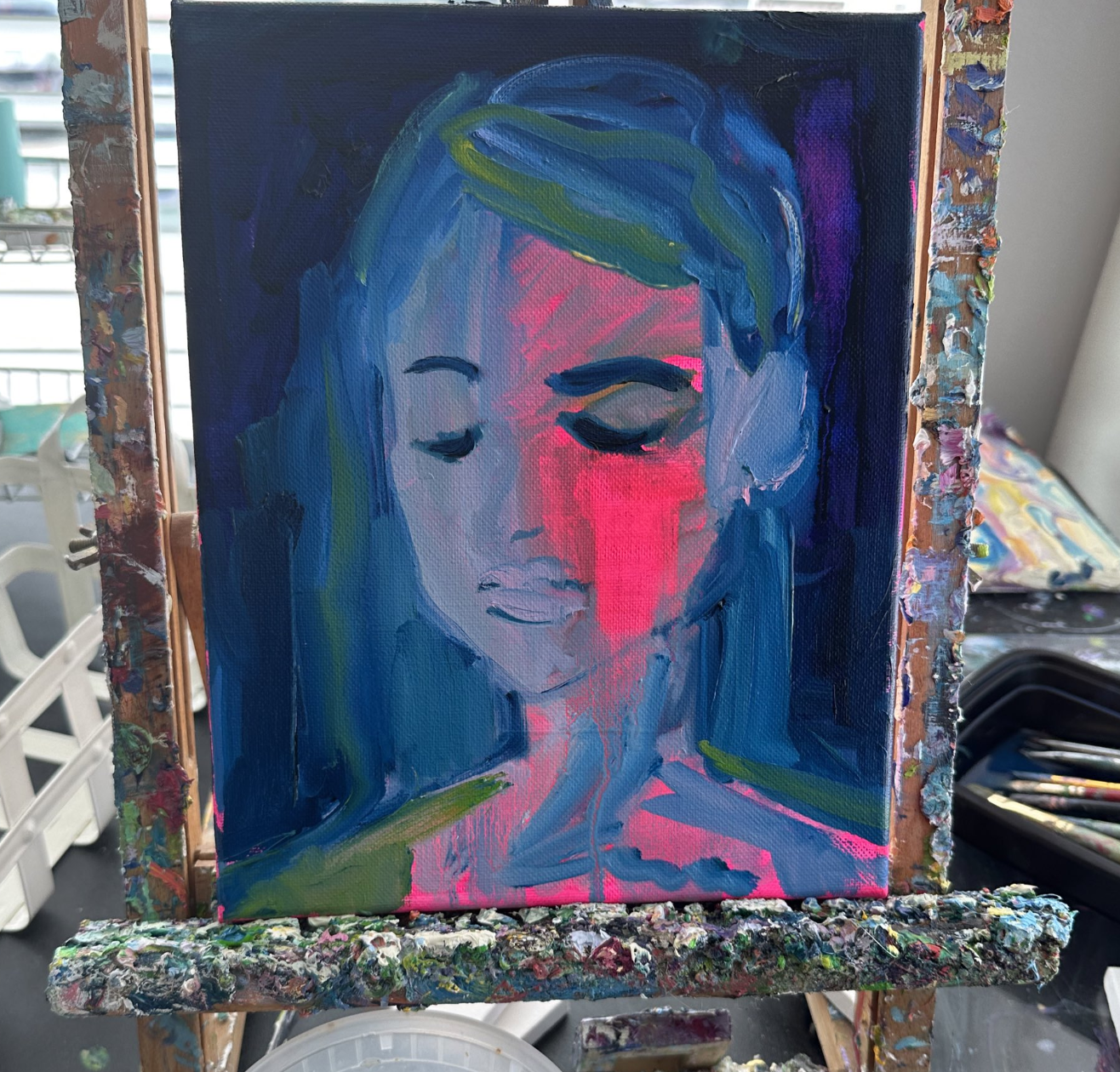

Now that I am painting in oil after having my baby, I am moving back into realism. I will be focusing on figures and maybe, landscapes, in April. It’s been an exciting way to work again.

I’m not sure why but sometimes I forget how much I’ve trained in realism and also how happy it makes me to paint this way. Maybe writing this will help.
Lately I moved my studio to a new part of my place so it’s more light. It’s been really nice.

As far as things outside of the studio, I did get out to paint a bit en plein air at the end of March. It’s been a very snowy winter, and cold, so it was very cool to get out on a nice day. I painted in oil en plein air for, I think, the first time in a couple years, as most of the plein air paintings I made in 2021 were gouache.


On the digital drawing/design side of things in March, my friend’s cat, Bitty, is running for Pet Mayor of Louisville so I made some button designs for Bitty’s campaign. It was really fun to do this.

Travel:
In March I went to DC for a bit, I saw a friend’s art show, went to the National Gallery, and I caught a bit of blossoming season. I can’t believe my incredible luck with this. I don’t mind being one of those silly, over-the-top tourists who gets really close to the trees and takes dozens of photos. Some sights in life never get old to me, and those include tree blossoms, mountains, and water.


I also stopped by my hometown of Leadville to see a tiny bit of skijoring! It’s always fun to see this whenever I get a chance. Few things are more “Leadville”

Reading:
On the plane back from DC to Denver, I finished reading The Urth of the New Sun. This book brought Book of the New Sun home for me, as I’m sure it does for most people. I won’t say much more but I loved it. I bought The Fifth Head of Cerberus and The Litany of the Long Sun to read next.
Running:

I had some decent running in March! I’m still getting ready for the Leadville Heavy Half this summer. I knocked out an 11 mile run in Boulder that spanned from Wonderland Lake to Chautauqua and back again. I’ve always wanted to do this, and, it’s very possible. I’m not sure why it took me so long to finally do it, but there you go. Every time I run up Chautauqua there’s a lot of elevation gain to be had. It’s also pretty hard, I think at least, to run from Boulder Creek up to Chautauqua and then keep running around Chautauqua.
The Sketchbook Confessional is a blog where I look at the past month and all the art and creative things I did in that month. Like a backwards to-do list, the Sketchbook Confessional is a ‘done’ list.
In February I reworked some of the drawings I did in 2015, 2016, and 2018, I made them a bit looser and more colorful:


In my original drawings like this, the colors were only blues and whites. It’s been fun to revisit the drawings and redo them.
I added a new piece to this series too:

In February I started a new kind of painting - I am making imaginary landscapes with hikers or backpacker figures in each one. It’s been an adventure to do this. I really like what I am making, with these.

These are painted on clear plexiglass and also color plexiglass. It’s fun to have a color background to effectively work as a built-in underpaint color. Some of the plexiglass colors that I have are very bright or different colors than I would typically use as underpainting colors, so they are a good stretch of my routine.

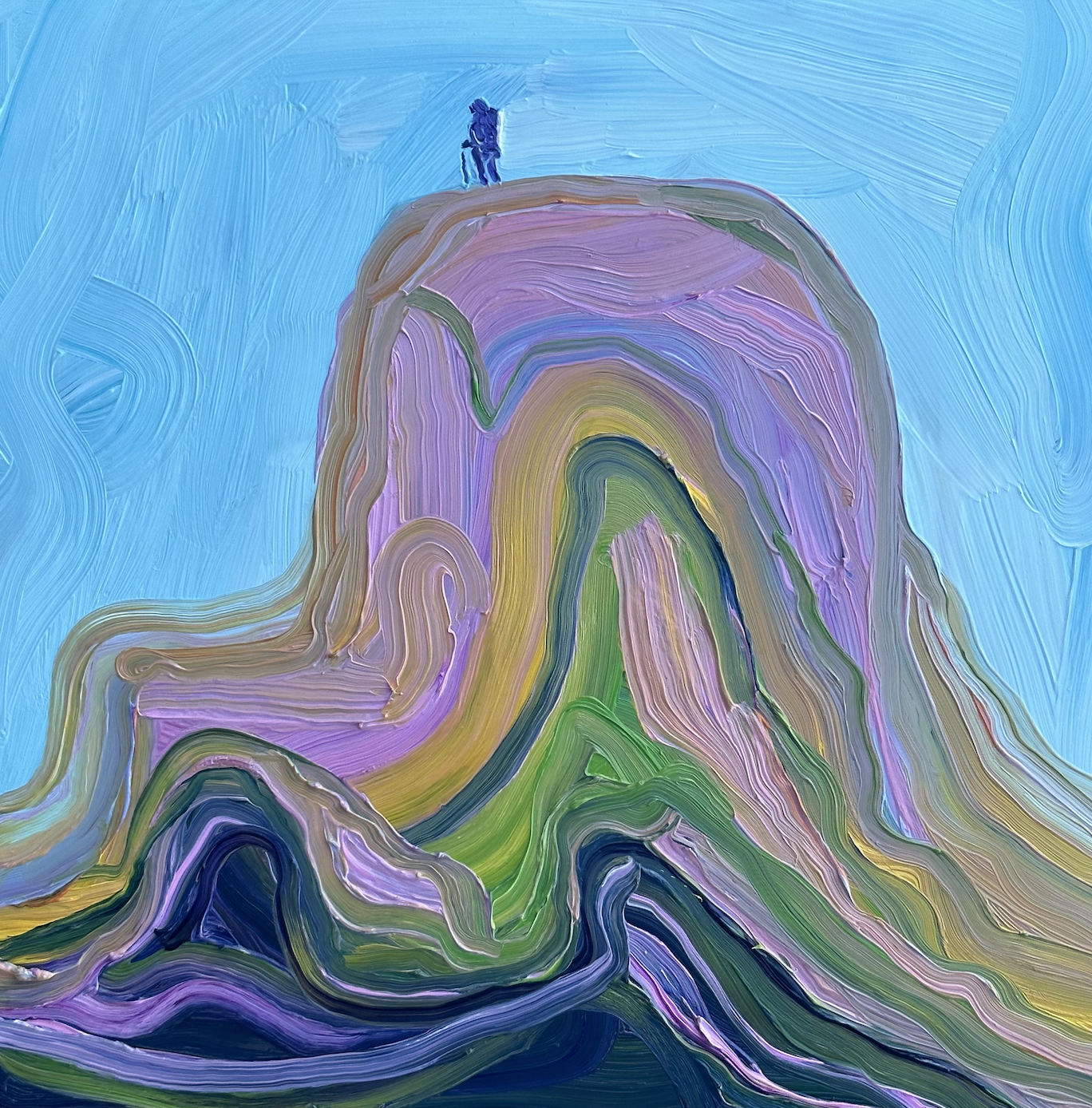
In February I did a few paintings of Mt. Elbert that I don’t see as finished yet. I will add a couple more touches to these over time.


I added these to this blog to see how they change next month. All I have to say for these is they are super thick paintings and I love them. They will definitely take a bit of time to get done.
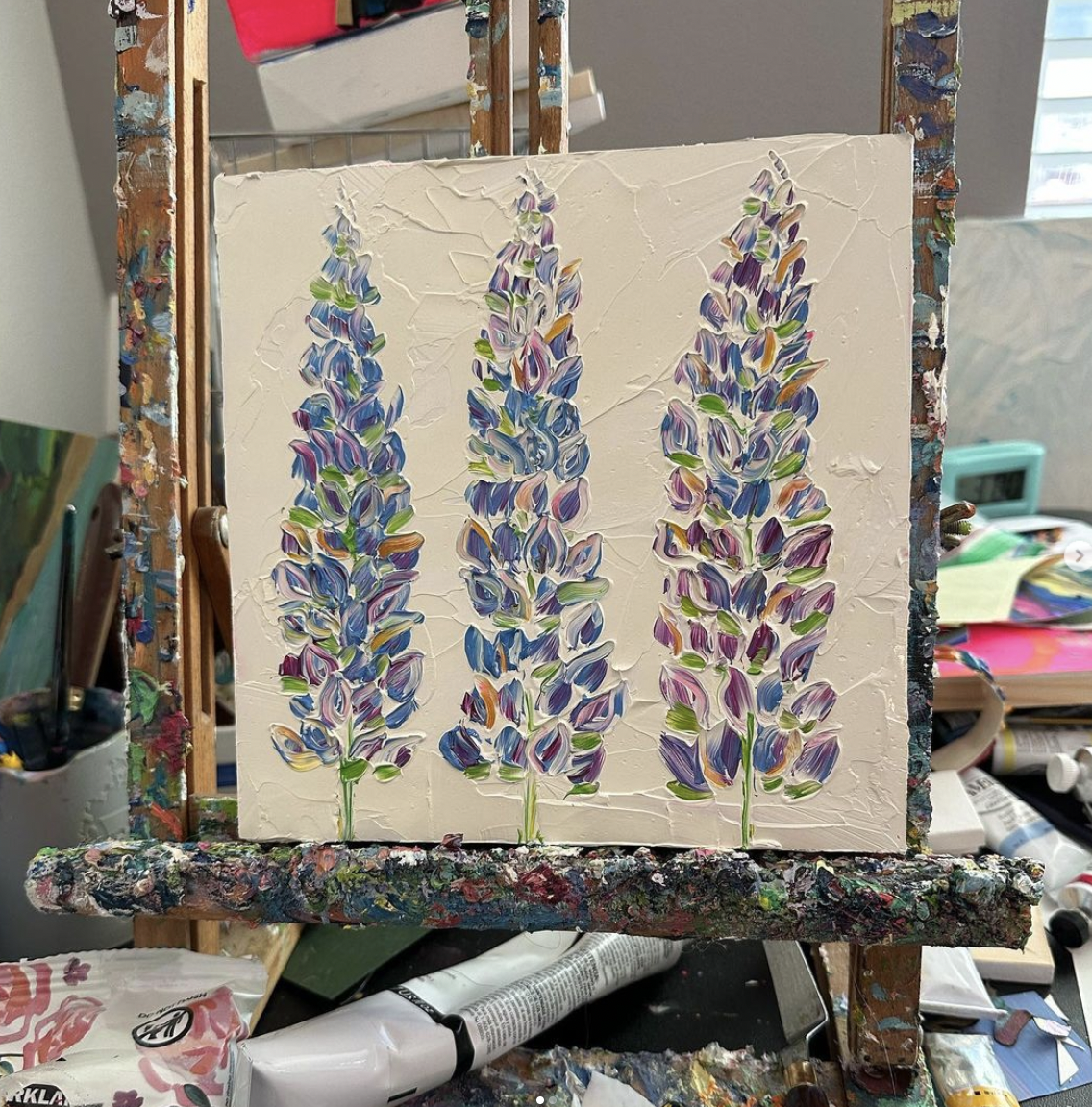
I made a few lupine oil paintings also.
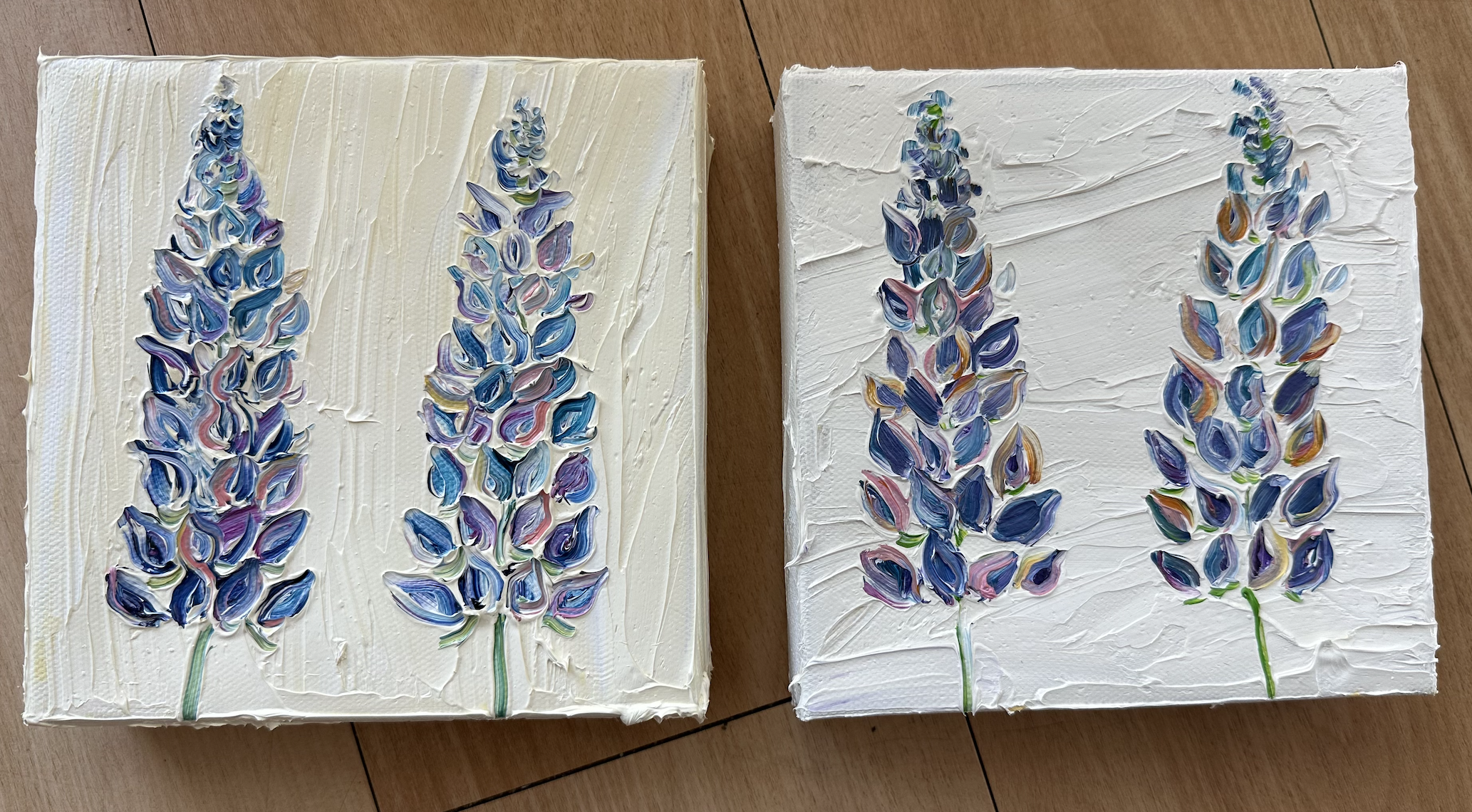
The lupine paintings are a fun way for me to get into the swing of things with impasto.
In February I was able to get outside and do a few plein air pieces. I went to Boulder Falls the day before Valentine’s Day and did a few watercolors that I enjoyed making.

I think of romance a lot in February since it’s the month of Valentine’s day and it’s unavoidable, but I also think of February 14 as exactly half of February, most years. I also like that there are so many flowers in the supermarkets because they are green and there’s not much green around in Colorado in February. It’s such a short and cold month, not as dark or cold as January, but still cold. I do like running and skiing in the snow but I don’t mind the idea of beaches and sun.
I signed up for the Leadville Heavy Half marathon and knocked out a few runs in Leadville in February. I have a long way to go before June. As far as training, what I’m up to is going for hikes or runs whenever I can get childcare for Baby Jewell, or the occasional stroller run. I think the stroller running makes me stronger but who knows. I also don’t want to put Baby Jewell through running in some of the 0 degree weather we’ve had lately.

All in all I’m happy with my mile splits for any given terrain, this spring I will work on driving down the times for my splits at high altitude or over 10000 feet.
Overall I’m feeling 100% and have felt this way for about a month after getting Covid in November. It really did take about 8 weeks before I felt normal or back to where I was after I gave birth.
That’s what I got for February! Until next time, see you, Space Cowboy.
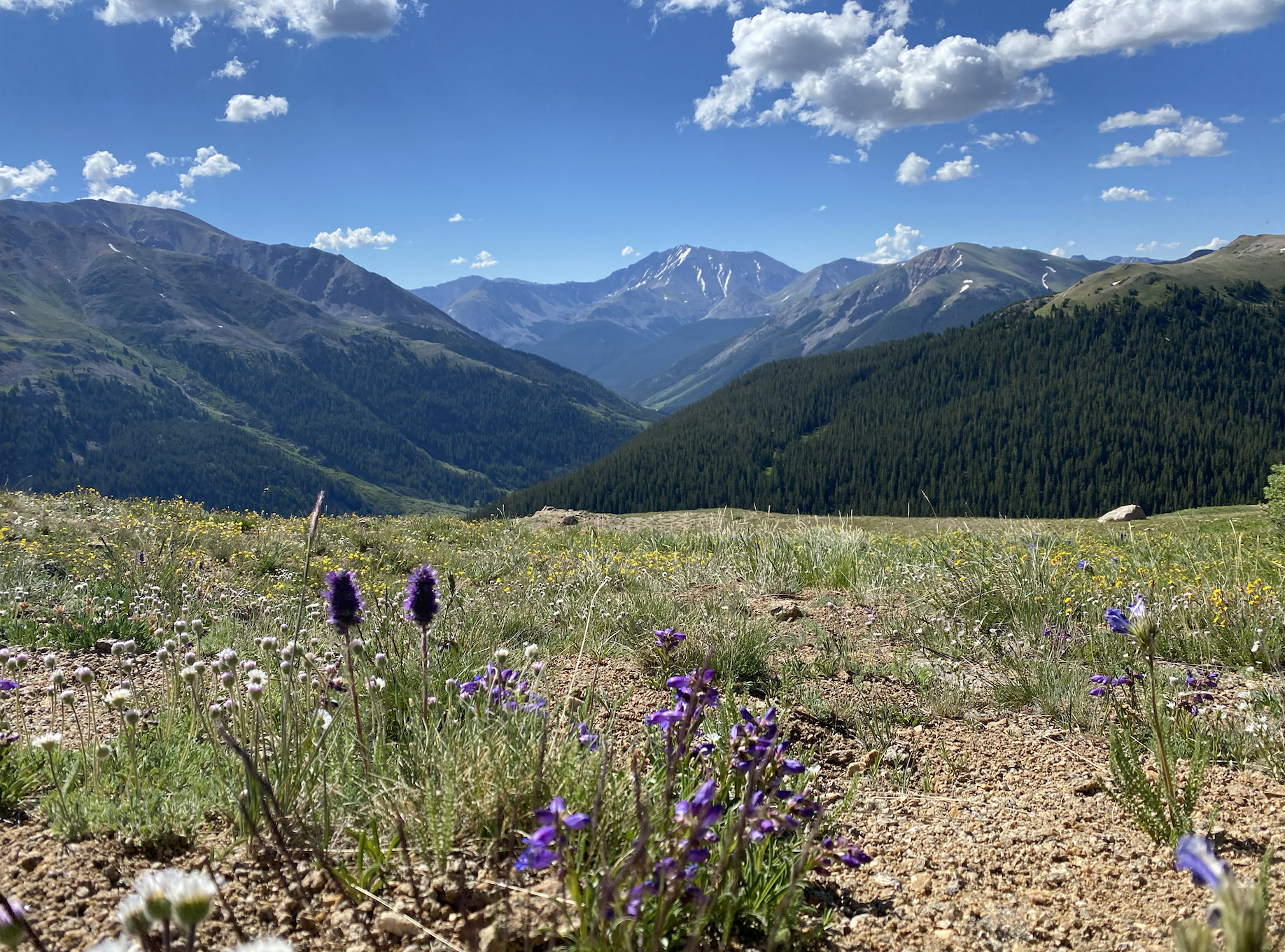
Between Aspen and Leadville, Independence Pass is open in the summer. It can be a harrowing drive up from Aspen and a little easier, I think, up from Leadville. For these photos I drove up from the Leadville side in the summer and walked around a bit at the top of the pass.

I was able to see a group of female bighorn sheep with a few babies right off the road! It was fun to see them. I’ve seen male bighorns nearby as well though they are more solitary.


The Sketchbook Confessional is a blog where I recap all of the art that I made in a month, as well as what I’m reading, watching, writing, and up to as far as exercise.
Art:
This month I waded back into oil painting with a few paintings of the Boulder Flatirons.
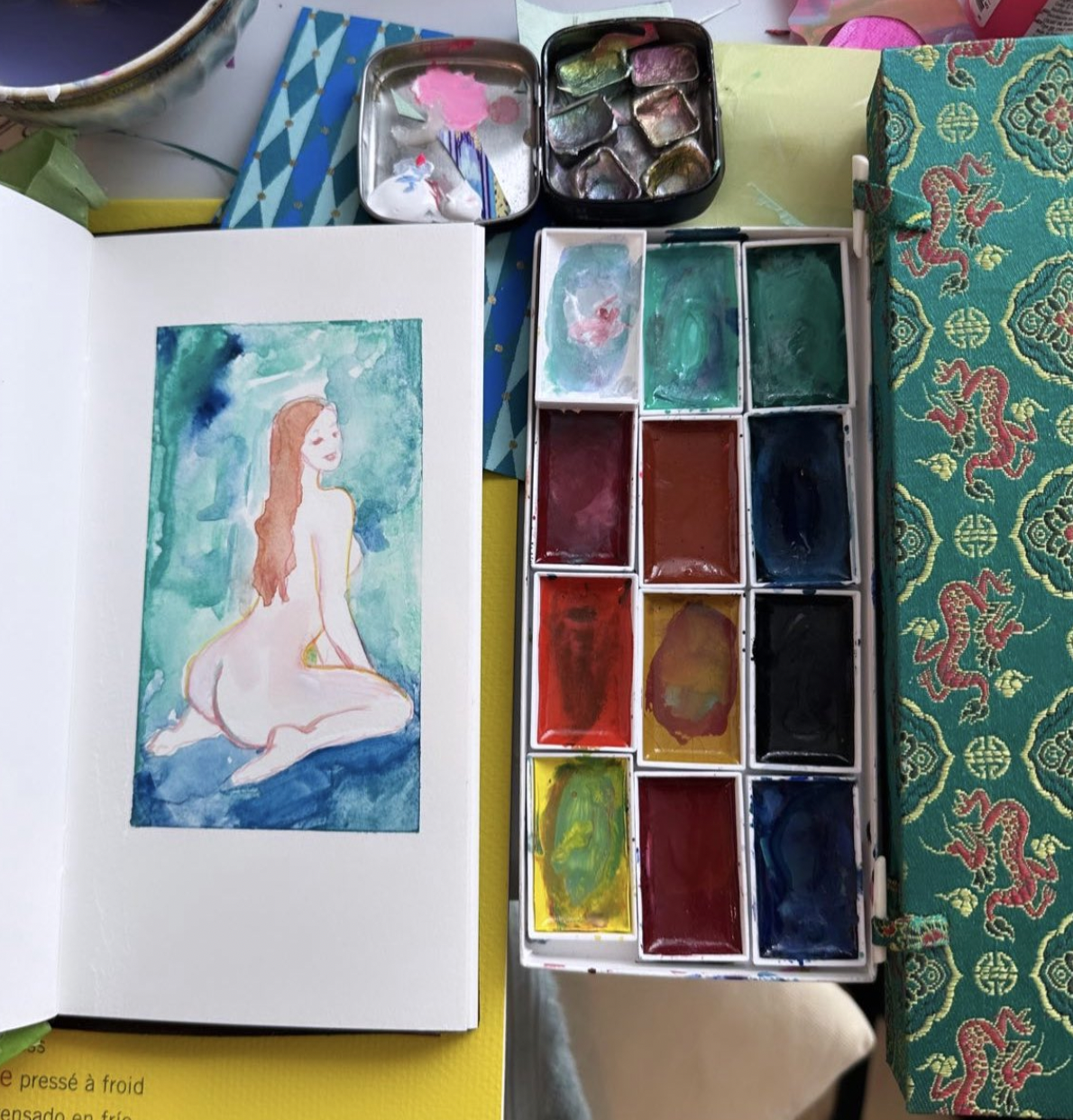
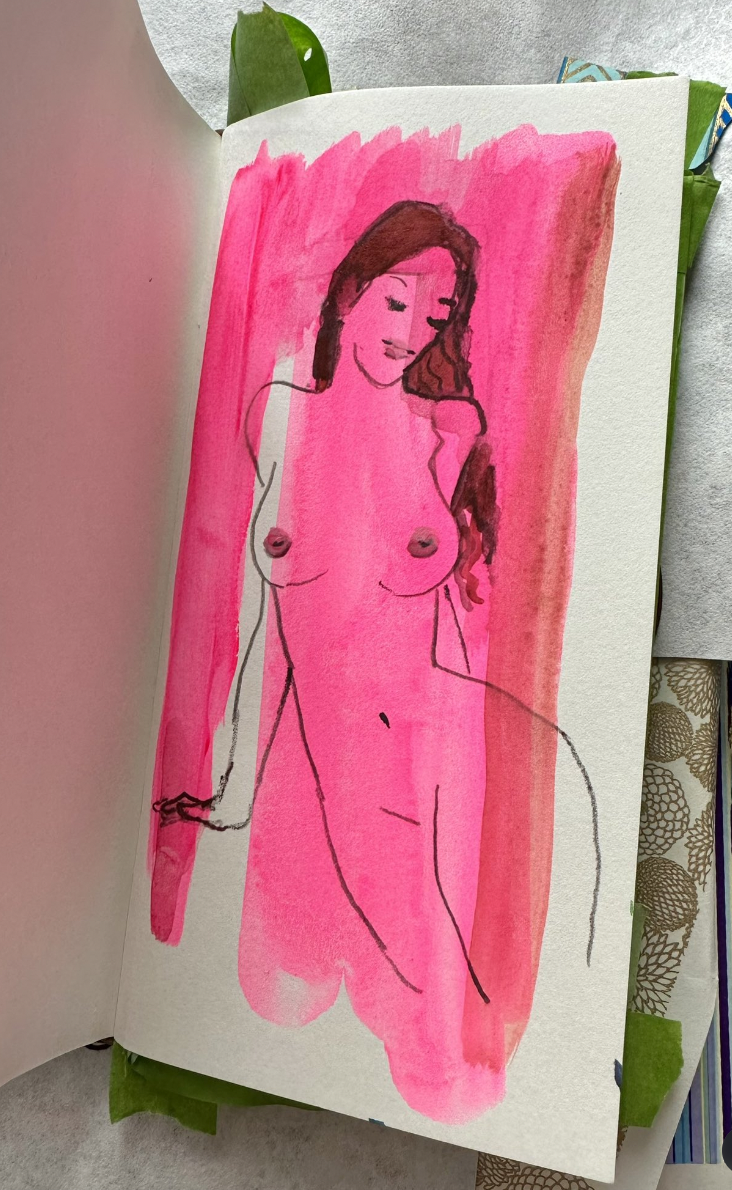
I had a lot of fun painting in my watercolor paper in my Traveler’s Notebook. I discovered the magic of taping off the edges of the paper and painting within a little square or rectangle. Oddly I have never tried this before and I really enjoyed it.

I painted a few fish in watercolor on paper that I’d purchased on my Paris trip in 2017. I’m glad I saved the paper for these rainbow trout, though next time I think I will use it sooner, haha.
Speaking of documentation, In January of 2023, I finished reading several books and also blogs covering my thoughts about the books, as well as art related blogs. I find that when I’m caring for my baby, I always have time to either jot down a few sentences on my phone or read my kindle. Here are all the blogs I finished this month:
All Art is a Force of Optimism
Painting the Boulder Flatirons
Quote blog: “All art is quite useless” - Oscar Wilde
Book blog: The War of Art - Steven Pressfield
Book blog: Never Finished - David Goggins
Book blog: The Philosophy of Andy Warhol
In January I created a couple new designs that I figured I would upload to Society6.

Overall I had a lot of fun making the above design using goauche, acrylic, and watercolor on duralar.
I made several oil paintings this month. I have had a lot of fun ‘drawing’ with oil paint, which I’ve done before - what I end up doing is laying down a thin layer of white or offwhite paint and then drawing into the paint with a dark color like teal. Impasto or thick painting is pretty unpredictable but drawing with it is at least a little controllable.


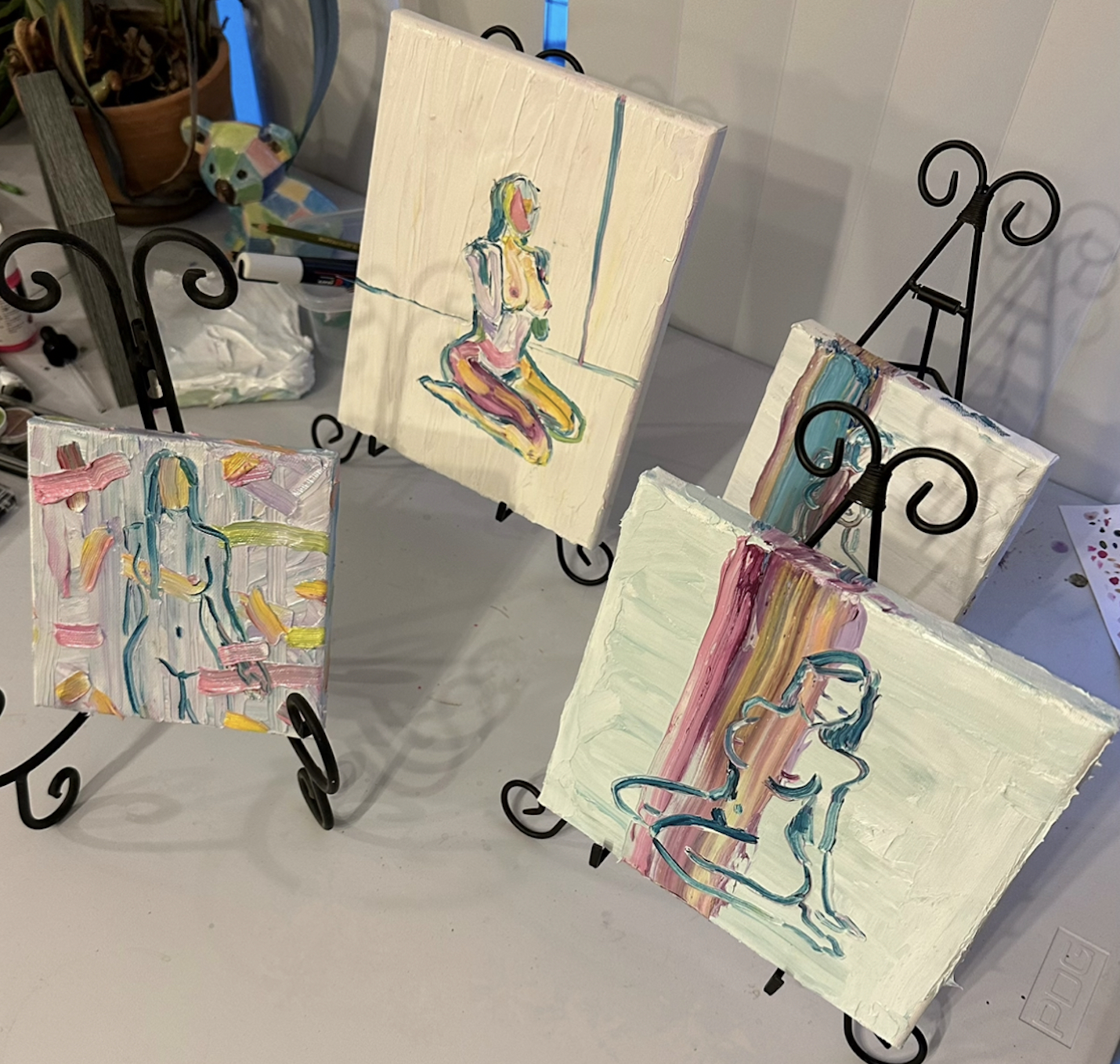
I stayed on two subjects this month, mountains and nudes, which I plan to continue throughout the year now that I feel better painting in oil again. I stopped for a while out of concerns for breastfeeding and while I was pregnant with my baby. If you’ve ever smelled oil paint you will probably understand this, haha. It’s nice to be back.
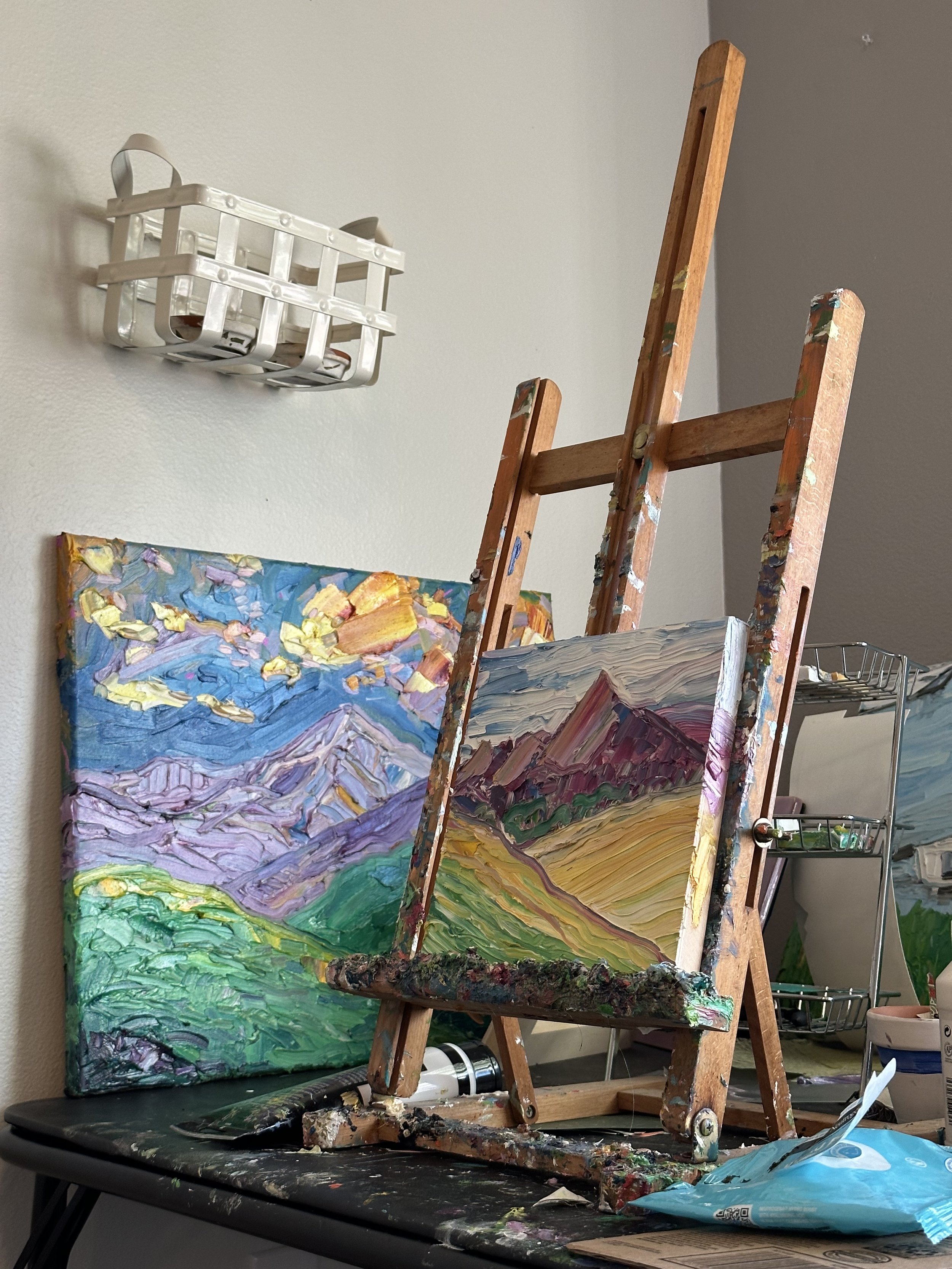
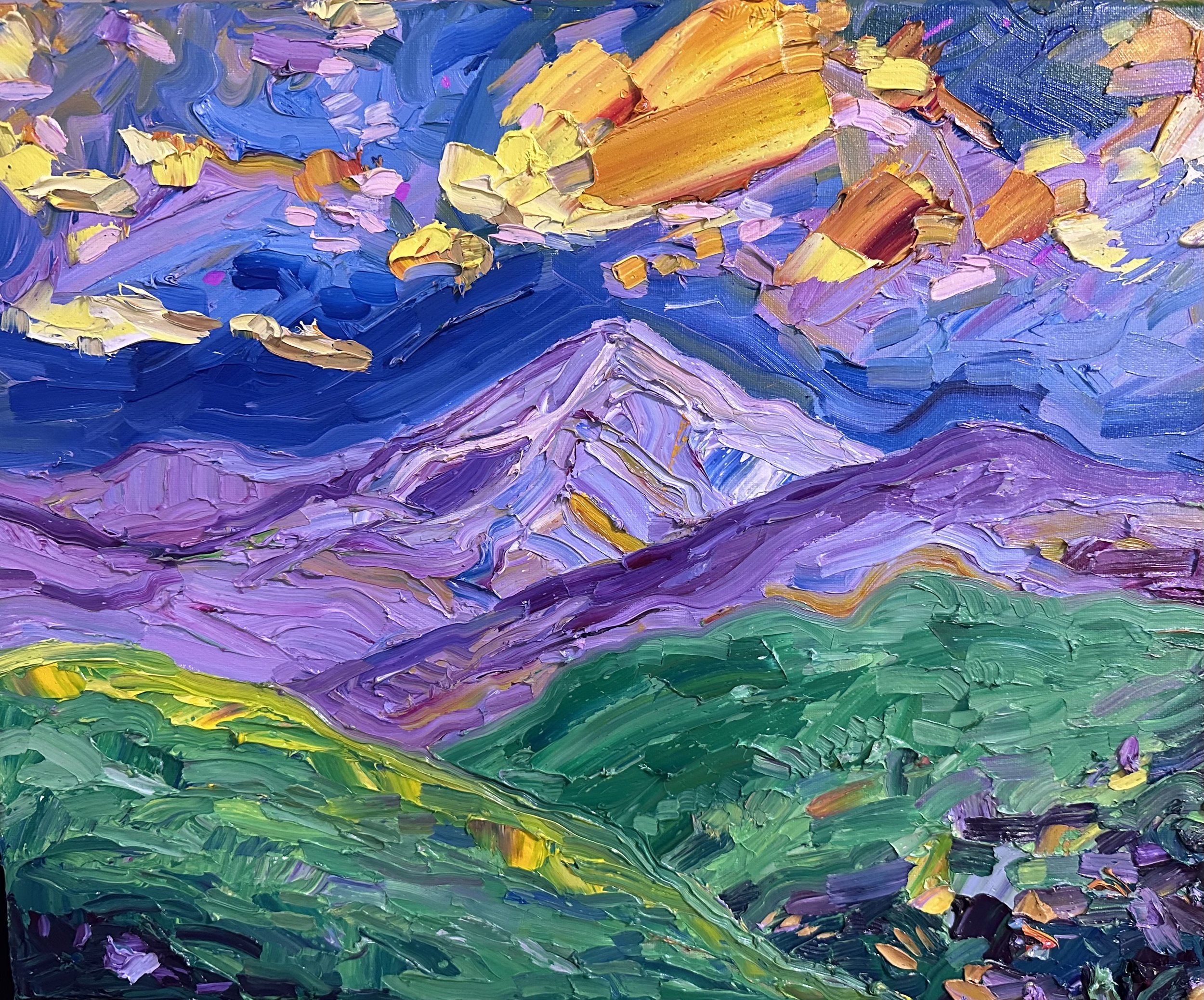
The painting of Mt. Elbert that I made at the end of December dried out this month though it did take a while.
What I’m reading:
I had what I think of as a huge literary accomplishment this month. I finished reading the first three books of Gene Wolfe’s Book of the New Sun. I started reading it in 2020 and put it down for a few years, and only recently in 2023 have I powered through the last 30% in about a week where it was too snowy to go outside and I was too overwhelmed by the idea of brushing the snow off my car and chipping at the ice on my windshield. I had also run out of books to read and it was my last book I could read for free before buying a new one. This is also how I ended up reading as much Proust as I did, if I am on an airplane for a long time or stuck indoors somewhere I do end up reading books that otherwise seem impossible to scale.
I decided to start drawing pages from Botns as warmups on my tablet.
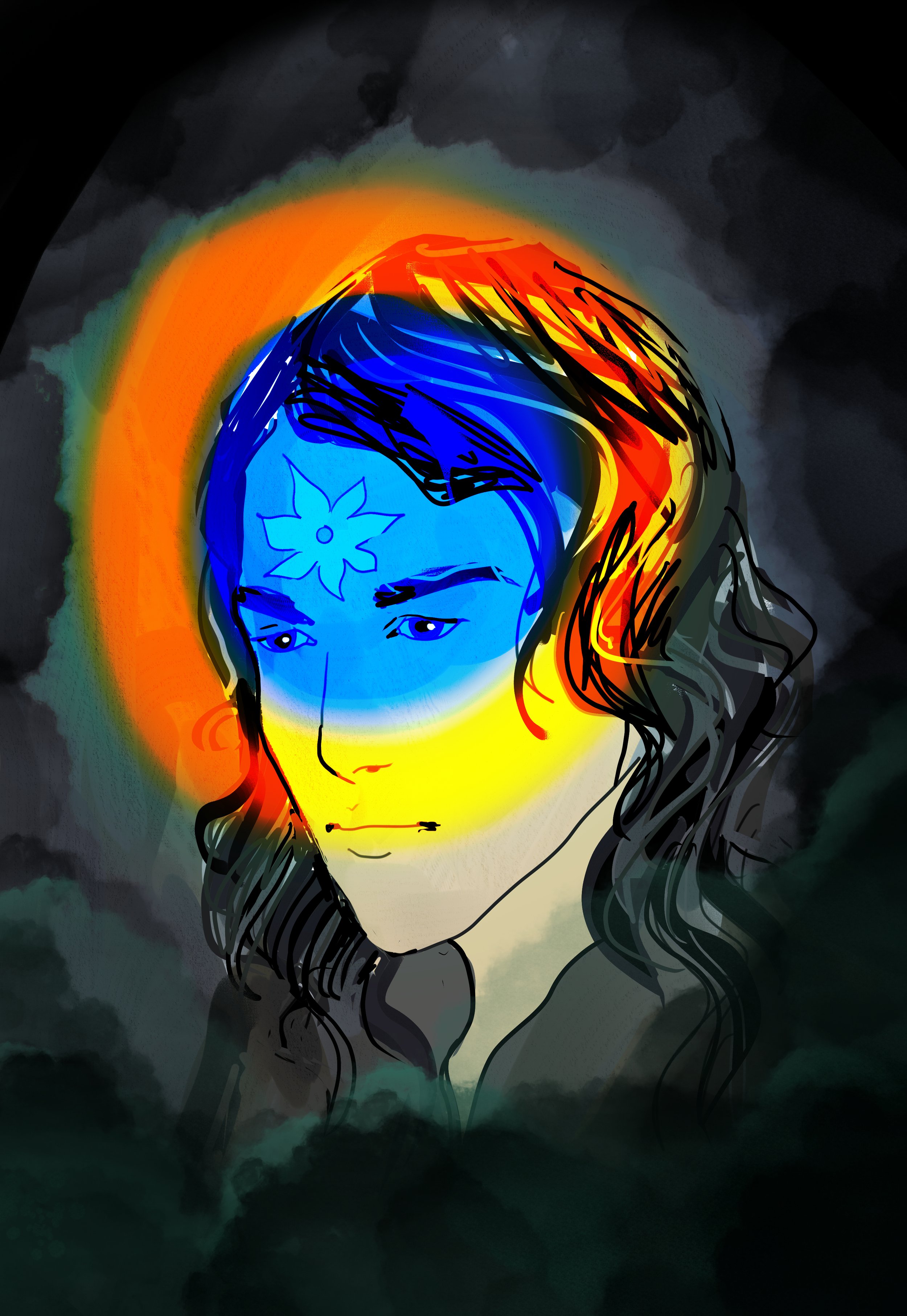
I think Severian is an interesting character because he does so many unlikeable things yet he does his best in all the terrible situations he finds himself in. He’s way more likeable to me than the character in Dune. Anyways, I’ve drawn some Botns stuff before and I’m excited to do more of it.
I think Botns is hard to read because of the violence. Otherwise it’s worthwhile. If anyone were to read this blog and start reading Botns for the first time afterwards they’d probably be like “omg why does she like this book, this is horrendous.” All I can say is it gets better at the end or in the last half. The language or writing is good the whole time but I liked the last half of the plot a lot more than the first half. I’m now reading through book 4, which feels like an afterwards, yet is still a part of the series.
This month I also finished Steven Pressfield’s The War of Art and The Philosophy of Andy Warhol, along with the new David Goggins book.
Running
I did walk a bit in January and squeezed in a couple 1 mile runs around Chautauqua. On a couple days, I hiked with my baby and my easel and a diaper bag, for a total of 42 pounds of weight I was carrying around. I sort of couldn’t believe I was doing this, but I did gain about 40 pounds while pregnant so maybe it’s not so different from how I spent most of 2022.

I knocked out a 7 mile run at the end of January and was glad to feel like I’ve completely gotten Covid out of my system after a rough couple months of residual symptoms. The first 3 mile run that I did after having Covid felt horrendous, I felt like I’d never be the same. Luckily I got over it, somehow, and am running back at my 2021 levels. It took about 8 weeks to feel better. After having my baby I was able to knock out a 6 mile run pretty easily, so I think Covid was harder on me than having my baby, strangely enough. I hope I never get it again.
Until next time -
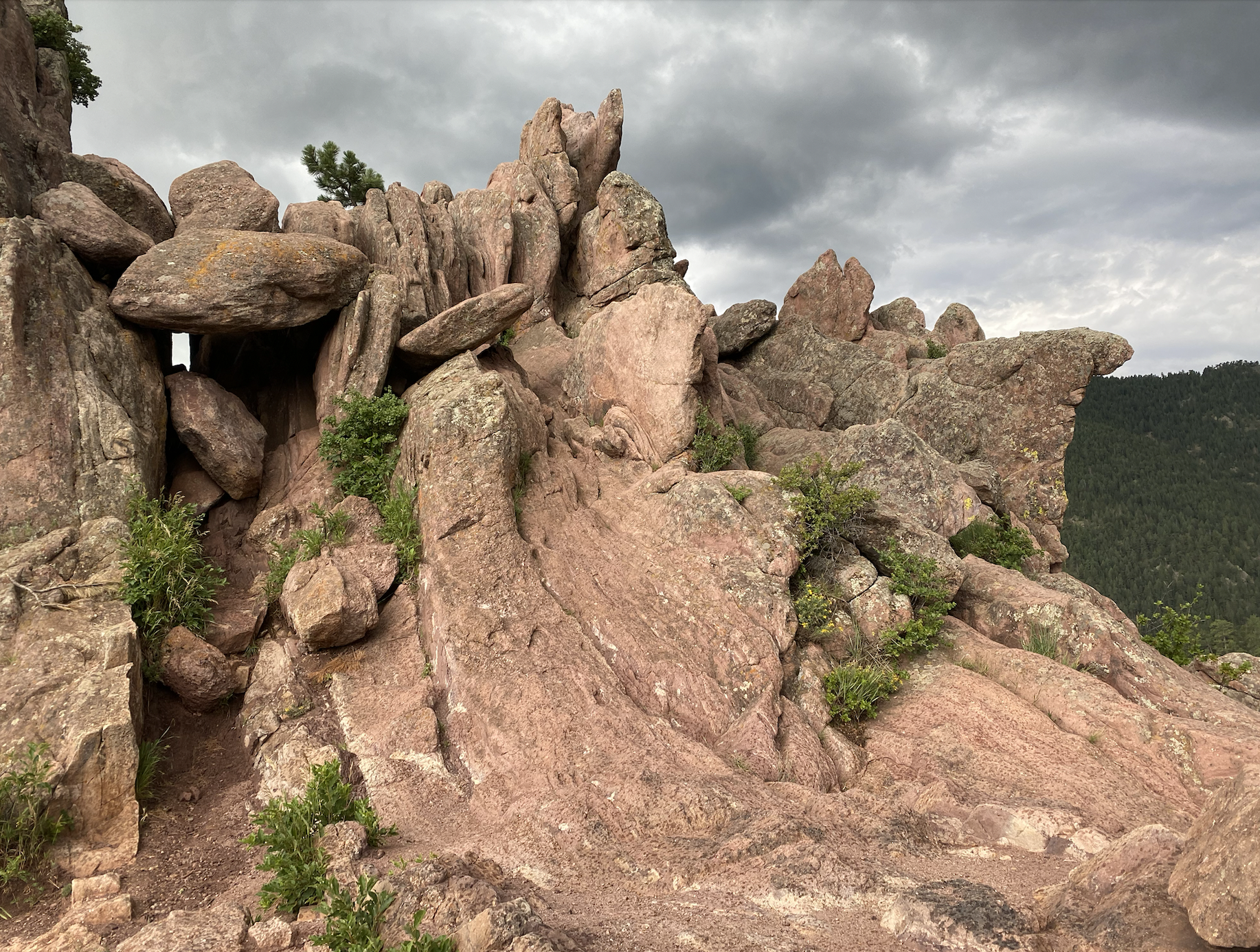
I’ve visited the Red Rocks Trail in Boulder often to either paint or just hang out. It’s a fun trail to get to, a little hard to find parking in the summer.
I liked taking photos on this overcast day, the colors of the rocks stand out when the sky is gray.


Every now and then I paint here, it’s very fun because the shapes of the rocks are so different. I’ve really liked every painting I’ve made at this trail or from sketches that I brought back to my studio.


I visited Red Rocks in the winter recently because I’d never been up there with the snow! It was totally deserted and very beautiful. For once, the trailhead parking lot was empty - probably because it was about 5 degrees out.


It was a little difficult to get up on the rocks, I wouldn’t recommend this hike in the winter without studded shoes. It was also easier to get up the rocks than go down - definitely a beautiful place to go and good to be careful.

When the snow melts in the summer in Leadville there are many small waterfalls to be seen. They’re very beautiful. I have a few photos of these here.

What I love most about these waterfalls is how much they change the terrain they fall on - the high rockies are usually dry and brutal, but all kinds of life - flowers, mosses - can grow around these snowmelt falls.


It seems like another world. These waterfalls are probably at about 11,000 feet, maybe even 11, 500 or so.

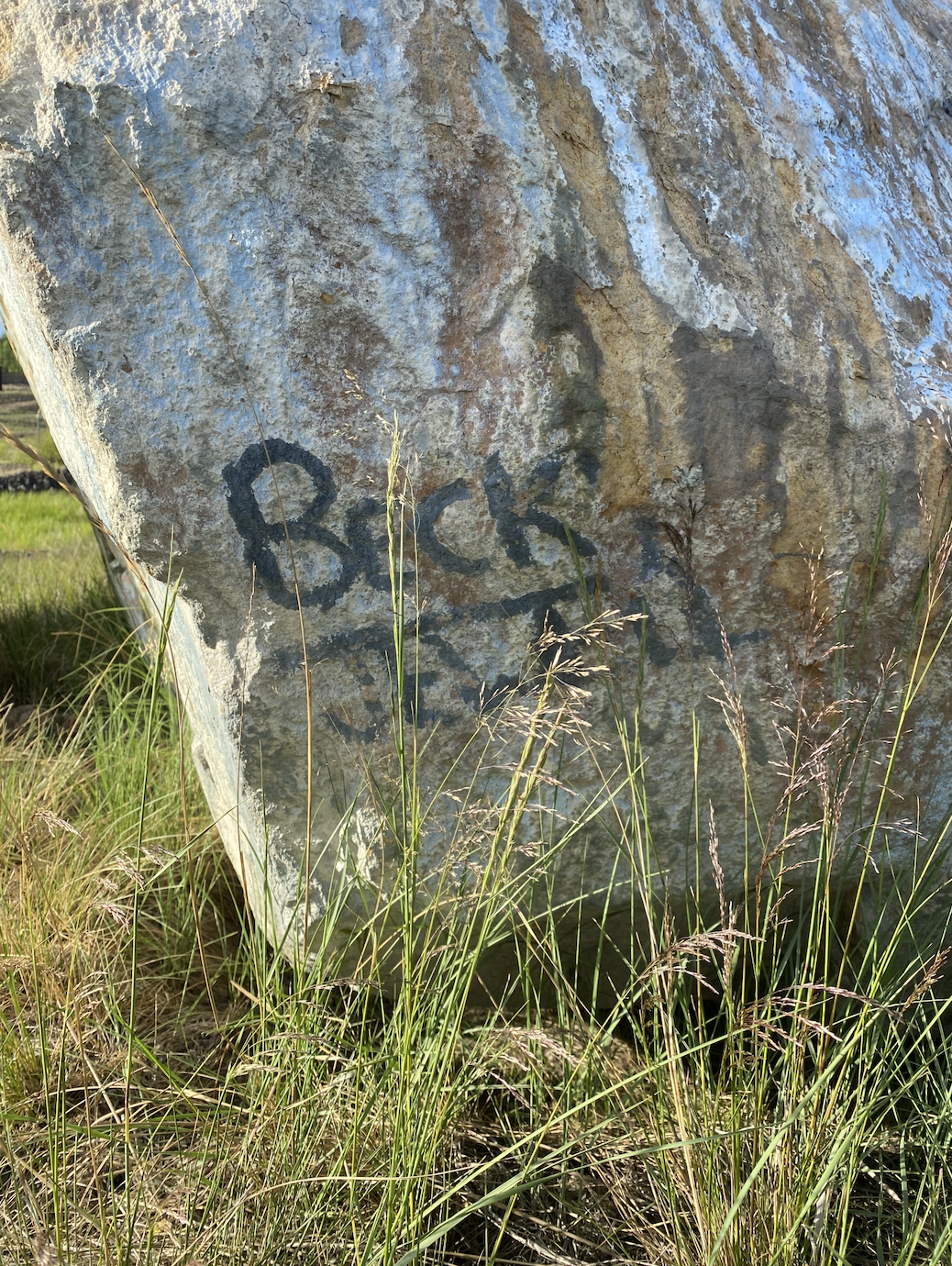
In Leadville you can still see some rocks or large boulders that I painted in high school for the Boom Days Drilling competition. This one is my favorite, it was a bright sky blue and now is a powder blue.


In 2022 I was lucky to get up to Brainard Lake and go even a bit further to Long Lake. There were many wildflowers and waterfalls to be seen! I loved it up there and I didn’t realize it was about 10000 feet until afterwards. The terrain and flowers remind me quite a bit of the high country around Leadville for this reason.


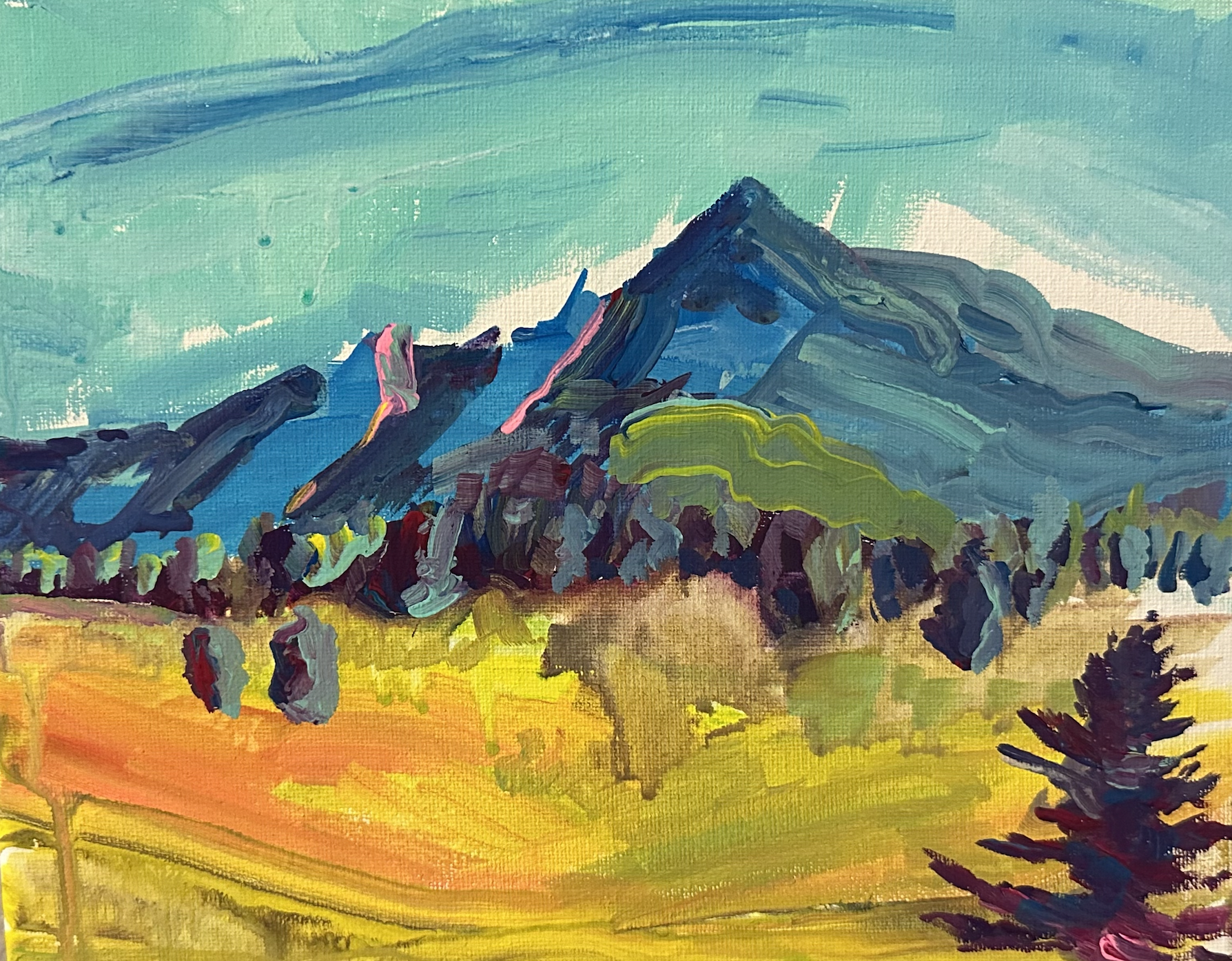
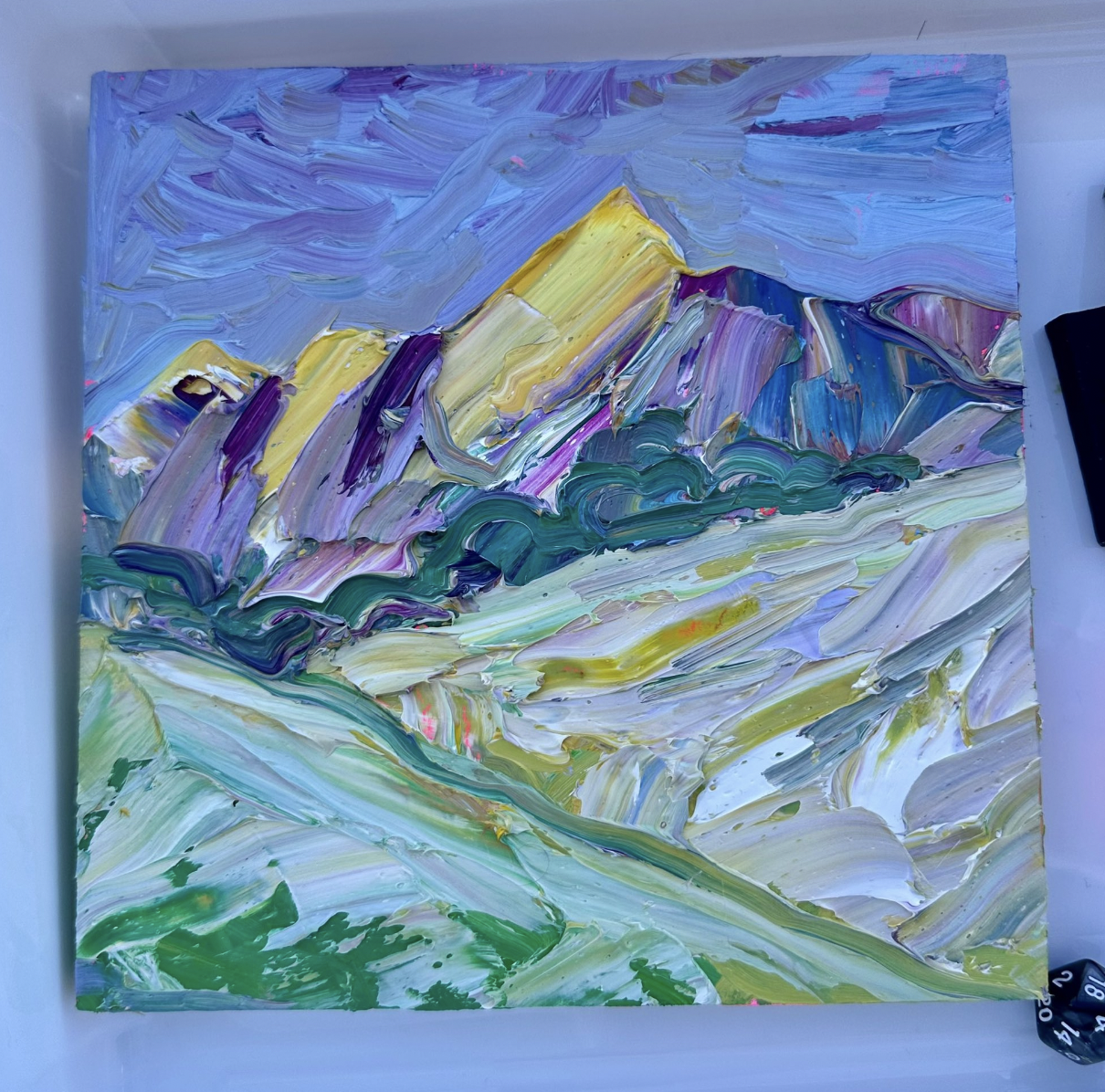
I’ve had fun painting the Boulder flatirons from the large open area of Chautauqua park. In 2021 I painted a few flatiron paintings en plein air in gouache.

I’m using the paintings I made en plein air to create oil paintings in the studio of the flatirons. I also go up to the flatirons every now and then to catch the sunset. It’s the most colorful part of winter.


It’s been fun to do this as a way to get back in to oil. My usual mountain subject is Mt. Elbert over Leadville, and I’m enjoying figuring out the flatirons as painting subjects as well, they are very fun to figure out.
I’ve also painted higher up in Chautauqua park, it can be challenging to hike up with an easel, and it is fun to paint the sunset there, especially in June and July, when large rainclouds appear across the front range.

What is great about this area is that in the summer and the winter, there are many layers to paint. Even the area in front of the rock formations is interesting and full of waves and lines.

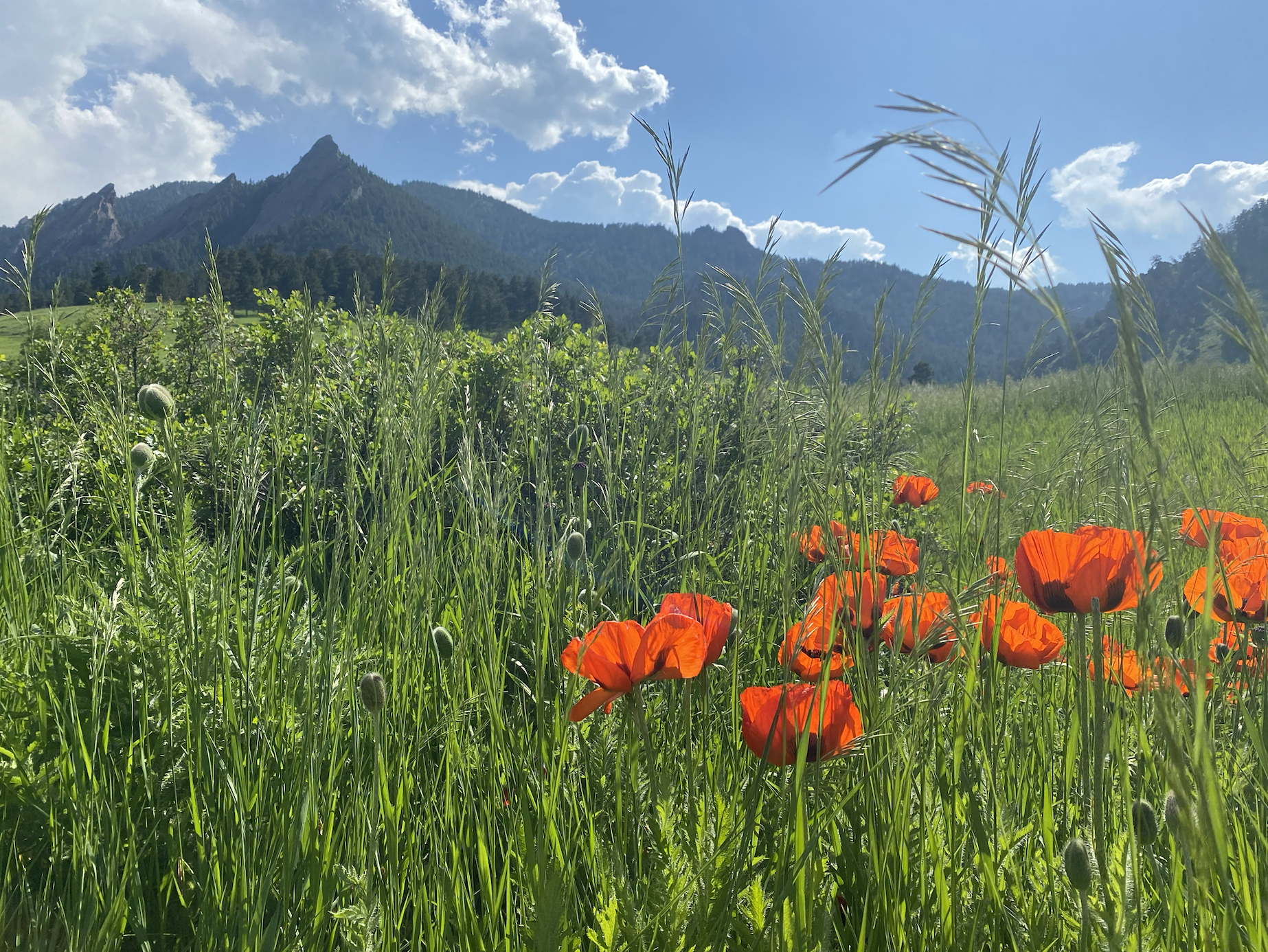
Here are a few of my photos of the flatirons in the summer also, it’s fun to see the poppies and various other flowers around Chautauqua.

What I personally like to do with the flatirons is paint them a bit plein air, then take the plein air paintings back to the studio to rework and add details. This way I get the energy of plein air and also the focus I need to really nail down the trees, grass, and edges of everything.

The book reads similarly to the Diaries of Andy Warhol, which I enjoyed quite a lot. The Diaries are a bit more my style because they’re massive and detailed and almost overwhelming, and what’s fun is you can look up any day, and find out what Andy Warhol was doing that day.
The Philosophy of Andy Warhol is a lot like a compressed episode of the Diaries, where Andy Warhol shops at Macy’s and talks to his friends on the phone for hours, but it is interspersed with overarching quotes or thoughts about life.
I like Andy Warhol a lot, and I think that the reason I like him because he is ready to admit things about life that other people don’t want to talk about, yet his art isn’t ugly or mean. I think that his admissions of beauty and unbeauty are novel or unusual right now in 2023, and may would have been abrupt in the 1960s. There’s something about Andy Warhol’s approach to life that feels refreshingly, maybe even shockingly straightforward. I wouldn’t use the words ‘honest’ or ‘blunt’ so much as ‘direct,’ and this directness doesn’t feel antagonistic or mean. It just ‘is’. Maybe this directness and fearlessness carried into his art, and it’s one reason why he was so successful. In addition to having scores of funny friends and understanding people very, very well, he worked, and eventually people worked with and for him.
What I think is the most true about Andy Warhol is that his ability to understand people led him to being able to predict the future. He seemed to know what people wanted, and because of this, he was able to know how the world worked and how it would work, which led him to his 15 minutes of fame quote. In this book, he also predicts futuristic moments like how much people will love holograms, and the idea of a metaverse or at least an online world or a community that isn’t in person. He does this without thinking of it in terms of computers, which I think is very novel. It feels like he predicted the high speed rail without first knowing about the steam engine.
There are a lot of worthwhile moments in this book, I loved it.

Book of the New Sun - Page 1
It is possible I already had some presentiment of my future

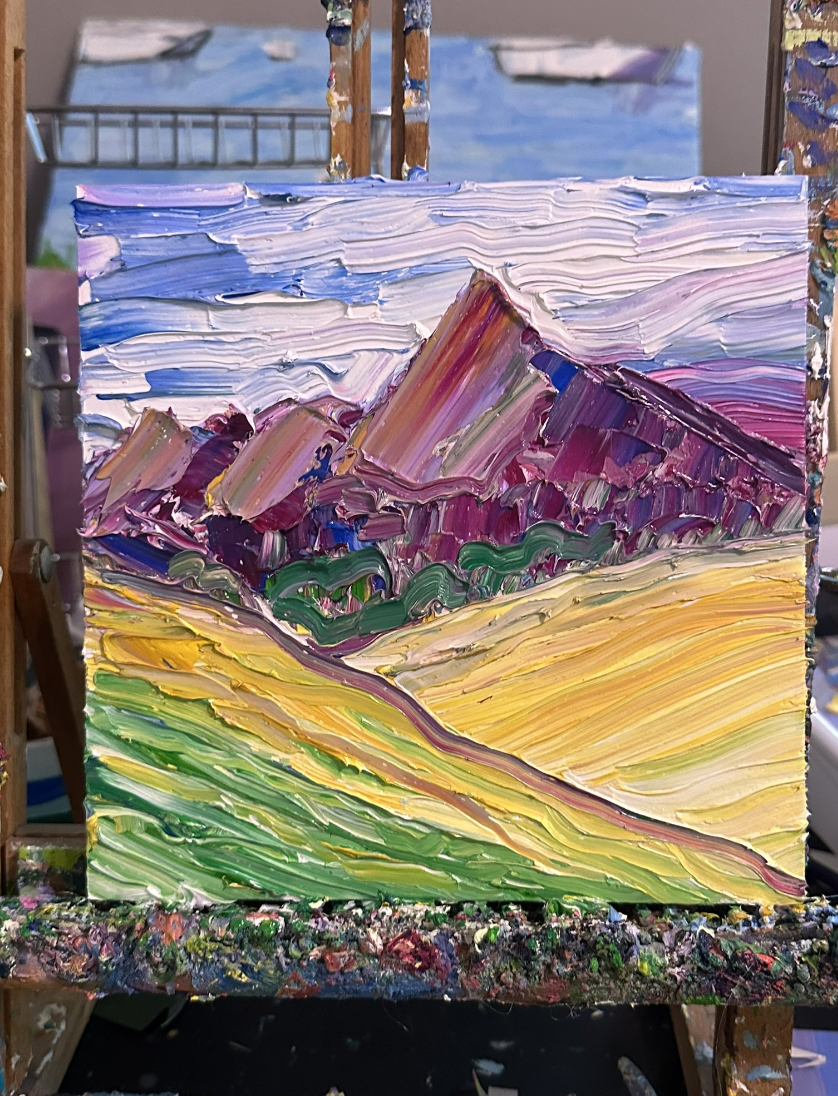
My latest medium-sized Mt. Elbert painting is done! Here it is:

This was my first larger oil painting I’ve done in about 18 months, since I’ve been avoiding oil paint while pregnant and in my months of breastfeeding.
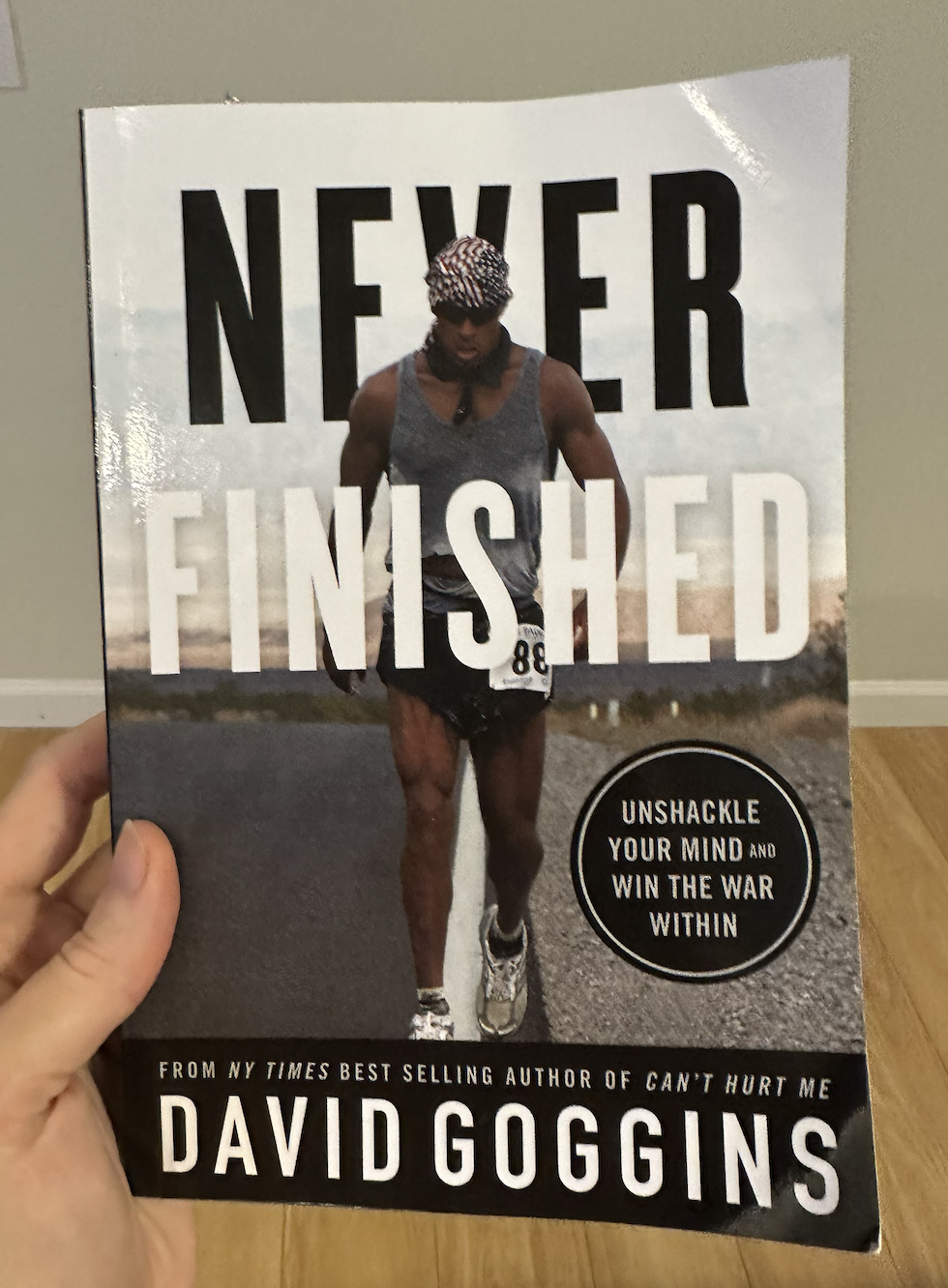
What I like most about David Goggins is that he keeps challenging the parts of himself that he doesn’t like. In both his first book and Never Finished, he often splits himself into two personas: David, and Goggins, where David is a person to transcend, and Goggins is his transcended ultimate self, his truest, best self.
I think that this approach is good, first of all, because it’s on Goggins’ own terms. Nobody else is pushing him to be the way he is except for him. The split persona approach might work for many people, because it allows all of us to confront the parts of ourselves that we dislike as if they are people who are separate from us. It’s a compartmentalization of the old and new, and parts of ourselves that work well for us vs. parts that do not.
I read Can’t Hurt Me a few years ago. I tend to read many nonfiction books at once, and Can’t Hurt Me felt like someone was finally being real with me and telling me the truth while others were serving up platitudes and embellishments. Maybe ‘truth’ isn’t the right word for it, and neither is ‘accountability’. What DG does in his first book is radical self-confrontation. He hones in on himself and his goals and ends up being a Navy Seal. He continues this in Never Finished in the form of ‘evolutions’ as chapters. Each chapter is biographical and also interspersed with applications. It usually takes the form of a few pages of biography, and a few paragraphs of applications. I personally found this cadence to be useful and worth imitating. The format of a personal anecdote followed with advice or broader application is something I resonate with.
What I like a lot about Never Finished is DG provides a few highlight tools to perform radical self-confrontation. In the first couple chapters, he recommends recording your own voice and also listening to your haters, or reading every comment. I think this is wonderful, because I’ve never heard more discomfort than from people who record their own voice, and also the popular adage is to never read the comments.
Several years ago I was one of those people too who hated the sound of my own voice, and I ended up getting rid of this by listening to myself over and over. And frankly I’m going to read the comments anyways, and DG had some good advice in his book on what to do with those. It’s not what you might expect so I won’t spoil it.
The title of Never Finished is perfect, as Goggins does believe that when most of us say we are doing 100 percent in life and physical feats, we are actually doing about 40 percent. If phoning it in is the most horrible feeling in the world, leaving it all on the field is the best feeling in the world.
The idea of self-leadership that Goggins discusses in this book is another good idea. It was my favorite concept in the whole book. Again I won’t spoil it or summarize, all I will say is this concept, for me, is one of the most important concepts to review and re-read.
Ultimately, I loved this book and I found so much wisdom in it that I plan on re-reading it often. I can’t think of two people on the planet who are more different than me and David Goggins, yet I find his work highly relatable. The one thing we do have in common is Leadville - I grew up there, and Goggins has run the LT 100 at least twice. I’ve never done the hundred, yet, maybe this is the most exciting aspect of Ultrarunning. It’s an equalizer, where people of different backgrounds, ages, and races all run the same trail but each experience is wildly different. DG’s voice is like this - it’s a challenger and an equalizer. It seeks to bring us all up to the same level. I don’t think a book can have a better mission than that.
What I think Oscar Wilde meant in this quote is that art has no utility, it isn’t a hammer or a horse, it doesn’t help us accomplish tasks or work.
As much as it is fun to rebel against this thought and make a grandiose list of the ways art is useful, I think that ultimately, he’s right.
Art doesn’t have a ‘use’ like a tissue or a shirt or a textbook full of infographics. It’s something else. I can’t say what it does have, but I do have to agree that it has no use.
I think what Jerry Saltz has to say about art being an operating system makes a lot of sense. Maybe the funniest part of this to me is remembering how much computer operating systems are flawed, and have to reboot. But if I think of the word “operating system” and try to forget the way this phrase is used in terms of computers, it does get very close to how art works.
Art is useless. It isn’t used. It operates, yes, but it can’t be applied. It’s something we can use to communicate, but it can’t shelter our feet against rocks like shoes do. Art is useless, but it still works. It performs movements of energy from one area to another. Art threads through our lives in perfect daylight or peripherally. Like a feeling, art can be the most noticeable thing in the world, or something we forget within a moment.
The moment that art has a use, it ceases to be art.
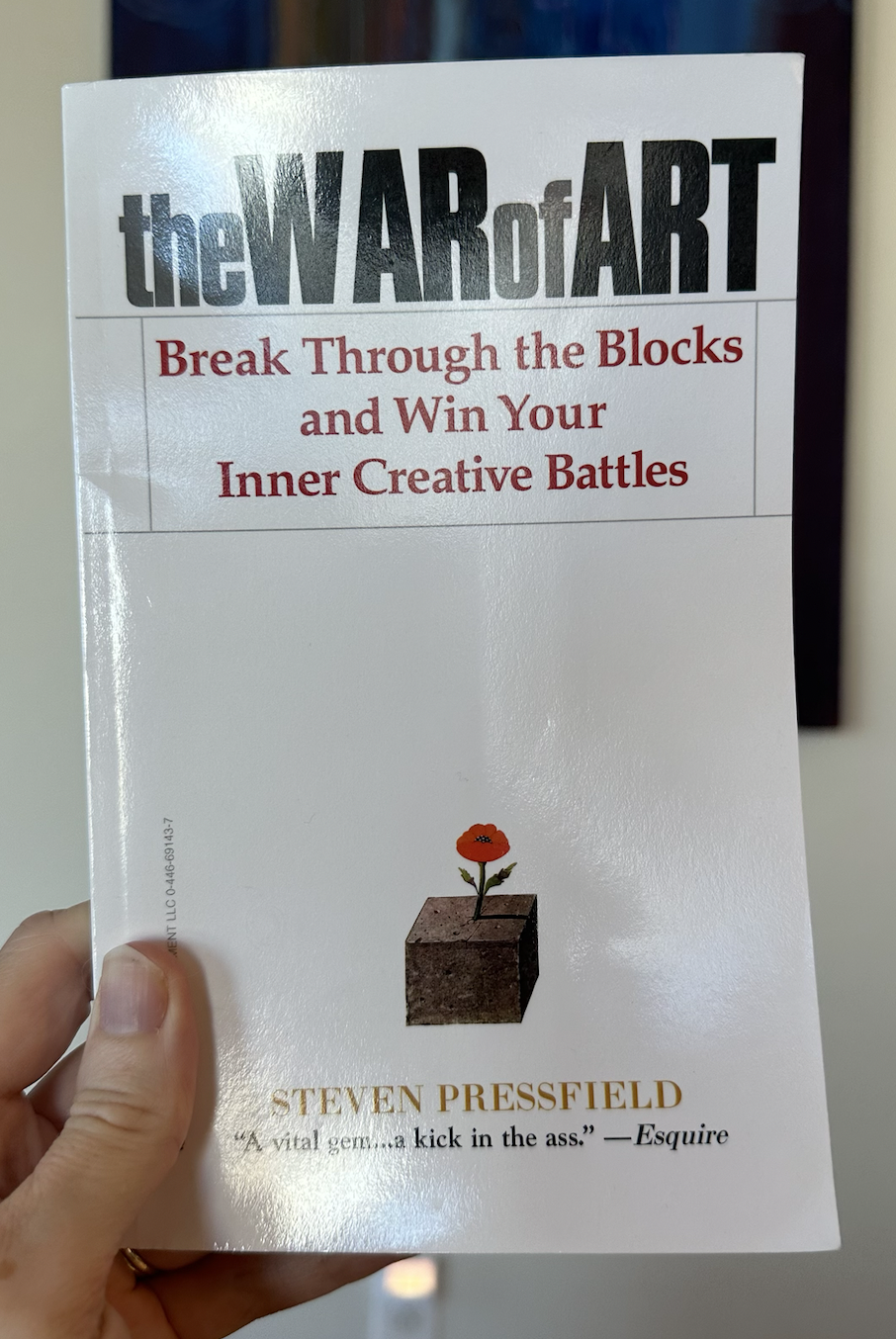
I like this book’s ideas about Resistance and about overcoming Resistance. Resistance, in Pressfield’s world, is a deeply antagonizing force like gravity - it is anything that keeps us from doing what we want to do and what we were meant to do.
I first encountered the idea of Resistance in a Seth Godin book, I now see the idea is at least a bit older than the Godin book that I read. It’s a solid concept about a diffuse entity. I find it useful to identify and even personify the kinds of procrastination that keep artists from working.
Aspects of Pressfield’s beliefs towards discipline that are critical towards certain foods and also sex are a little harsh, as we all need both to keep living and to live day-by-day. I’m all for discipline in most cases but I’m going to keep eating food the way that I usually do, and I think even if you held a gun to my head, I’m not going to percieve my sex life as a distraction from my art.
The book was published in 2002 and doesn’t seem to have been re-editioned or footnoted, because Pressfield casts up an example of fortitude in Lance Armstrong’s accomplishment of winning the Tour de France after having cancer. There’s no mention of Armstrong’s doping admissions. It happens… but anyone reading this book in 2023 probably won’t see Armstrong as a paragon of resilience. I doubt Pressfield does either since he is against drug and alcohol use.
Maybe what is pure about this book is that Pressfield just wants to inspire us to get off our butts - he doesn’t get to the point of asking artists to resist the urge to break the rules in the way Lance Armstrong did. Resistance is so difficult to spy and defeat that it hid within one of Pressfield’s examples, in the form of doping.
That’s enough about Lance Armstrong I guess. With more importance, I appreciate Pressfield’s distinction of the Professional versus all others, where Professionals show up each day despite facing various challenges, where non-professionals seem to give up for any reason.
The page/chapter I felt I resonated with most was “How to be Miserable” which covers how Marines know to be miserable, and they keep moving on despite this, and how artists are similar. Being a person raised by a Marine veteran, this page rang true for me. Sometimes art is hell, and it’s funny how hellish it is. It’s fun to laugh at one’s own failure and keep moving on. I won’t quote the page directly, but if you do read or have read the book you’ll know what page I mean.
What I also like a lot in this book is the idea that art doesn’t come from the artist at all. I’ve never felt comfortable taking credit for most of my work, to the point where I hate signing my paintings. This book helps explain why this happens to me, and millions of other artists out there.
All in all, some parts of this book may make some people a bit mad, and it’s hard to agree with all of it. I do like the more secular and eternal principles here, and when a chapter had something I could relate to, like Marines or being a mother, it did stand out to me as true.